Santiago-Rodriguez Tasha M, Fornaciari Gino, Luciani Stefania, Dowd Scot E, Toranzos Gary A, Marota Isolina, Cano Raul J
Department of Pathology, University of California San Diego, San Diego, CA, United States of America.
Department of Translational Research on New Technologies in Medicine and Surgery, Division of Paleopathology, University of Pisa, Pisa, Italy; Center for Anthropological, Paleopathological and Historical Studies of the Sardinian and Mediterranean Populations, Department of Biomedical Sciences, University of Sassari, Sassari, Italy.
PLoS One. 2015 Sep 30;10(9):e0138135. doi: 10.1371/journal.pone.0138135. eCollection 2015.
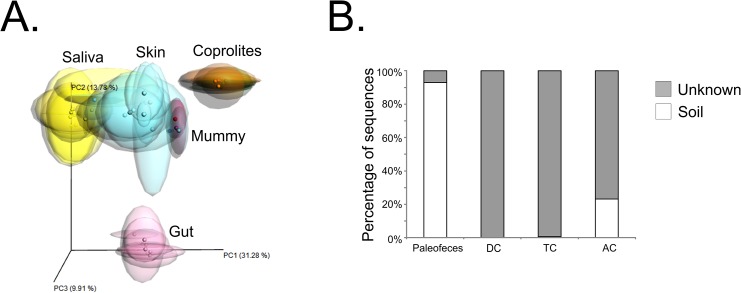
The process of natural mummification is a rare and unique process from which little is known about the resulting microbial community structure. In the present study, we characterized the microbiome of paleofeces, and ascending, transverse and descending colon of an 11th century A.D. pre-Columbian Andean mummy by 16S rRNA gene high-throughput sequencing and metagenomics. Firmicutes were the most abundant bacterial group, with Clostridium spp. comprising up to 96.2% of the mummified gut, while Turicibacter spp. represented 89.2% of the bacteria identified in the paleofeces. Microbiome profile of the paleofeces was unique when compared to previously characterized coprolites that did not undergo natural mummification. We identified DNA sequences homologous to Clostridium botulinum, Trypanosoma cruzi and human papillomaviruses (HPVs). Unexpectedly, putative antibiotic-resistance genes including beta-lactamases, penicillin-binding proteins, resistance to fosfomycin, chloramphenicol, aminoglycosides, macrolides, sulfa, quinolones, tetracycline and vancomycin, and multi-drug transporters, were also identified. The presence of putative antibiotic-resistance genes suggests that resistance may not necessarily be associated with a selective pressure of antibiotics or contact with European cultures. Identification of pathogens and antibiotic-resistance genes in ancient human specimens will aid in the understanding of the evolution of pathogens as a way to treat and prevent diseases caused by bacteria, microbial eukaryotes and viruses.
自然木乃伊化过程是一个罕见且独特的过程,人们对由此产生的微生物群落结构知之甚少。在本研究中,我们通过16S rRNA基因高通量测序和宏基因组学对公元11世纪前哥伦布时期安第斯木乃伊的古粪便、升结肠、横结肠和降结肠的微生物组进行了表征。厚壁菌门是最丰富的细菌类群,其中梭菌属在木乃伊化肠道中占比高达96.2%,而Turicibacter属在古粪便中鉴定出的细菌中占89.2%。与之前表征的未经历自然木乃伊化的粪化石相比,古粪便的微生物组特征是独特的。我们鉴定出了与肉毒梭菌、克氏锥虫和人乳头瘤病毒(HPV)同源的DNA序列。出乎意料的是,还鉴定出了包括β-内酰胺酶、青霉素结合蛋白、对磷霉素、氯霉素、氨基糖苷类、大环内酯类、磺胺类、喹诺酮类、四环素和万古霉素的抗性以及多药转运蛋白在内的假定抗生素抗性基因。假定抗生素抗性基因的存在表明,抗性不一定与抗生素的选择压力或与欧洲文化的接触有关。在古代人类标本中鉴定病原体和抗生素抗性基因将有助于理解病原体的进化,以此作为治疗和预防由细菌、微生物真核生物和病毒引起的疾病的一种方式。