Jo Chris H, Shin Ji Sun, Kim Ji Eun, Oh Sohee
Department of Orthopedic Surgery, SMG-SNU Boramae Medical Center, Seoul National University College of Medicine, Seoul, Korea.
Department of Pathology, SMG-SNU Boramae Medical Center, Seoul National University College of Medicine, Seoul, Korea.
BMC Musculoskelet Disord. 2015 Sep 30;16:272. doi: 10.1186/s12891-015-0740-x.
Whereas synovitis is one of most common findings during arthroscopic surgery in patients with rotator cuff diseases, no study has investigated its characteristics. We propose a macroscopic assessment system for investigating the characteristics of synovitis.
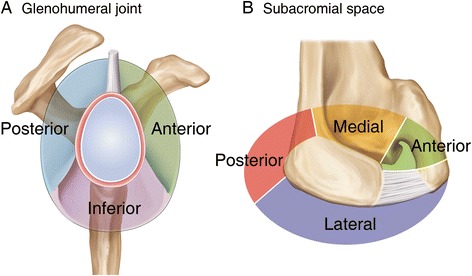
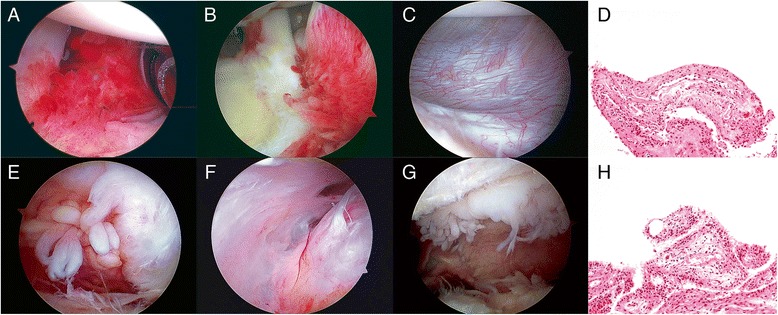
Fifty-four patients with a full-thickness rotator cuff tear undergoing arthroscopic rotator cuff repair with an average age of 62.5 ± 7.0 years were included. For the macroscopic assessment, 3 parameters, villous hypertrophy, hyperemia, and density, were measured and translated into grades in 3 regions-of-interest (ROI) in the glenohumeral joint and 4 ROIs in the subacromial space. For the microscopic assessments, 4 commonly used microscopic assessment systems were used. The reliability and association between the macroscopic and microscopic assessments were investigated.
The inter- and intra-observer reliability of all of the macroscopic and microscopic assessments were excellent. The severity of synovitis was significantly greater in the glenohumeral joint than that in the subacromial space, 1.54 ± 0.61 versus 0.94 ± 0.56 (p < 0.001). Synovitis varied with respect to location, and was generally more severe near the tear with the macroscopic assessment system. Meanwhile, none of the microscopic assessment systems demonstrated differences between different ROIs in both the glenohumeral joint and the subacromial space.
The macroscopic assessment system for synovitis in rotator cuff disease in this study showed excellent reliability. It critically described characteristics of synovitis that microscopic assessment systems could not. Therefore, this system could be a useful tool for investigating synovitis in rotator cuff disease.
虽然滑膜炎是肩袖疾病患者关节镜手术中最常见的发现之一,但尚无研究对其特征进行调查。我们提出了一种用于研究滑膜炎特征的宏观评估系统。
纳入54例平均年龄为62.5±7.0岁、接受关节镜下肩袖修补术的全层肩袖撕裂患者。对于宏观评估,测量绒毛肥大、充血和密度这3个参数,并将其转换为盂肱关节3个感兴趣区域(ROI)和肩峰下间隙4个ROI的分级。对于微观评估,使用4种常用的微观评估系统。研究宏观评估与微观评估之间的可靠性及相关性。
所有宏观和微观评估的观察者间及观察者内可靠性均极佳。盂肱关节滑膜炎的严重程度显著高于肩峰下间隙,分别为1.54±0.61和0.94±0.56(p<0.001)。滑膜炎因位置而异,使用宏观评估系统时,通常在撕裂部位附近更严重。同时,在盂肱关节和肩峰下间隙的不同ROI中,没有一种微观评估系统显示出差异。
本研究中肩袖疾病滑膜炎的宏观评估系统显示出极佳的可靠性。它准确描述了微观评估系统无法描述的滑膜炎特征。因此,该系统可能是研究肩袖疾病滑膜炎的有用工具。