Lewis Andrew L, Jordan Faron, Patel Tina, Jeffery Kirk, King Gareth, Savage Martin, Shalet Stephen, Illum Lisbeth
Critical Pharmaceuticals Ltd (A.L.L., F.J., T.P., K.J., G.K., L.I.), BioCity Nottingham, Nottingham NG1 1GF, United Kingdom; Department of Endocrinology (M.S.), William Harvey Research Institute, Barts and the Royal London School of Medicine and Dentistry, London E1 1BB, United Kingdom; and Department of Endocrinology (S.S.), Christie Hospital, Manchester M20 4BX, United Kingdom.
J Clin Endocrinol Metab. 2015 Nov;100(11):4364-71. doi: 10.1210/jc.2014-4146. Epub 2015 Oct 1.
The development of an improved, efficacious human GH (hGH) product administered by a noninjectable route of delivery such as the nasal route is highly desirable. We have developed a novel nasal hGH product (CP024) that showed excellent nasal absorption in animal models; however, the translation of these results into the clinical setting is essential because past attempts to develop such formulations by other groups have been unable to induce IGF-1 in man.
The objective of the study was to assess the pharmacokinetics, pharmacodynamics, and tolerability of CP024 compared with a sc hGH injection.
This was a single-center, nonrandomized placebo-controlled, open-label, five-way crossover study in eight healthy volunteers.
The study was carried out at a contract research organization, Quotient Bioresearch.
Eight healthy male volunteers, given an iv infusion of octreotide to suppress the endogenous GH secretion during the study period, participated in the study. No volunteers were withdrawn due to side effects.
Measurement of hGH and IGF-1 levels and tolerability of the drug product was performed.
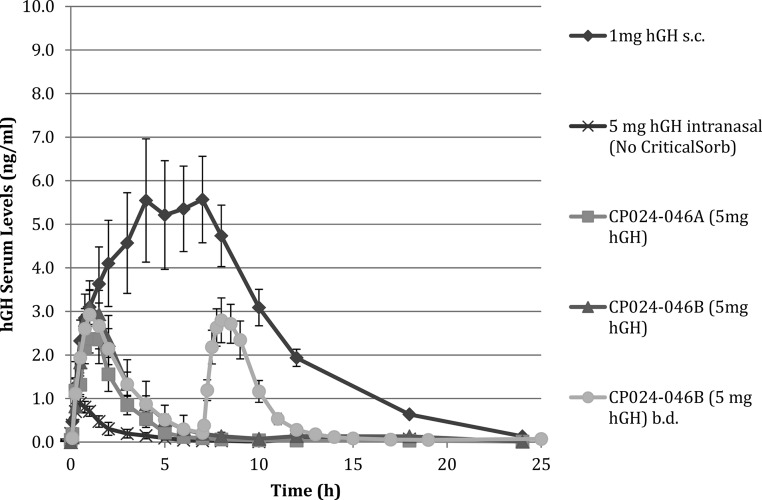
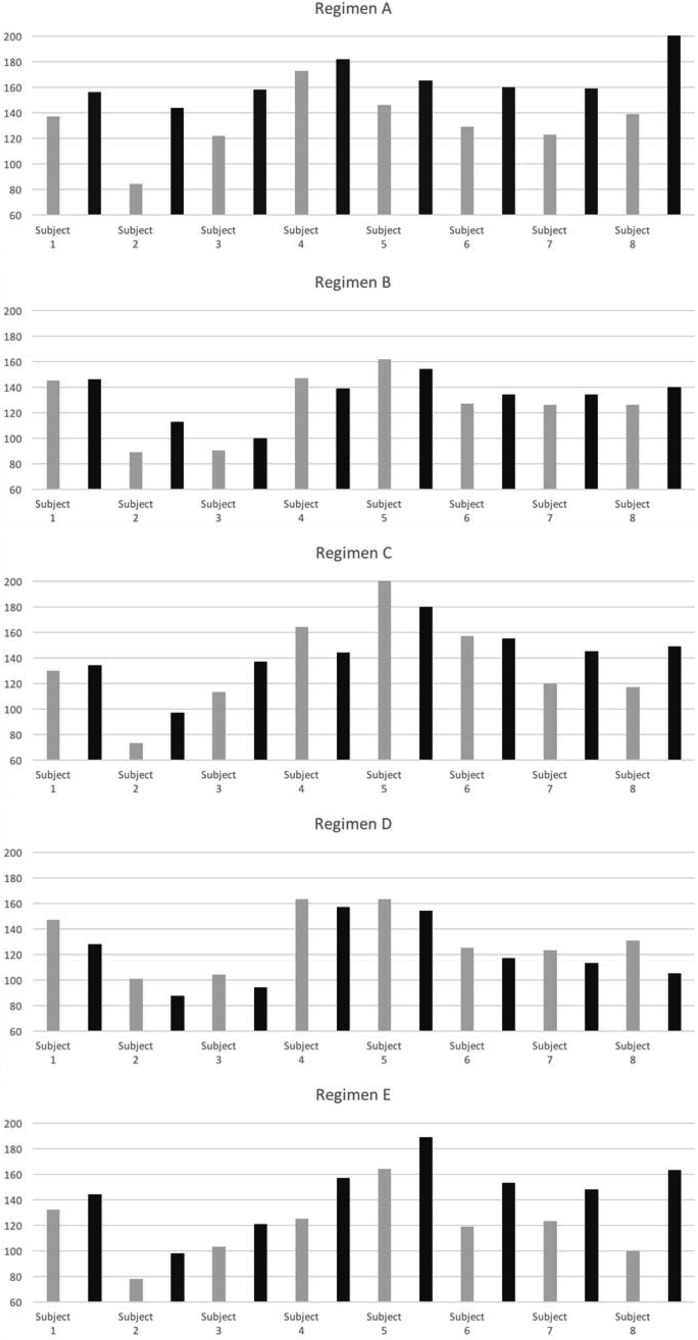
No serious adverse events were reported and no subjects withdrawn from study due to the treatment. After the nasal administration of CP024, 3-fold higher hGH blood levels were obtained as compared with hGH nasal control. The relative bioavailability was about 3%. CP024 (given twice daily) induced a significant increase in IGF-1 levels up to 19 hours after administration, with no significant difference to those obtained after the sc injection of hGH.
The study indicates that CP024 is a promising candidate for an efficacious nasal product for the treatment of GH deficiency due to induction of IGF-1 similar to that after a sc injection, despite the lower plasma hGH concentration obtained. A dose-response study is needed to evaluate the optimal nasal dose.
开发一种经非注射途径(如鼻腔途径)给药的改良、有效的人生长激素(hGH)产品非常必要。我们已经开发出一种新型鼻腔hGH产品(CP024),在动物模型中显示出优异的鼻腔吸收性能;然而,将这些结果转化到临床环境中至关重要,因为其他团队过去开发此类制剂的尝试未能在人体中诱导胰岛素样生长因子-1(IGF-1)的产生。
本研究的目的是评估CP024与皮下注射hGH相比的药代动力学、药效学和耐受性。
这是一项在8名健康志愿者中进行的单中心、非随机、安慰剂对照、开放标签的五交叉研究。
该研究在合同研究组织Quotient Bioresearch进行。
8名健康男性志愿者参与了本研究,在研究期间通过静脉输注奥曲肽来抑制内源性生长激素分泌。没有志愿者因副作用退出研究。
进行hGH和IGF-1水平的测定以及药品耐受性的评估。
未报告严重不良事件,也没有受试者因治疗退出研究。鼻腔给予CP024后,与鼻腔hGH对照相比,hGH血药浓度高出3倍。相对生物利用度约为3%。CP024(每日给药两次)在给药后长达19小时可诱导IGF-1水平显著升高,与皮下注射hGH后获得的水平无显著差异。
该研究表明,尽管获得的血浆hGH浓度较低,但CP024是一种有前景的用于治疗生长激素缺乏症的有效鼻腔产品候选物,因为它诱导IGF-1的效果与皮下注射后相似。需要进行剂量反应研究以评估最佳鼻腔给药剂量。