Stessel Björn, Fiddelers Audrey A, Joosten Elbert A, Hoofwijk Daisy M N, Gramke Hans-Fritz, Buhre Wolfgang F F A
From the Department of Anesthesiology, Jessa Hospital, Hasselt, Belgium (BS) and Department of Anesthesiology, Maastricht University Medical Center, Maastricht, The Netherlands (BS, AAF, EAJ, DMNH, H-FG, WFFAB).
Medicine (Baltimore). 2015 Sep;94(39):e1553. doi: 10.1097/MD.0000000000001553.
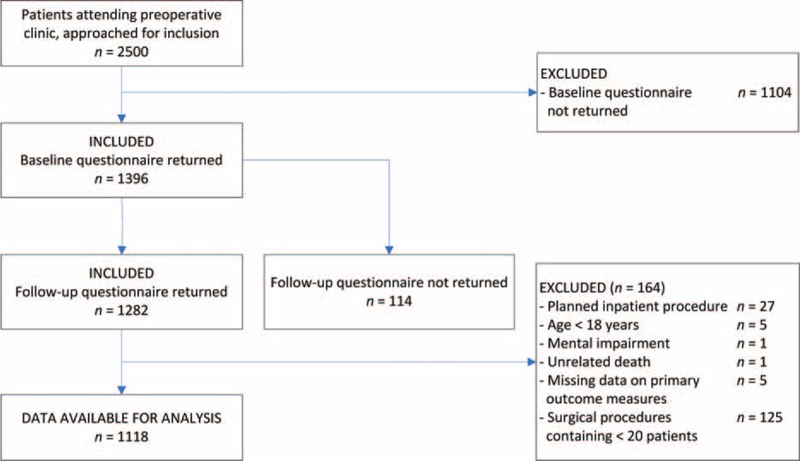
Traditionally, major complications and unanticipated admission/readmission rates were used to assess outcome after day surgery. However, in view of the relative absence of major complications the quality of recovery (QOR) should be considered one of the principal endpoints after day surgery. In our study, the level of QOR is defined by a combination of the Global Surgical Recovery (GSR) Index and the Quality of Life (QOL). The aim of this study was to analyze prevalence and predictors of QOR after day surgery on the fourth postoperative day. Elective patients scheduled for day surgery from November 2008 to April 2010 were enrolled in a prospective cohort study. Outcome parameters were measured by using questionnaire packages at 2 time points: 1 week preoperatively and 4 days postoperatively. Primary outcome parameter is the QOR and is defined as good if the GSR index >80% as well as the postoperative QOL is unchanged or improved as compared with baseline. QOR is defined as poor if both the GSR index ≤ 80% and if the postoperative QOL is decreased as compared with baseline. QOR is defined as intermediate in all other cases. Three logistic regression analyses were performed to determine predictors for poor QOR after day surgery. A total of 1118 patients were included. A good QOR was noted in 17.3% of patients, an intermediate QOR in 34.8%, and a poor QOR in 47.8% 4 days after day surgery. The best predictor for poor QOR after day surgery was type of surgery. Other predictors were younger age, work status, and longer duration of surgery. A history of previous surgery, expected pain (by the patient) and high long-term surgical fear were significant predictors of poor QOR in only 1 of 3 prediction models. The QOR at home 4 days after day surgery was poor in the majority of patients and showed a significant procedure-specific variation. Patients at risk for poor QOR can be identified during the preoperative period based on type of surgery, age, work status, and the duration of the surgery.
传统上,重大并发症以及意外入院/再入院率被用于评估日间手术的预后。然而,鉴于重大并发症相对较少,恢复质量(QOR)应被视为日间手术术后的主要终点之一。在我们的研究中,QOR水平由全球手术恢复(GSR)指数和生活质量(QOL)共同定义。本研究的目的是分析日间手术后第4天QOR的患病率及预测因素。2008年11月至2010年4月计划接受日间手术的择期患者被纳入一项前瞻性队列研究。结局参数通过在两个时间点使用问卷包进行测量:术前1周和术后4天。主要结局参数是QOR,若GSR指数>80%且术后QOL与基线相比未改变或有所改善,则定义为良好。若GSR指数≤80%且术后QOL与基线相比下降,则QOR定义为差。在所有其他情况下,QOR定义为中等。进行了三项逻辑回归分析以确定日间手术后QOR差的预测因素。共纳入1118例患者。日间手术后4天,17.3%的患者QOR良好,34.8%的患者QOR中等,47.8%的患者QOR差。日间手术后QOR差的最佳预测因素是手术类型。其他预测因素包括年龄较小、工作状态和手术持续时间较长。既往手术史、预期疼痛(患者自评)和长期手术恐惧程度高仅在3个预测模型中的1个中是QOR差的显著预测因素。日间手术后4天,大多数患者在家中的QOR较差,且存在显著的手术类型特异性差异。术前可根据手术类型、年龄、工作状态和手术持续时间识别QOR差的风险患者。