Berkovitch Anat, Segev Amit, Barbash Israel, Grossman Yoni, Maor Elad, Erez Aharon, Regev Ehud, Fink Noam, Mazin Israel, Hamdan Ashraf, Goldenberg Ilan, Hay Ilan, Spiegelstien Dan, Guetta Victor, Fefer Paul
Leviev Heart Center, Chaim Sheba Medical Center, 52621, Tel Hashomer, Israel.
Department of Internal Medicine D, Chaim Sheba Medical Center, Tel Hashomer, Israel.
Cardiovasc Diabetol. 2015 Oct 1;14:131. doi: 10.1186/s12933-015-0291-3.
Diabetes mellitus (DM) and aortic stenosis (AS) are frequent findings in the elderly population. Data regarding the influence of DM on the outcomes of patients undergoing transcatheter aortic valve replacement (TAVR) due to AS are limited. The aim of this study was to examine the impact of DM on TAVR outcomes.
We investigated 443 patients with severe AS undergoing TAVR. Subjects were divided into insulin-dependent diabetic mellitus (IDDM) patients (N = 44), non-dependent insulin diabetic mellitus (NIDDM) patients (N = 114) and non-diabetics (N = 285) of whom 31 (74%), 86 (79%) and 209 (76%) respectively had trans-femoral TAVR. Peri-procedural complications and outcomes were recorded according to the Valve Academic Research Consortium-2 criteria.
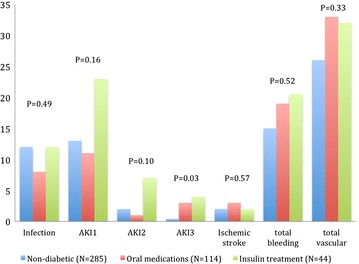
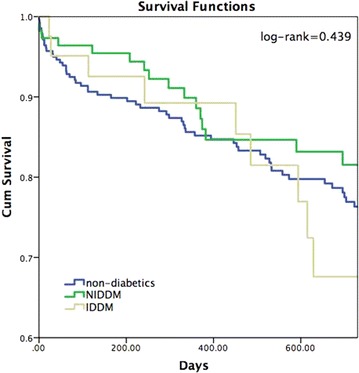
Patients with IDDM as well as NIDDM demonstrated similar complication rates compared with non-diabetic patients, except for acute kidney injury (AKI) grade 3 [4 (2%) and 3 (3%) vs. 1 (0.4%) respectively, p = 0.032]. Kaplan-Meier survival analysis showed that DM, regardless of the type of treatment, was not associated with increased 2 years mortality (Log-rank p value 0.44). Multivariate cox regression analysis adjusted for age, gender, coronary artery disease, DM, AKI3, hypertension, chronic renal failure and peripheral vascular disease found that AKI3 was associated with increased risk of 2 years mortality [HR = 7.35, 95% CI 2.16-25.07, p = 0.001] whereas female gender was found as a protective factor [HR = 0.47, 95% CI 0.28-0.8, p = 0.005], and DM was not associated with increased risk.
Following TAVR, DM patients seem to have similar peri-procedural and mid-term outcomes compared with patients without DM, while IDDM patients seem to suffer greater incidence of AKI. Further research in larger cohorts of patients is needed to validate our results.
糖尿病(DM)和主动脉瓣狭窄(AS)在老年人群中很常见。关于DM对因AS接受经导管主动脉瓣置换术(TAVR)患者预后影响的数据有限。本研究的目的是探讨DM对TAVR预后的影响。
我们调查了443例接受TAVR的重度AS患者。受试者分为胰岛素依赖型糖尿病(IDDM)患者(n = 44)、非胰岛素依赖型糖尿病(NIDDM)患者(n = 114)和非糖尿病患者(n = 285),其中分别有31例(74%)、86例(79%)和209例(76%)接受了经股动脉TAVR。根据瓣膜学术研究联盟-2标准记录围手术期并发症和预后。
与非糖尿病患者相比,IDDM患者和NIDDM患者的并发症发生率相似,但3级急性肾损伤(AKI)除外[分别为4例(2%)、3例(3%)和1例(0.4%),p = 0.032]。Kaplan-Meier生存分析表明,无论治疗类型如何,DM均与2年死亡率增加无关(对数秩p值0.44)。对年龄、性别、冠状动脉疾病、DM、AKI3、高血压、慢性肾衰竭和外周血管疾病进行校正的多变量cox回归分析发现,AKI3与2年死亡风险增加相关[HR = 7.35,95%CI 2.16 - 25.07,p = 0.001],而女性被发现是一个保护因素[HR = 0.47,95%CI 0.28 - 0.8,p = 0.005],且DM与风险增加无关。
TAVR术后,DM患者与非DM患者相比,围手术期和中期预后似乎相似,而IDDM患者的AKI发生率似乎更高。需要在更大的患者队列中进行进一步研究以验证我们的结果。