Khan Sarah, Dargham Soha, Al Suwaidi Jassim, Jneid Hani, Abi Khalil Charbel
Research Department, Weill Cornell Medicine-Qatar, Doha, Qatar.
Heart Hospital, Hamad Medical Corporation, Doha, Qatar.
Front Cardiovasc Med. 2022 Mar 18;9:844068. doi: 10.3389/fcvm.2022.844068. eCollection 2022.
We aimed to assess the trend and outcome of aortic valve replacement in patients with diabetes.
Diabetes is associated with higher cardiovascular events.
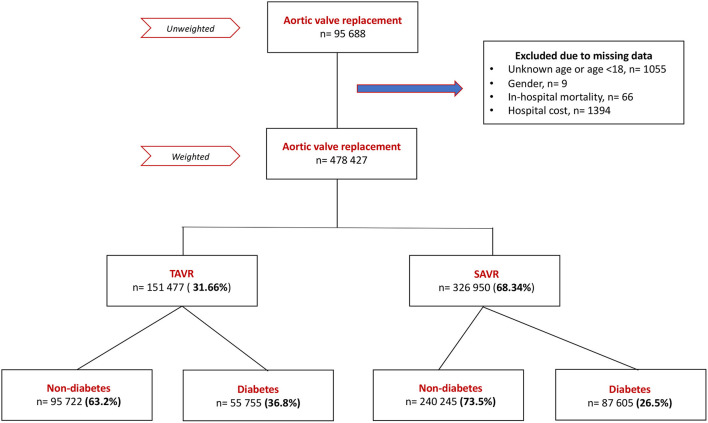
Data from the National Inpatient Sample was analyzed between 2012 and 2017. We compared hospitalizations and in-hospital cardiovascular outcomes in patients with diabetes to those without diabetes, hospitalized for aortic valve replacement.
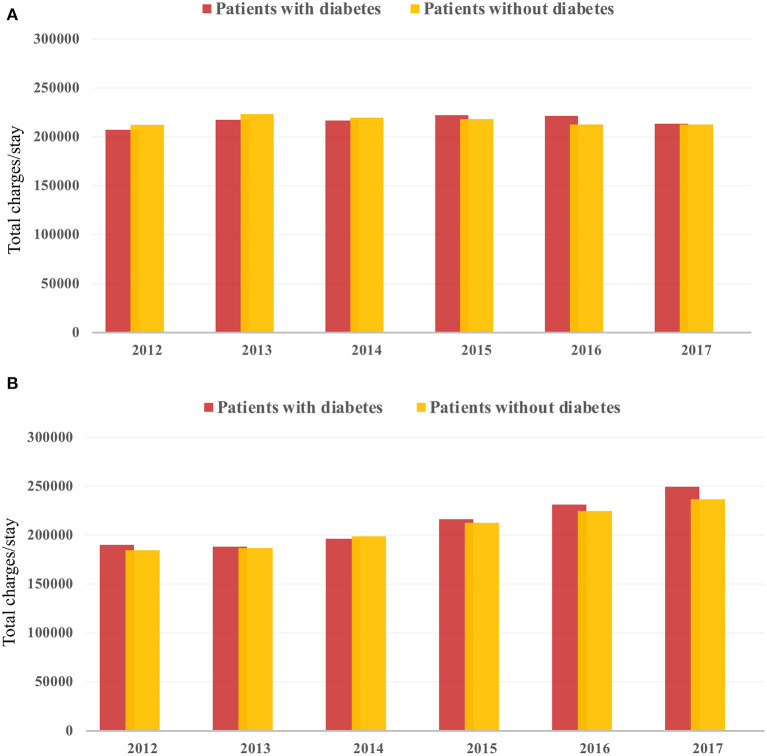
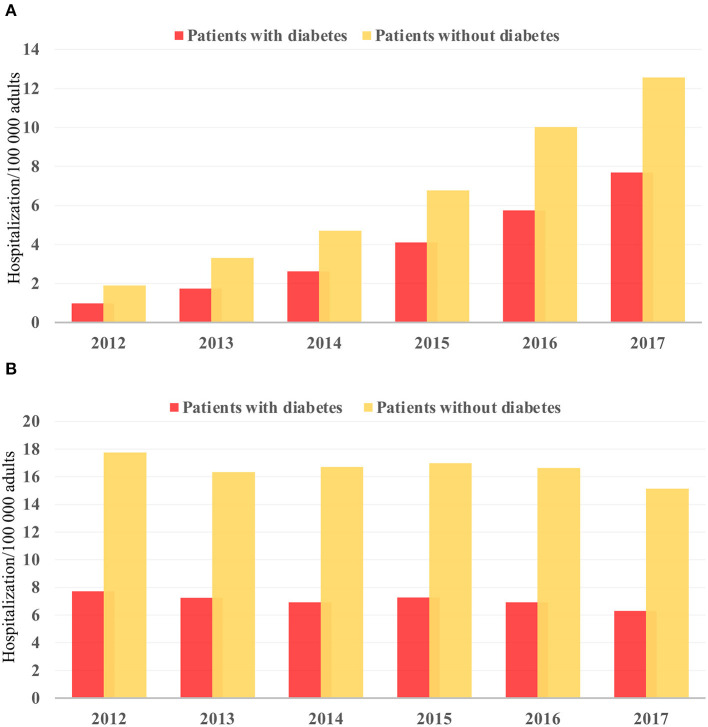
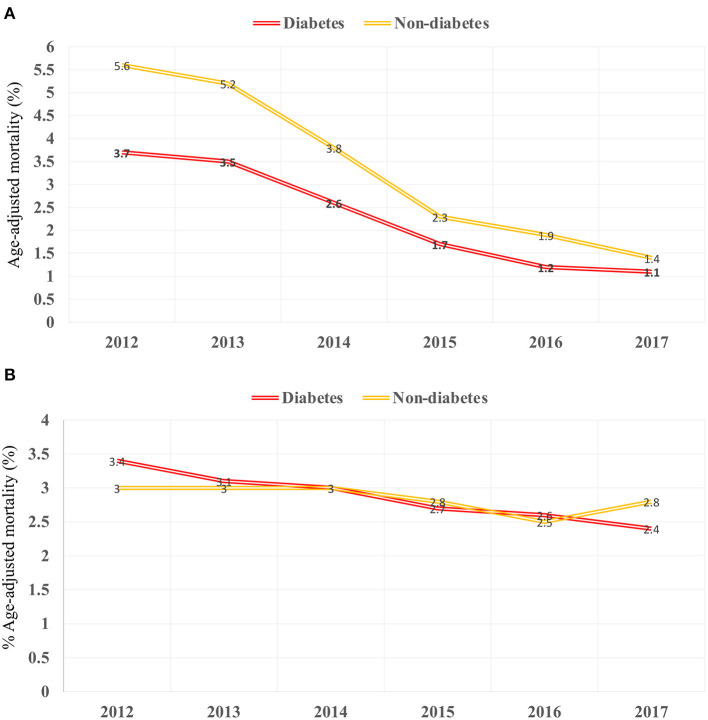
In diabetes patients undergoing TAVR, the mean age of participants decreased from 79.6 ± 8 to 67.8 ± 8, hospitalizations increased from 0.97 to 7.68/100,000 US adults ( < 0.002 for both). There was a significant temporal decrease in mortality, acute renal failure (ARF), and stroke. Compared to non-diabetic patients, those with diabetes had a higher risk of stroke, ARF, and pacemaker requirement [adjusted OR = 1.174 (1.03-1.34), 1.294 (1.24-1.35), 1.153 (1.11-1.20), respectively], but a similar adjusted mortality risk. In diabetes patients undergoing sAVR, the mean age of participants decreased from 70.4 ± 10 to 68 ± 9 ( < 0.001), hospitalizations dropped from 7.72 to 6.63/100,000 US adults ( = 0.025), so did mortality, bleeding, and ARF. When compared to non-diabetes patients, those with diabetes were older and had a higher adjusted risk of mortality, stroke, and ARF [adjusted OR= 1.115 (1.06-1.17), 1.140 (1.05-1.23), 1.217 (1.18-1.26); respectively].
The recent temporal trend of aortic valve replacement in patients with diabetes shows a significant increase in TAVR coupled with a decrease in sAVR. Mortality and other cardiovascular outcomes decreased in both techniques. sAVR, but not TAVR, was associated with higher in-hospital mortality risk.
我们旨在评估糖尿病患者主动脉瓣置换术的趋势和结果。
糖尿病与较高的心血管事件发生率相关。
分析了2012年至2017年期间来自国家住院患者样本的数据。我们比较了因主动脉瓣置换术住院的糖尿病患者和非糖尿病患者的住院情况及住院期间的心血管结局。
在接受经导管主动脉瓣置换术(TAVR)的糖尿病患者中,参与者的平均年龄从79.6±8岁降至67.8±8岁,住院率从0.97/10万美国成年人增至7.68/10万美国成年人(两者均P<0.002)。死亡率、急性肾衰竭(ARF)和中风在时间上有显著下降。与非糖尿病患者相比,糖尿病患者发生中风、ARF和需要起搏器的风险更高[调整后的比值比分别为1.174(1.03 - 1.34)、1.294(1.24 - 1.35)、1.153(1.11 - 1.20)],但调整后的死亡风险相似。在接受外科主动脉瓣置换术(sAVR)的糖尿病患者中,参与者的平均年龄从70.4±10岁降至68±9岁(P<0.001),住院率从7.72/10万美国成年人降至6.63/10万美国成年人(P = 0.025),死亡率、出血和ARF也有所下降。与非糖尿病患者相比,糖尿病患者年龄更大,调整后的死亡、中风和ARF风险更高[调整后的比值比分别为1.115(1.06 - 1.17)、1.140(1.05 - 1.23)、1.217(1.18 - 1.26)]。
糖尿病患者主动脉瓣置换术最近的时间趋势显示,TAVR显著增加,而sAVR减少。两种技术的死亡率和其他心血管结局均有所下降。sAVR与较高的住院死亡风险相关,而TAVR并非如此。