Cotton Simon L, D'Errico Raffaele, Oestges Claude
ECIT Institute, Queen's University Belfast Belfast, UK.
CEA, -LETI Grenoble, France.
Radio Sci. 2014 Jun;49(6):371-388. doi: 10.1002/2013RS005319. Epub 2014 Jun 12.
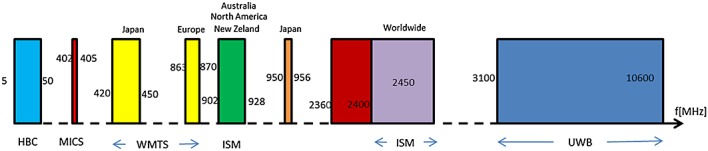
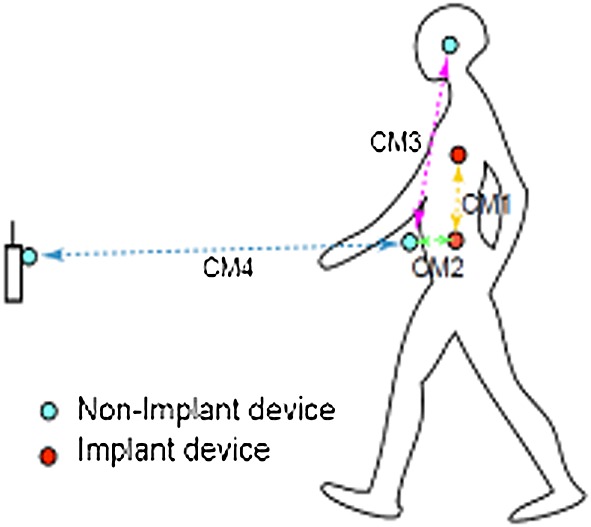
The human body is an extremely challenging environment for the operation of wireless communications systems, not least because of the complex antenna-body electromagnetic interaction effects which can occur. This is further compounded by the impact of movement and the propagation characteristics of the local environment which all have an effect upon body centric communications channels. As the successful design of body area networks (BANs) and other types of body centric system is inextricably linked to a thorough understanding of these factors, the aim of this paper is to conduct a survey of the current state of the art in relation to propagation and channel models primarily for BANs but also considering other types of body centric communications. We initially discuss some of the standardization efforts performed by the Institute of Electrical and Electronics Engineers 802.15.6 task group before focusing on the two most popular types of technologies currently being considered for BANs, namely narrowband and Ultrawideband (UWB) communications. For narrowband communications the applicability of a generic path loss model is contended, before presenting some of the scenario specific models which have proven successful. The impacts of human body shadowing and small-scale fading are also presented alongside some of the most recent research into the Doppler and time dependencies of BANs. For UWB BAN communications, we again consider the path loss as well as empirical tap delay line models developed from a number of extensive channel measurement campaigns conducted by research institutions around the world. Ongoing efforts within collaborative projects such as Committee on Science and Technology Action IC1004 are also described. Finally, recent years have also seen significant developments in other areas of body centric communications such as off-body and body-to-body communications. We highlight some of the newest relevant research in these areas as well as discussing some of the advanced topics which are currently being addressed in the field of body centric communications.
对于无线通信系统的运行而言,人体是一个极具挑战性的环境,这尤其是因为可能会出现复杂的天线与人体电磁相互作用效应。运动的影响以及当地环境的传播特性进一步加剧了这一情况,所有这些都会对以人体为中心的通信信道产生影响。由于人体区域网络(BAN)和其他类型的以人体为中心的系统的成功设计与对这些因素的透彻理解有着千丝万缕的联系,本文的目的是对主要针对BAN但也考虑其他类型以人体为中心的通信的传播和信道模型的当前技术水平进行综述。我们首先讨论电气和电子工程师协会802.15.6任务组所做的一些标准化工作,然后重点关注目前为BAN所考虑的两种最流行的技术类型,即窄带和超宽带(UWB)通信。对于窄带通信,在介绍一些已被证明成功的特定场景模型之前,先讨论通用路径损耗模型的适用性。还介绍了人体阴影和小尺度衰落的影响,以及一些关于BAN的多普勒和时间依赖性的最新研究。对于UWB BAN通信,我们再次考虑路径损耗以及根据世界各地研究机构进行的大量广泛信道测量活动所开发的经验抽头延迟线模型。还描述了诸如科学技术行动委员会IC1004等合作项目中的 ongoing efforts。最后,近年来以人体为中心的通信的其他领域,如体外和人体对人体通信,也有了显著发展。我们重点介绍了这些领域中一些最新的相关研究,并讨论了目前以人体为中心的通信领域正在探讨的一些前沿话题。