Wang Hua, Wen Yingyou, Zhao Dazhe
School of Computer Science and Engineering, Northeastern University, Shenyang 110819, Liaoning, China.
State Key Laboratory of Software Architecture, Neusoft Corporation, Shenyang 110179, Liaoning, China.
Technol Health Care. 2018;26(S1):3-18. doi: 10.3233/thc-173812.
Knowledge of the location of sensor devices is crucial for many medical applications of wireless body area networks, as wearable sensors are designed to monitor vital signs of a patient while the wearer still has the freedom of movement. However, clinicians or patients can misplace the wearable sensors, thereby causing a mismatch between their physical locations and their correct target positions. An error of more than a few centimeters raises the risk of mistreating patients.
The present study aims to develop a scheme to calculate and detect the position of wearable sensors without beacon nodes.
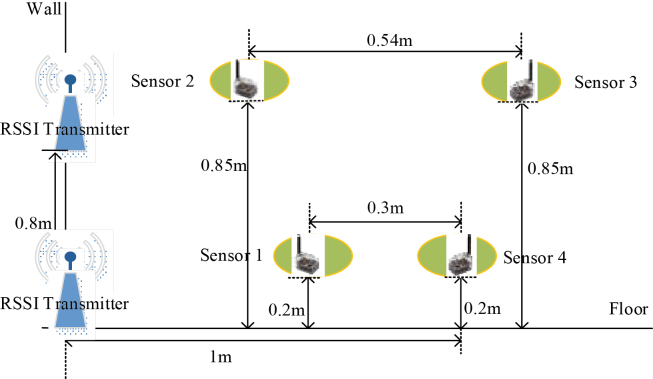
A new scheme was proposed to verify the location of wearable sensors mounted on the patient's body by inferring differences in atmospheric air pressure and received signal strength indication measurements from wearable sensors. Extensive two-sample t tests were performed to validate the proposed scheme.
The proposed scheme could easily recognize a 30-cm horizontal body range and a 65-cm vertical body range to correctly perform sensor localization and limb identification.
All experiments indicate that the scheme is suitable for identifying wearable sensor positions in an indoor environment.
对于无线体域网的许多医学应用而言,了解传感器设备的位置至关重要,因为可穿戴传感器旨在在患者仍可自由活动时监测其生命体征。然而,临床医生或患者可能会误放可穿戴传感器,从而导致其实际位置与正确目标位置不匹配。几厘米以上的误差会增加误治患者的风险。
本研究旨在开发一种无需信标节点即可计算和检测可穿戴传感器位置的方案。
提出了一种新方案,通过推断大气气压差异以及可穿戴传感器的接收信号强度指示测量值,来验证安装在患者身体上的可穿戴传感器的位置。进行了广泛的双样本t检验以验证所提出的方案。
所提出的方案能够轻松识别30厘米的水平身体范围和65厘米的垂直身体范围,以正确执行传感器定位和肢体识别。
所有实验表明,该方案适用于在室内环境中识别可穿戴传感器的位置。