Anderson Kyle W, Turko Illarion V
Institute for Bioscience and Biotechnology Research, Rockville, MD 20850 USA ; Biomolecular Measurement Division, National Institute of Standards and Technology, Gaithersburg, MD 20899 USA ; Department of Chemistry and Biochemistry, University of Maryland, College Park, MD 20742 USA.
Institute for Bioscience and Biotechnology Research, Rockville, MD 20850 USA ; Biomolecular Measurement Division, National Institute of Standards and Technology, Gaithersburg, MD 20899 USA.
Clin Proteomics. 2015 Oct 1;12:26. doi: 10.1186/s12014-015-9098-1. eCollection 2015.
Alzheimer's disease (AD) is the sixth leading cause of death and the most costly disease in the US. Despite the enormous impact of AD, there are no treatments that delay onset or stop disease progression currently on the market. This is partly due to the complexity of the disease and the largely unknown pathogenesis of sporadic AD, which accounts for the vast majority of cases. Epigenetics has been implicated as a critical component to AD pathology and a potential "hot spot" for treatments. Histone post-translational modifications (PTMs) are a key element in epigenetic regulation of gene expression and are known to be associated with the pathology of numerous diseases. Investigation of histone PTMs can help elucidate AD pathology and identify targets for therapies.
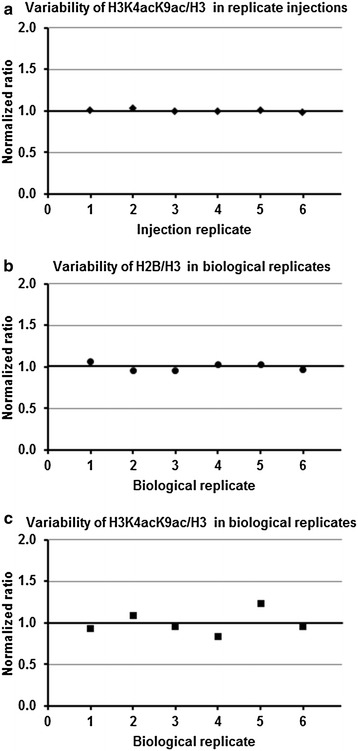
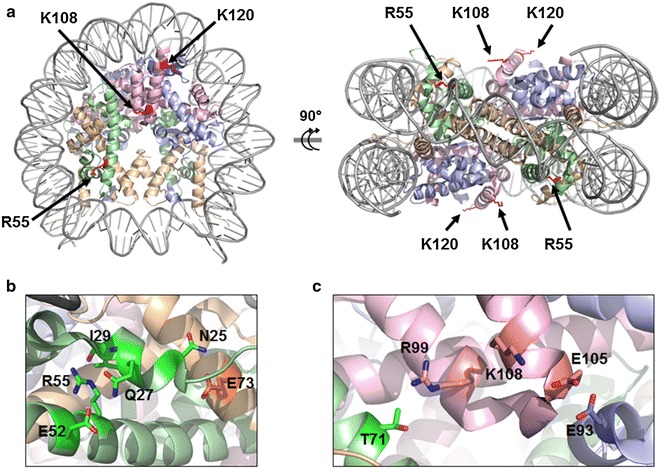
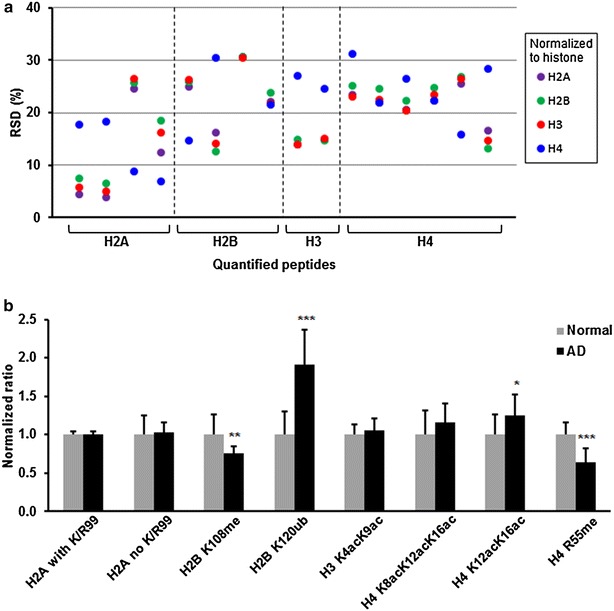
A multiple reaction monitoring mass spectrometry assay was used to measure changes in abundance of several histone PTMs in frontal cortex from human donors affected with AD (n = 6) and age-matched, normal donors (n = 6). Of the changes observed, notable decreases in methylation of H2B residue K108 by 25 % and H4 residue R55 by 35 % were measured and are likely associated with hydrogen bonding networks important for nucleosome stability. Additionally, a 91 % increase in ubiquitination of K120 on H2B was measured as well as an apparent loss in acetylation of the region near the N-terminus of H4. Our method of quantification was also determined to be precise and robust, signifying measured changes were representative of true biological differences between donors and sample groups.
We are the first to report changes in methylation of H2B K108, methylation of H4 R55, and ubiquitination of H2B K120 in frontal cortex from human donors with AD. These notable PTM changes may be of great importance in elucidating the epigenetic mechanism of AD as it relates to disease pathology. Beyond the structural and functional impacts of the changes we have measured, the sites of altered PTMs may be used to identify enzymes responsible for their modulation, which could be used as prospective drug targets for highly specific AD therapies.
阿尔茨海默病(AD)是美国第六大死因且是最昂贵的疾病。尽管AD影响巨大,但目前市场上尚无延迟发病或阻止疾病进展的治疗方法。部分原因在于该疾病的复杂性以及散发性AD的发病机制在很大程度上尚不明确,而散发性AD占绝大多数病例。表观遗传学已被认为是AD病理学的关键组成部分以及治疗的潜在“热点”。组蛋白翻译后修饰(PTMs)是基因表达表观遗传调控的关键要素,并且已知与多种疾病的病理学相关。对组蛋白PTMs的研究有助于阐明AD病理学并确定治疗靶点。
采用多反应监测质谱分析法测量了患有AD的人类供体(n = 6)和年龄匹配的正常供体(n = 6)额叶皮质中几种组蛋白PTMs丰度的变化。在所观察到的变化中,检测到H2B残基K108的甲基化显著降低25%,H4残基R55的甲基化显著降低35%,这可能与对核小体稳定性重要的氢键网络有关。此外,还检测到H2B上K120的泛素化增加91%以及H4 N端附近区域乙酰化明显减少。我们的定量方法也被确定为精确且稳健,这表明所测量的变化代表了供体和样本组之间真正的生物学差异。
我们首次报告了患有AD的人类供体额叶皮质中H2B K108甲基化、H4 R55甲基化和H2B K120泛素化的变化。这些显著的PTM变化对于阐明与疾病病理学相关的AD表观遗传机制可能非常重要。除了我们所测量变化的结构和功能影响外,PTM改变的位点可用于鉴定负责其调节的酶,这可作为高度特异性AD治疗的潜在药物靶点。