Brascamp Jan, Blake Randolph, Knapen Tomas
Helmholtz Institute and Division of Experimental Psychology, Utrecht University, Utrecht, the Netherlands.
Brain and Cognition, University of Amsterdam, Amsterdam, the Netherlands.
Nat Neurosci. 2015 Nov;18(11):1672-8. doi: 10.1038/nn.4130. Epub 2015 Oct 5.
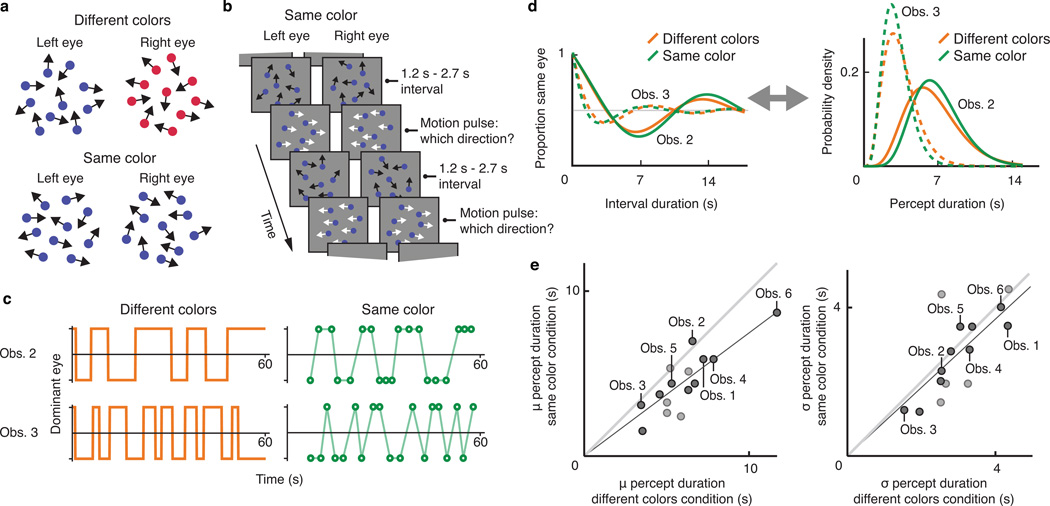
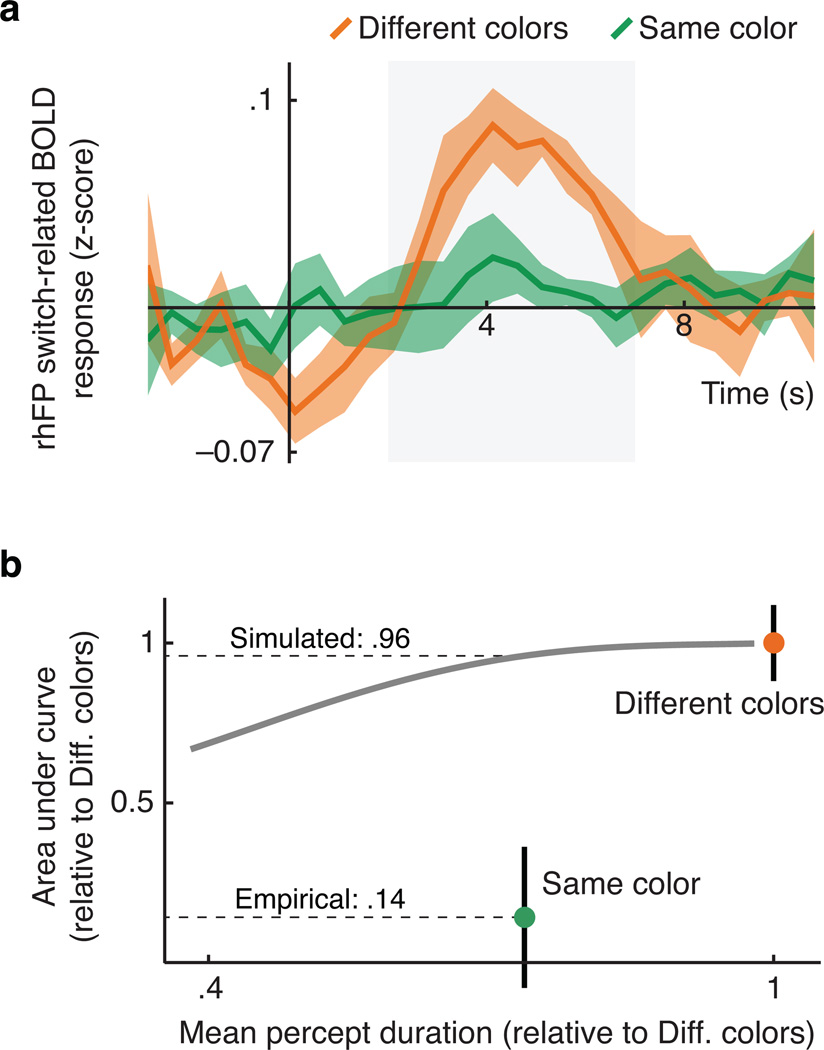
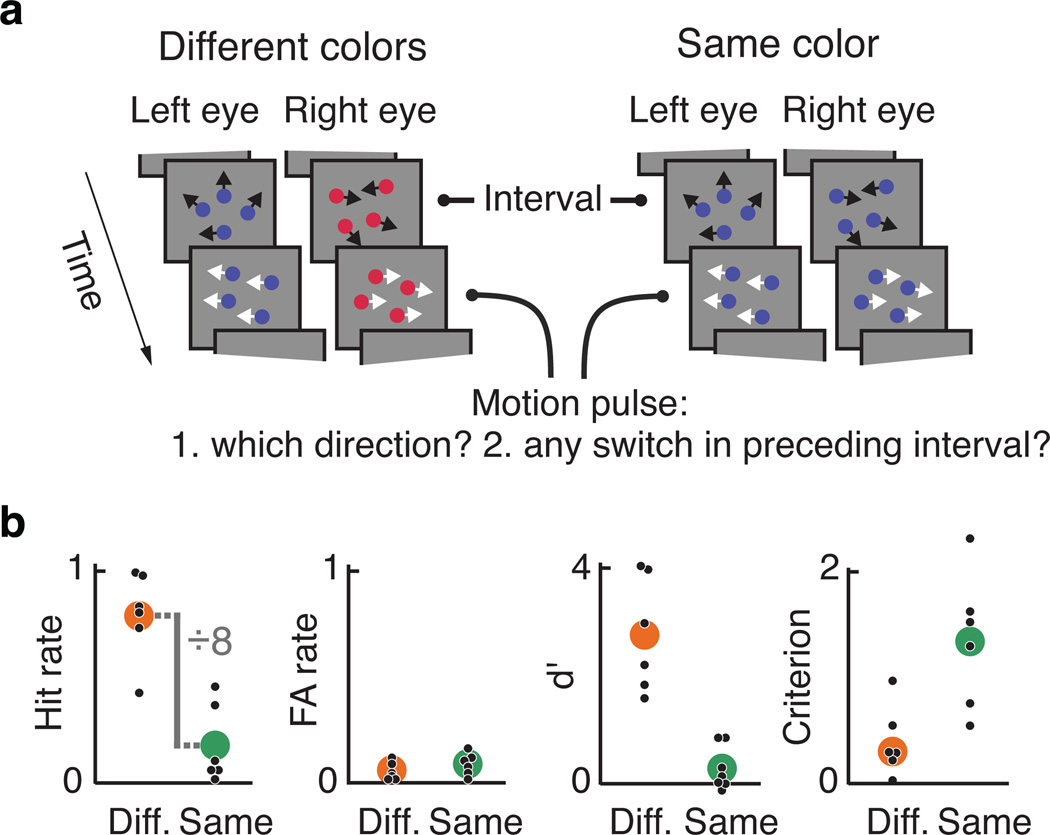
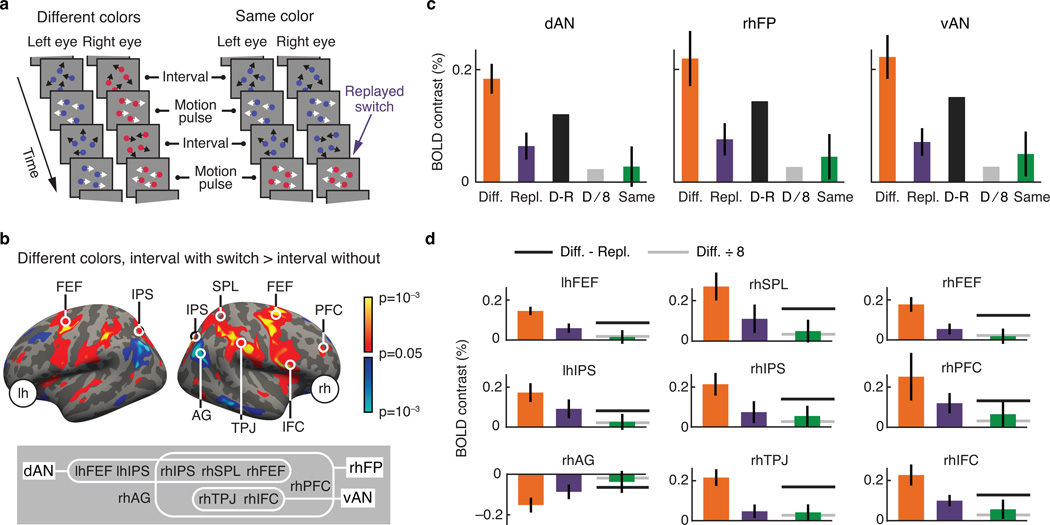
The human brain's executive systems have a vital role in deciding and selecting among actions. Selection among alternatives also occurs in the perceptual domain; for instance, when perception switches between interpretations during perceptual bistability. Whether executive systems also underlie this functionality remains debated, with known fronto-parietal concomitants of perceptual switches being variously interpreted as reflecting the switches' cause or as reflecting their consequences. We developed a procedure in which the two eyes receive different inputs and perception demonstrably switches between these inputs, yet the switches themselves are so inconspicuous as to become unreportable, minimizing their executive consequences. Fronto-parietal fMRI BOLD responses that accompanied perceptual switches were similarly minimized in this procedure, indicating that these reflect the switches' consequences rather than their cause. We conclude that perceptual switches do not always rely on executive brain areas and that processes responsible for selection among alternatives may operate outside the brain's executive systems.
人类大脑的执行系统在决策和行动选择中起着至关重要的作用。在感知领域也会出现备选方案之间的选择;例如,当在感知双稳态期间感知在不同解释之间切换时。执行系统是否也是这种功能的基础仍存在争议,已知的感知切换的额顶伴随现象被不同地解释为反映切换的原因或反映其后果。我们开发了一种程序,其中两只眼睛接收不同的输入,并且感知明显在这些输入之间切换,但切换本身非常不明显以至于无法报告,从而将其执行后果降至最低。在此程序中,伴随感知切换的额顶功能磁共振成像血氧水平依赖(BOLD)反应同样被降至最低,这表明这些反应反映的是切换的后果而非原因。我们得出结论,感知切换并不总是依赖于大脑的执行区域,并且负责备选方案之间选择的过程可能在大脑执行系统之外运作。