Callaghan Brian C, Price Raymond S, Chen Kevin S, Feldman Eva L
Department of Neurology, University of Michigan, Ann Arbor.
Department of Neurology, University of Pennsylvania, Philadelphia.
JAMA Neurol. 2015 Dec;72(12):1510-8. doi: 10.1001/jamaneurol.2015.2347.
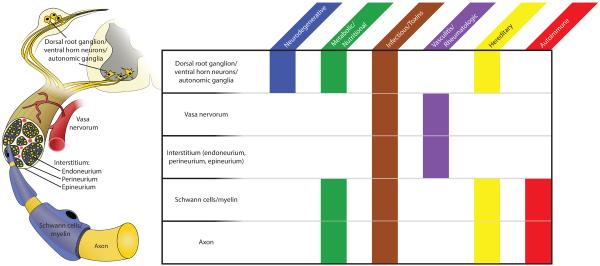
Peripheral neuropathy is a prevalent condition that usually warrants a thorough history and examination but has limited diagnostic evaluation. However, rare localizations of peripheral neuropathy often require more extensive diagnostic testing and different treatments.
To describe rare localizations of peripheral neuropathy, including the appropriate diagnostic evaluation and available treatments.
References were identified from PubMed searches conducted on May 29, 2015, with an emphasis on systematic reviews and randomized clinical trials. Articles were also identified through the use of the authors' own files. Search terms included common rare neuropathy localizations and their causes, as well as epidemiology, pathophysiology, diagnosis, and treatment.
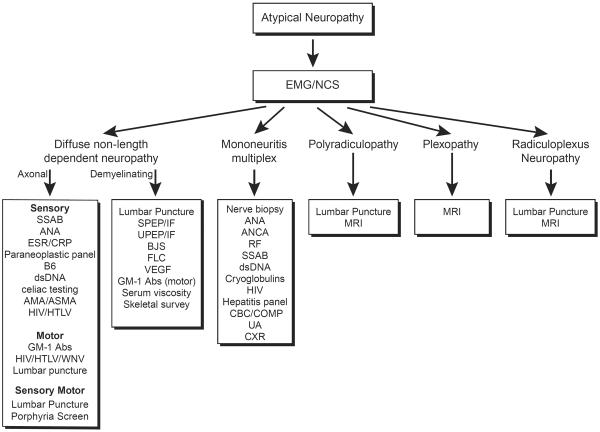
Diffuse, nonlength-dependent neuropathies, multiple mononeuropathies, polyradiculopathies, plexopathies, and radiculoplexus neuropathies are rare peripheral neuropathy localizations that often require extensive diagnostic testing. Atypical neuropathy features, such as acute/subacute onset, asymmetry, and/or motor predominant signs, are frequently present. The most common diffuse, nonlength-dependent neuropathies are Guillain-Barré syndrome, chronic inflammatory demyelinating polyneuropathy, multifocal motor neuropathy, and amyotrophic lateral sclerosis. Effective disease-modifying therapies exist for many diffuse, nonlength-dependent neuropathies including Guillain-Barré syndrome, chronic inflammatory demyelinating polyneuropathy, multifocal motor neuropathy, and some paraprotein-associated demyelinating neuropathies. Vasculitic neuropathy (multiple mononeuropathy) also has efficacious treatment options, but definitive evidence of a treatment effect for IgM anti-MAG neuropathy and diabetic amyotrophy (radiculoplexus neuropathy) is lacking.
Recognition of rare localizations of peripheral neuropathy is essential given the implications for diagnostic testing and treatment. Electrodiagnostic studies are an important early step in the diagnostic evaluation and provide information on the localization and pathophysiology of nerve injury.
周围神经病变是一种常见病症,通常需要全面的病史采集和体格检查,但诊断评估手段有限。然而,周围神经病变的罕见定位往往需要更广泛的诊断检测和不同的治疗方法。
描述周围神经病变的罕见定位,包括适当的诊断评估和可用的治疗方法。
通过2015年5月29日进行的PubMed检索确定参考文献,重点是系统评价和随机临床试验。文章也通过使用作者自己的文献资料来确定。检索词包括常见的罕见神经病变定位及其病因,以及流行病学、病理生理学、诊断和治疗。
弥漫性、非长度依赖性神经病变、多发性单神经病、多神经根病、臂丛神经病和神经根臂丛神经病是罕见的周围神经病变定位,通常需要广泛的诊断检测。非典型神经病变特征,如急性/亚急性起病、不对称和/或运动为主的体征,经常出现。最常见的弥漫性、非长度依赖性神经病变是吉兰-巴雷综合征、慢性炎症性脱髓鞘性多发性神经病、多灶性运动神经病和肌萎缩侧索硬化症。对于许多弥漫性、非长度依赖性神经病变,包括吉兰-巴雷综合征、慢性炎症性脱髓鞘性多发性神经病、多灶性运动神经病和一些副蛋白相关的脱髓鞘性神经病变,存在有效的疾病修饰疗法。血管炎性神经病(多发性单神经病)也有有效的治疗选择,但缺乏IgM抗MAG神经病和糖尿病性肌萎缩(神经根臂丛神经病)治疗效果的确切证据。
鉴于对诊断检测和治疗的影响,认识周围神经病变的罕见定位至关重要。电诊断研究是诊断评估中的重要早期步骤,可提供神经损伤的定位和病理生理学信息。