Fritz Gerhard, Henninger Christian
Institute of Toxicology, Heinrich Heine University Düsseldorf, Moorenstrasse 5, 40225 Düsseldorf, Germany.
Biomolecules. 2015 Sep 30;5(4):2417-34. doi: 10.3390/biom5042417.
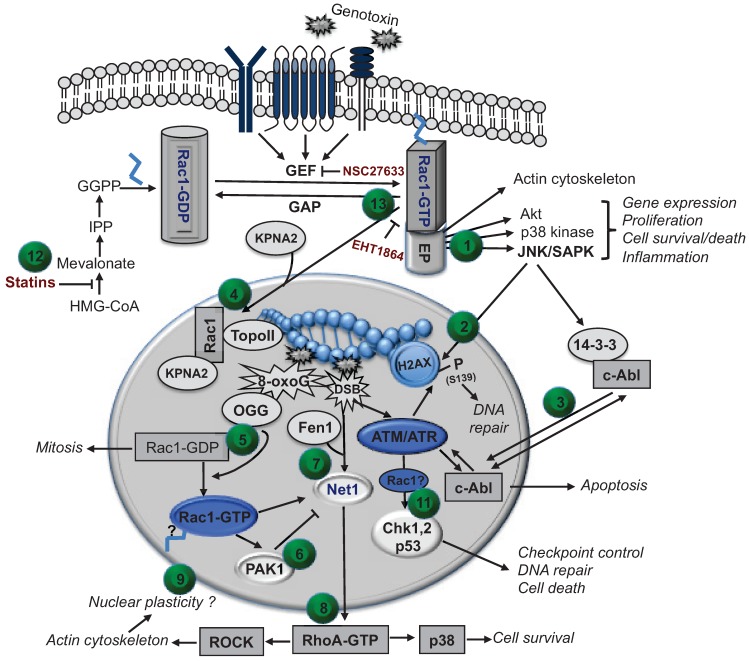
The Ras-related C3 botulinum toxin substrate 1 (Rac1) belongs to the family of Ras-homologous small GTPases. It is well characterized as a membrane-bound signal transducing molecule that is involved in the regulation of cell motility and adhesion as well as cell cycle progression, mitosis, cell death and gene expression. Rac1 also adjusts cellular responses to genotoxic stress by regulating the activity of stress kinases, including c-Jun-N-terminal kinase/stress-activated protein kinase (JNK/SAPK) and p38 kinases as well as related transcription factors. Apart from being found on the inner side of the outer cell membrane and in the cytosol, Rac1 has also been detected inside the nucleus. Different lines of evidence indicate that genotoxin-induced DNA damage is able to activate nuclear Rac1. The exact mechanisms involved and the biological consequences, however, are unclear. The data available so far indicate that Rac1 might integrate DNA damage independent and DNA damage dependent cellular stress responses following genotoxin treatment, thereby coordinating mechanisms of the DNA damage response (DDR) that are related to DNA repair, survival and cell death.
Ras相关的C3肉毒杆菌毒素底物1(Rac1)属于Ras同源小GTP酶家族。它作为一种膜结合信号转导分子已被充分表征,参与细胞运动、黏附以及细胞周期进程、有丝分裂、细胞死亡和基因表达的调控。Rac1还通过调节应激激酶(包括c-Jun氨基末端激酶/应激激活蛋白激酶(JNK/SAPK)和p38激酶)以及相关转录因子的活性来调整细胞对基因毒性应激的反应。除了存在于细胞膜内侧和细胞质溶胶中,Rac1也已在细胞核内被检测到。不同的证据表明,基因毒素诱导的DNA损伤能够激活核Rac1。然而,所涉及的确切机制和生物学后果尚不清楚。目前可得的数据表明,Rac1可能整合基因毒素处理后与DNA损伤无关和与DNA损伤相关的细胞应激反应,从而协调与DNA修复、存活和细胞死亡相关的DNA损伤反应(DDR)机制。