Abellán Ruiz María Salud, Barnuevo Espinosa María Dolores, Contreras Fernández Carlos J, Luque Rubia Antonio J, Sánchez Ayllón Francisca, Aldeguer García Miriam, García Santamaría Carlos, López Román Francisco Javier
Cátedra de Fisiología del Ejercicio. Facultad de Ciencias de la Salud, UCAM -Universidad Católica de Murcia, Campus de los Jerónimos, n° 135 Guadalupe, 30107, Murcia, Spain.
Facultad de Enfermería, Universidad Católica San Antonio, Murcia, Spain.
Eur J Nutr. 2016 Dec;55(8):2389-2397. doi: 10.1007/s00394-015-1045-4. Epub 2015 Oct 6.
Increased awareness of the importance of dietary fibre has led to increased interest in "functional" fibre components like digestion-resistant maltodextrin (RMD). This randomized, placebo-controlled, double-blind study assessed the effects of RMD in the colonic transit time (CTT) and defecation characteristics (frequency, stool volume and consistency).
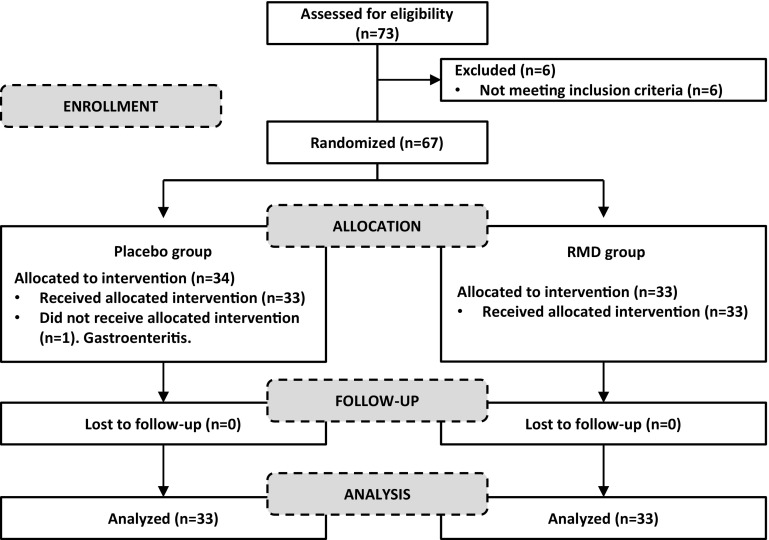
Sixty-six healthy adult volunteers (32 men) who did not have a daily defecation habit had a 7-day run-in period before the 21-day intervention period with RMD or placebo. CTT and segmental CTT (SCTT) were assessed by a single abdominal X-ray film taken at the end of both periods after radiopaque marker ingestion. Defecation characteristics and intestinal functions were also assessed, which were self-reported by patients. Intragroup comparisons were evaluated by Student's paired t test, Bonferroni test and Chi-square test, while time comparisons by analysis of variance (ANOVA) and time-by-treatment interaction by repeated-measures ANOVA.
Fifty-seven subjects were assessed for CTT (placebo, n = 28; RMD, n = 29). In the RMD group, the total CTT, left SCTT and rectosigmoidal SCTT decreased significantly compared to baseline (p < 0.01 each; -13.3, -4.7, -8.7 h, respectively). Significant differences between groups were observed in total CTT and left SCTT. Significant time-by-treatment interaction was observed in the RMD group for stool volume (p = 0.014), increasing 56 % compared to baseline (p < 0.01), while remained unchanged in the placebo group. Stool consistency was improved only in the RMD group (p < 0.01). No adverse effects related to study products were observed.
The results show that RMD improved CTT, stool volume, stool consistency and some intestinal functions in a healthy population.
对膳食纤维重要性的认识不断提高,使得人们对诸如抗消化麦芽糊精(RMD)等“功能性”纤维成分的兴趣日益浓厚。这项随机、安慰剂对照、双盲研究评估了RMD对结肠运输时间(CTT)和排便特征(频率、粪便体积和稠度)的影响。
66名无每日排便习惯的健康成年志愿者(32名男性)在接受RMD或安慰剂为期21天的干预期之前,有一个为期7天的导入期。在摄入不透X线标志物后,在两个阶段结束时分别拍摄一张腹部X光片,以此评估CTT和节段性CTT(SCTT)。还评估了排便特征和肠道功能,由患者自行报告。组内比较采用学生配对t检验、Bonferroni检验和卡方检验,时间比较采用方差分析(ANOVA),时间与治疗交互作用采用重复测量ANOVA。
对57名受试者进行了CTT评估(安慰剂组,n = 28;RMD组,n = 29)。在RMD组中,总CTT、左半结肠SCTT和直肠乙状结肠SCTT与基线相比显著降低(均p < 0.01;分别为-13.3、-4.7、-8.7小时)。在总CTT和左半结肠SCTT方面观察到组间存在显著差异。在RMD组中,观察到粪便体积存在显著的时间与治疗交互作用(p = 0.014),与基线相比增加了56%(p < 0.01),而在安慰剂组中保持不变。仅在RMD组中粪便稠度得到改善(p < 0.01)。未观察到与研究产品相关的不良反应。
结果表明,RMD改善了健康人群的CTT以及粪便体积、粪便稠度和一些肠道功能。