Yuan Ting, Zhang Ting, Han Zhen
Department of Obstetrics and Gynecology, First Affiliated Hospital of Xi'an Jiaotong University College of Medicine, Shaanxi, China.
BMC Pregnancy Childbirth. 2015 Oct 5;15:240. doi: 10.1186/s12884-015-0666-1.
Hypertensive disorders complicating pregnancy (HDCP) continues to be a leading cause of maternal and neonatal mortality and morbidity. The clinical value of placental three-dimensional power Doppler (3DPD) in assessing HDCP requires further confirmation. The research was developed to assess changes of placental vascularity in HDCP using 3DPD and to investigate the placental vascularity in small for gestational age (SGA) compared with not-SGA in patients with HDCP.
There were 126 normotensive and 128 hypertensive pregnant women included in this prospective case-control study from March 2011 to March 2013. Pregnant women underwent 3DPD. Vascularization index (VI), flow index (FI) and vascularization flow index (VFI) were obtained. The placental 3DPD indices, umbilical artery systolic and diastolic ratio (S/D) and pregnancy outcomes were compared between the groups.
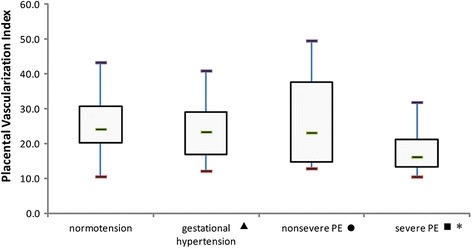
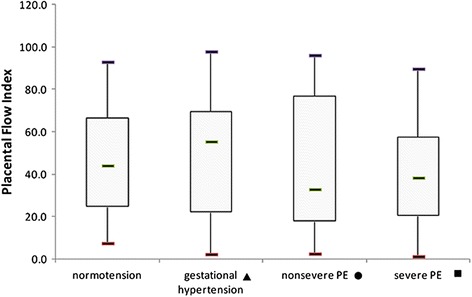
The placental VI and VFI were significantly lower in hypertensive women compared with normotensive women (P < 0.001 and P = 0.014, respectively), and these parameters were significantly reduced in severe preeclampsia (P < 0.001 and P = 0.003, respectively). A weak correlation was found between VI and umbilical artery S/D in HDCP group (r = -0.277, P = 0.001). In HDCP population, neonates who were postnatally diagnosed with SGA had lower VI (P = 0.041) and higher S/D (P < 0.001).
The placental vascularity indices decreased in hypertensive women and the reduction inplacental perfusion was consistent with the severity of the hypertensive disorder. The associations betweenplacental vascularization and umbilical artery impedance may be valuable for further researches and arerequired confirmation. The significant differences in the 3DPD placental vascularization between SGA andnot-SGA in hypertensive pregnancy population may show some clinical importance that we could use tobetter assess or predict the progression and adverse outcomes in the future. Although 3DPD quantificationhas been widely used in multiple publications, we have to acknowledge its limitations.
The intraplacental vascularization was poor in HDCP, and especially in severe preeclampsia. Neonates with SGA had poor placental vascularization and higher umbilical artery S/D. Further studies should focus on the clinical assessment of placental 3DPD as well as a combination of placental 3DPD and other fetal Doppler indices to better predict the development and outcomes of preeclampsia.
妊娠期高血压疾病(HDCP)仍然是孕产妇和新生儿发病及死亡的主要原因。胎盘三维能量多普勒(3DPD)在评估HDCP中的临床价值需要进一步证实。本研究旨在利用3DPD评估HDCP患者胎盘血管的变化,并调查HDCP患者中小于胎龄儿(SGA)与非SGA者的胎盘血管情况。
本前瞻性病例对照研究纳入了2011年3月至2013年3月期间的126例血压正常孕妇和128例高血压孕妇。孕妇接受3DPD检查,获取血管化指数(VI)、血流指数(FI)和血管化血流指数(VFI)。比较两组间的胎盘3DPD指标、脐动脉收缩压与舒张压比值(S/D)及妊娠结局。
高血压孕妇的胎盘VI和VFI显著低于血压正常孕妇(分别为P<0.001和P = 0.014),且这些参数在重度子痫前期显著降低(分别为P<0.001和P = 0.003)。HDCP组中VI与脐动脉S/D之间存在弱相关性(r = -0.277,P = 0.001)。在HDCP人群中,出生后诊断为SGA的新生儿VI较低(P = 0.041),S/D较高(P<0.001)。
高血压孕妇的胎盘血管指数降低,胎盘灌注减少与高血压疾病的严重程度一致。胎盘血管化与脐动脉阻抗之间的关联可能对进一步研究有价值,尚需证实。高血压妊娠人群中SGA与非SGA者在3DPD胎盘血管化方面的显著差异可能具有一定临床意义,可用于未来更好地评估或预测病情进展及不良结局。尽管3DPD定量分析已在多篇文献中广泛应用,但我们必须承认其局限性。
HDCP患者胎盘内血管化较差,尤其是重度子痫前期患者。SGA新生儿胎盘血管化较差,脐动脉S/D较高。进一步研究应聚焦于胎盘3DPD的临床评估以及胎盘3DPD与其他胎儿多普勒指标的联合应用,以更好地预测子痫前期的发展及结局。