
使用三维能量多普勒的超声预测模型用于绝经后出血女性子宫内膜癌的检测
Ultrasonic prediction model using three-dimensional power doppler for endometrial cancer detection in women with postmenopausal bleeding.
作者信息
Wang Li, Quan Shimin, Yang Xiaofeng
机构信息
Department of Gynecology and Obstetrics, The First Affiliated Hospital of Xi'an Jiaotong University, Xi'an, 710061, Shaanxi, China.
出版信息
Sci Rep. 2025 May 26;15(1):18302. doi: 10.1038/s41598-025-02067-y.
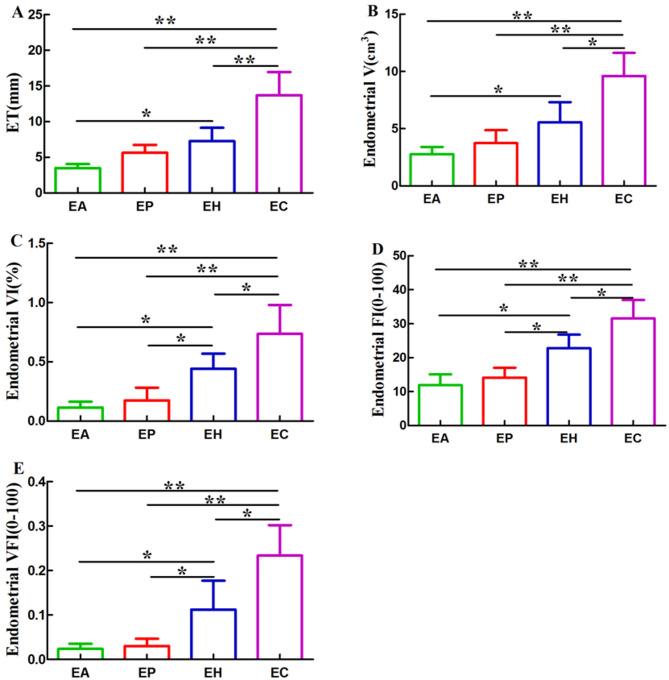
Distinguishing benign and malignant endometrial lesions on the basis of endometrial thickness (ET) may lead to a missed diagnosis of endometrial carcinoma (EC) in women with postmenopausal bleeding (PMB) or increased invasive examination and pain in women with benign endometrial lesions. Our research aims to establish an ultrasonic prediction model for differentiating between benign endometrial lesions and EC in women with PMB. PMB women with ET ≥ 5 mm (n = 412) or ET < 5 mm who presented with recurrent vaginal bleeding (n = 57) were enrolled in this prospective observational study. According to the pathological examination results of the endometrium, women with PMB were divided into endometrial atrophy (EA) (n = 231), endometrial polyp (EP) (n = 98), endometrial hyperplasia (EH) (n = 58) and EC (n = 82) groups. Ultrasonic parameters were compared among the four groups. The predictive value of different parameters for differentiation between benign endometrial lesions and EC in women with PMB was determined via receiver operating characteristic (ROC) curves. The best cut-off of ultrasonic parameters analyzed by ROC curves was used to establish prediction model. Women with EC had significantly thicker endometrium and higher endometrial volume (EV), vascularization index (VI), flow index (FI) and vascularization-flow index (VFI) than women with other pathological types of endometrium (P < 0.05). The endometrial VI, FI and VFI of women with EH were significantly higher compared with those in women with EA and EP (P < 0.05). For patients with ET ≥ 5 mm, the best parameter for distinguishing between benign lesions and EC was the FI, with an area under the curve (AUC) of 0.86, a sensitivity of 86.7% and a specificity of 81.4%. In addition, for patients with ET < 5 mm, the best parameter for distinguishing between benign lesions and EC was the VI, with an AUC of 0.92, a sensitivity of 92.1% and a specificity of 72.9%. The ultrasonic prediction model based on the FI and VI had better predictive value for EC in both patients with ET ≥ 5 mm and patients with ET < 5 mm. The ultrasonic parameters differed among the different pathological types of the endometrium in women with PMB. The ultrasonic prediction model based on the endometrial FI and VI was clinically useful for differentiating between benign endometrial lesions and EC, especially in postmenopausal patients with recurrent vaginal bleeding presenting with ET of less than 5 mm.
根据子宫内膜厚度(ET)来区分良性和恶性子宫内膜病变,可能会导致绝经后出血(PMB)女性漏诊子宫内膜癌(EC),或者导致良性子宫内膜病变女性接受更多侵入性检查并承受痛苦。我们的研究旨在建立一个超声预测模型,用于区分PMB女性的良性子宫内膜病变和EC。ET≥5mm的PMB女性(n = 412)或出现反复阴道出血的ET<5mm女性(n = 57)被纳入这项前瞻性观察研究。根据子宫内膜的病理检查结果,PMB女性被分为子宫内膜萎缩(EA)组(n = 231)、子宫内膜息肉(EP)组(n = 98)、子宫内膜增生(EH)组(n = 58)和EC组(n = 82)。比较四组之间的超声参数。通过受试者操作特征(ROC)曲线确定不同参数对PMB女性良性子宫内膜病变和EC鉴别的预测价值。使用ROC曲线分析的超声参数的最佳截断值来建立预测模型。与其他病理类型的子宫内膜女性相比,EC女性的子宫内膜明显更厚,子宫内膜体积(EV)、血管化指数(VI)、血流指数(FI)和血管化血流指数(VFI)更高(P<0.05)。EH女性的子宫内膜VI、FI和VFI与EA和EP女性相比明显更高(P<0.05)。对于ET≥5mm的患者,区分良性病变和EC的最佳参数是FI,曲线下面积(AUC)为0.86,灵敏度为86.7%,特异度为81.4%。此外,对于ET<5mm的患者,区分良性病变和EC的最佳参数是VI,AUC为0.92,灵敏度为92.1%,特异度为72.9%。基于FI和VI的超声预测模型对ET≥5mm患者和ET<5mm患者的EC均具有较好的预测价值。PMB女性不同病理类型的子宫内膜之间超声参数存在差异。基于子宫内膜FI和VI的超声预测模型在临床上有助于区分良性子宫内膜病变和EC,尤其是对于ET小于5mm且出现反复阴道出血的绝经后患者。


 Zotero 插件