Borges Rui, Khan Imran, Johnson Warren E, Gilbert M Thomas P, Zhang Guojie, Jarvis Erich D, O'Brien Stephen J, Antunes Agostinho
CIIMAR/CIMAR, Interdisciplinary Centre of Marine and Environmental Research, University of Porto, Rua dos Bragas, 177, 4050-123, Porto, Portugal.
Department of Biology, Faculty of Sciences, University of Porto, Rua do Campo Alegre, 4169-007, Porto, Portugal.
BMC Genomics. 2015 Oct 6;16:751. doi: 10.1186/s12864-015-1924-3.
The wide range of complex photic systems observed in birds exemplifies one of their key evolutionary adaptions, a well-developed visual system. However, genomic approaches have yet to be used to disentangle the evolutionary mechanisms that govern evolution of avian visual systems.
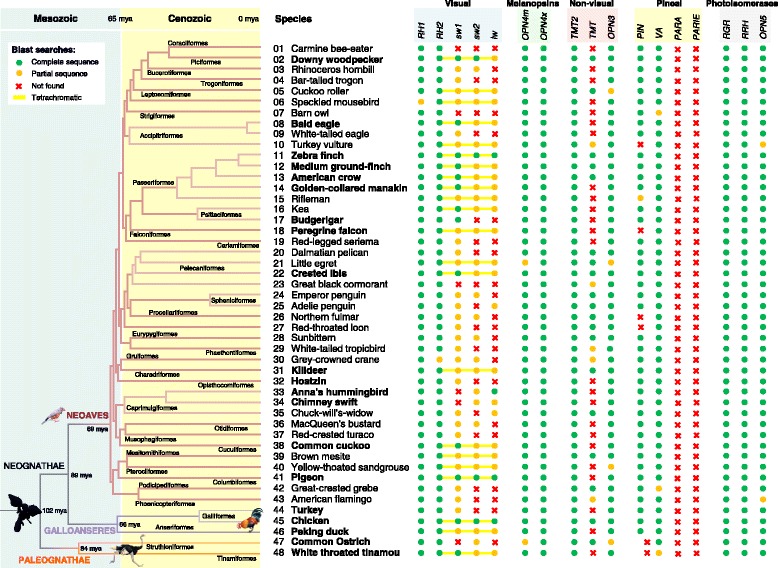
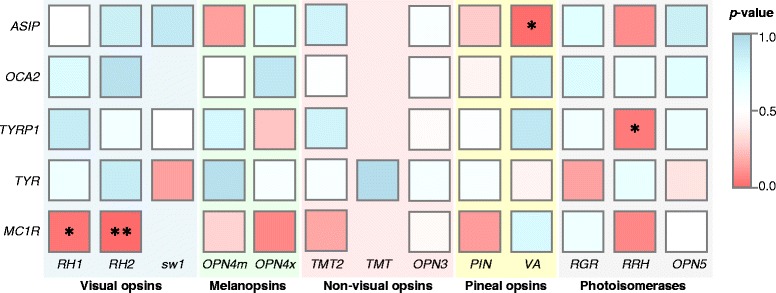
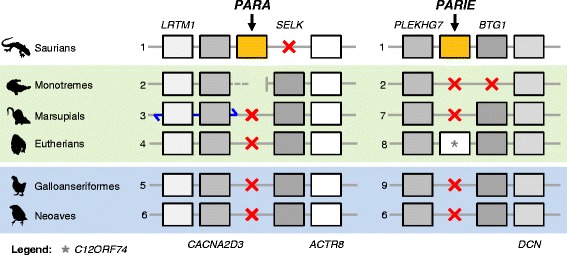
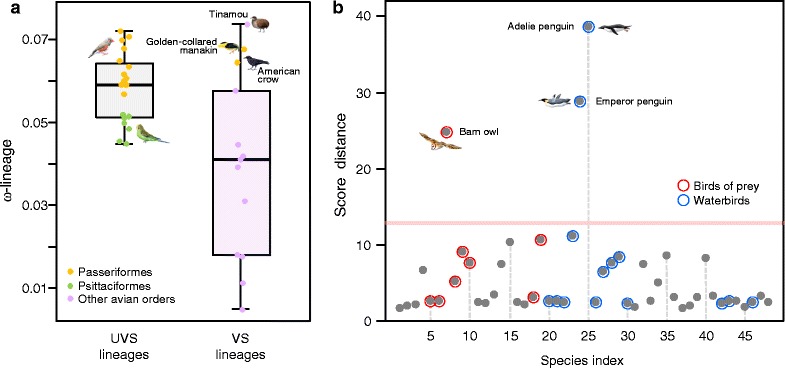
We performed comparative genomic analyses across 48 avian genomes that span extant bird phylogenetic diversity to assess evolutionary changes in the 17 representatives of the opsin gene family and five plumage coloration genes. Our analyses suggest modern birds have maintained a repertoire of up to 15 opsins. Synteny analyses indicate that PARA and PARIE pineal opsins were lost, probably in conjunction with the degeneration of the parietal organ. Eleven of the 15 avian opsins evolved in a non-neutral pattern, confirming the adaptive importance of vision in birds. Visual conopsins sw1, sw2 and lw evolved under negative selection, while the dim-light RH1 photopigment diversified. The evolutionary patterns of sw1 and of violet/ultraviolet sensitivity in birds suggest that avian ancestors had violet-sensitive vision. Additionally, we demonstrate an adaptive association between the RH2 opsin and the MC1R plumage color gene, suggesting that plumage coloration has been photic mediated. At the intra-avian level we observed some unique adaptive patterns. For example, barn owl showed early signs of pseudogenization in RH2, perhaps in response to nocturnal behavior, and penguins had amino acid deletions in RH2 sites responsible for the red shift and retinal binding. These patterns in the barn owl and penguins were convergent with adaptive strategies in nocturnal and aquatic mammals, respectively.
We conclude that birds have evolved diverse opsin adaptations through gene loss, adaptive selection and coevolution with plumage coloration, and that differentiated selective patterns at the species level suggest novel photic pressures to influence evolutionary patterns of more-recent lineages.
鸟类中观察到的广泛而复杂的光感系统是其关键的进化适应之一,即发达的视觉系统。然而,基因组方法尚未用于解开控制鸟类视觉系统进化的进化机制。
我们对跨越现存鸟类系统发育多样性的48个鸟类基因组进行了比较基因组分析,以评估视蛋白基因家族的17个代表基因和5个羽毛颜色基因的进化变化。我们的分析表明,现代鸟类保留了多达15种视蛋白。共线性分析表明,PARA和PARIE松果体视蛋白可能随着顶眼器官的退化而丢失。15种鸟类视蛋白中的11种以非中性模式进化,证实了视觉在鸟类中的适应性重要性。视觉视锥蛋白sw1、sw2和lw在负选择下进化,而暗光RH1光色素则多样化。鸟类中sw1的进化模式和对紫光/紫外线的敏感性表明,鸟类祖先具有对紫光敏感的视觉。此外,我们证明了RH2视蛋白与MC1R羽毛颜色基因之间存在适应性关联,表明羽毛颜色是由光介导的。在鸟类内部水平上,我们观察到了一些独特的适应性模式。例如,仓鸮的RH2出现了假基因化的早期迹象,这可能是对夜行性行为的反应,而企鹅在负责红移和视网膜结合的RH2位点存在氨基酸缺失。仓鸮和企鹅的这些模式分别与夜行性和水生哺乳动物的适应性策略趋同。
我们得出结论,鸟类通过基因丢失、适应性选择以及与羽毛颜色的共同进化,进化出了多种视蛋白适应性,并且物种水平上不同的选择模式表明存在新的光压力来影响最近谱系的进化模式。