CIIMAR/CIMAR, Interdisciplinary Centre of Marine and Environmental Research, University of Porto, Portugal.
Department of Biology, Faculty of Sciences, University of Porto, Portugal.
Genome Biol Evol. 2019 Aug 1;11(8):2244-2255. doi: 10.1093/gbe/evz111.
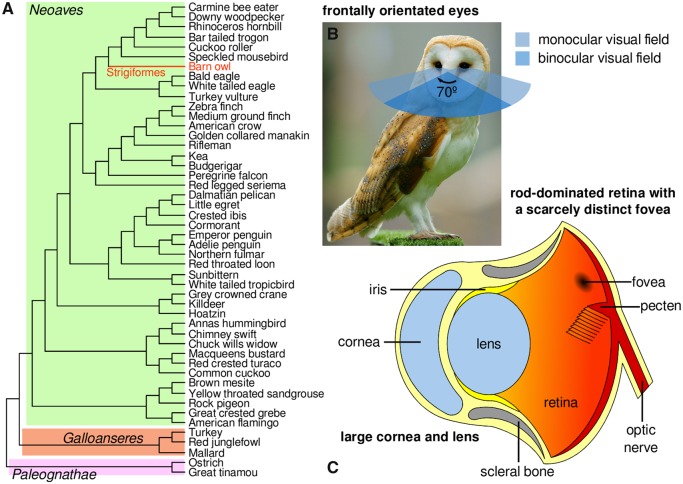
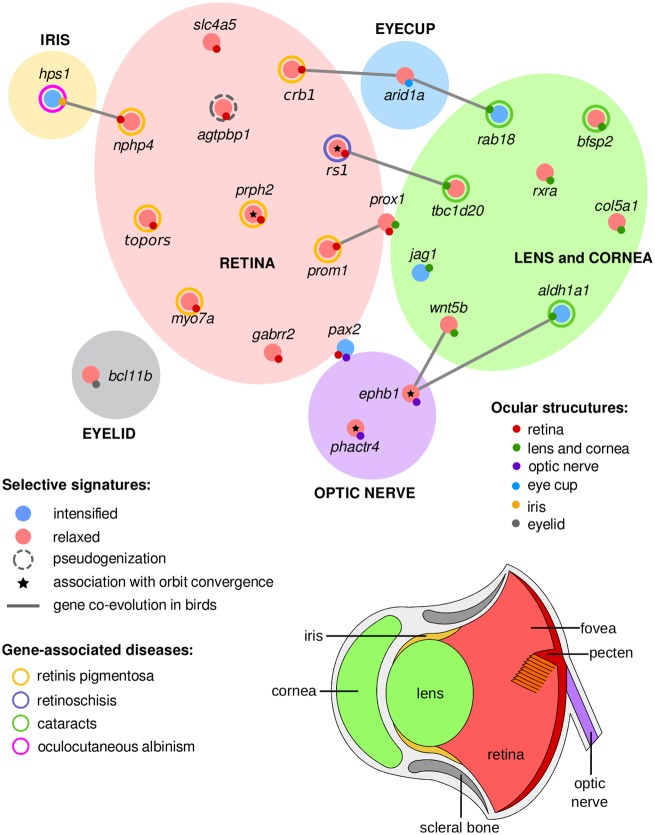
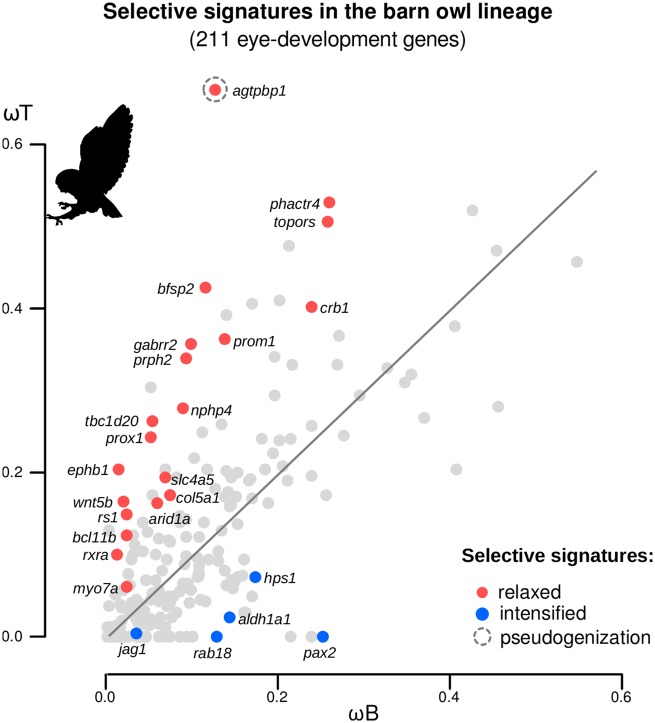
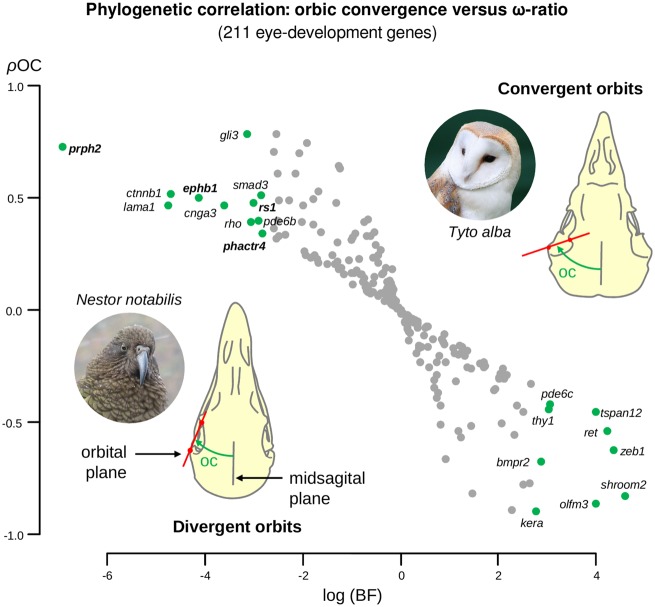
Typical avian eyes are phenotypically engineered for photopic vision (daylight). In contrast, the highly derived eyes of the barn owl (Tyto alba) are adapted for scotopic vision (dim light). The dramatic modifications distinguishing barn owl eyes from other birds include: 1) shifts in frontal orientation to improve binocularity, 2) rod-dominated retina, and 3) enlarged corneas and lenses. Some of these features parallel mammalian eye patterns, which are hypothesized to have initially evolved in nocturnal environments. Here, we used an integrative approach combining phylogenomics and functional phenotypes of 211 eye-development genes across 48 avian genomes representing most avian orders, including the stem lineage of the scotopic-adapted barn owl. Overall, we identified 25 eye-development genes that coevolved under intensified or relaxed selection in the retina, lens, cornea, and optic nerves of the barn owl. The agtpbp1 gene, which is associated with the survival of photoreceptor populations, was pseudogenized in the barn owl genome. Our results further revealed that barn owl retinal genes responsible for the maintenance, proliferation, and differentiation of photoreceptors experienced an evolutionary relaxation. Signatures of relaxed selection were also observed in the lens and cornea morphology-associated genes, suggesting that adaptive evolution in these structures was essentially structural. Four eye-development genes (ephb1, phactr4, prph2, and rs1) evolved in positive association with the orbit convergence in birds and under relaxed selection in the barn owl lineage, likely contributing to an increased reliance on binocular vision in the barn owl. Moreover, we found evidence of coevolutionary interactions among genes that are expressed in the retina, lens, and optic nerve, suggesting synergetic adaptive events. Our study disentangles the genomic changes governing the binocularity and low-light perception adaptations of barn owls to nocturnal environments while revealing the molecular mechanisms contributing to the shift from the typical avian photopic vision to the more-novel scotopic-adapted eye.
典型的鸟类眼睛在表型上是为光觉(日光)设计的。相比之下,仓鸮(Tyto alba)高度特化的眼睛适应于暗视觉(暗光)。仓鸮眼睛与其他鸟类明显不同的显著特征包括:1)前端方向的转变以提高双眼视觉,2)以杆细胞为主的视网膜,以及 3)扩大的角膜和晶状体。这些特征中的一些与哺乳动物眼睛的模式相似,这些模式被假设最初是在夜间环境中进化而来的。在这里,我们使用了一种综合方法,结合了 48 个鸟类基因组中的 211 个眼睛发育基因的系统发育基因组学和功能表型,这些基因组代表了大多数鸟类目,包括特化于暗光的仓鸮的祖先谱系。总的来说,我们确定了 25 个眼睛发育基因,这些基因在仓鸮的视网膜、晶状体、角膜和视神经中受到强化或放松选择的共同进化。与光感受器群体存活有关的 agtpbp1 基因在仓鸮基因组中发生了假基因化。我们的研究结果进一步表明,负责维持、增殖和分化光感受器的仓鸮视网膜基因经历了进化放松。在晶状体和角膜形态相关基因中也观察到了选择放松的特征,这表明这些结构的适应性进化在本质上是结构上的。四个眼睛发育基因(ephb1、phactr4、prph2 和 rs1)与鸟类的眼眶会聚呈正相关进化,并且在仓鸮谱系中受到放松选择,这可能有助于增加仓鸮对双眼视觉的依赖。此外,我们发现了在视网膜、晶状体和视神经中表达的基因之间协同进化相互作用的证据,表明协同适应事件的发生。我们的研究揭示了控制仓鸮对夜间环境的双眼视觉和暗光感知适应的基因组变化,同时揭示了导致从典型鸟类光觉向更新型暗光适应眼睛转变的分子机制。