Arendrup Maiken Cavling, Jensen Rasmus Hare, Meletiadis Joseph
Unit of Mycology, Statens Serum Institut, Copenhagen, Denmark
Unit of Mycology, Statens Serum Institut, Copenhagen, Denmark.
Antimicrob Agents Chemother. 2015 Dec;59(12):7735-42. doi: 10.1128/AAC.01919-15. Epub 2015 Oct 5.
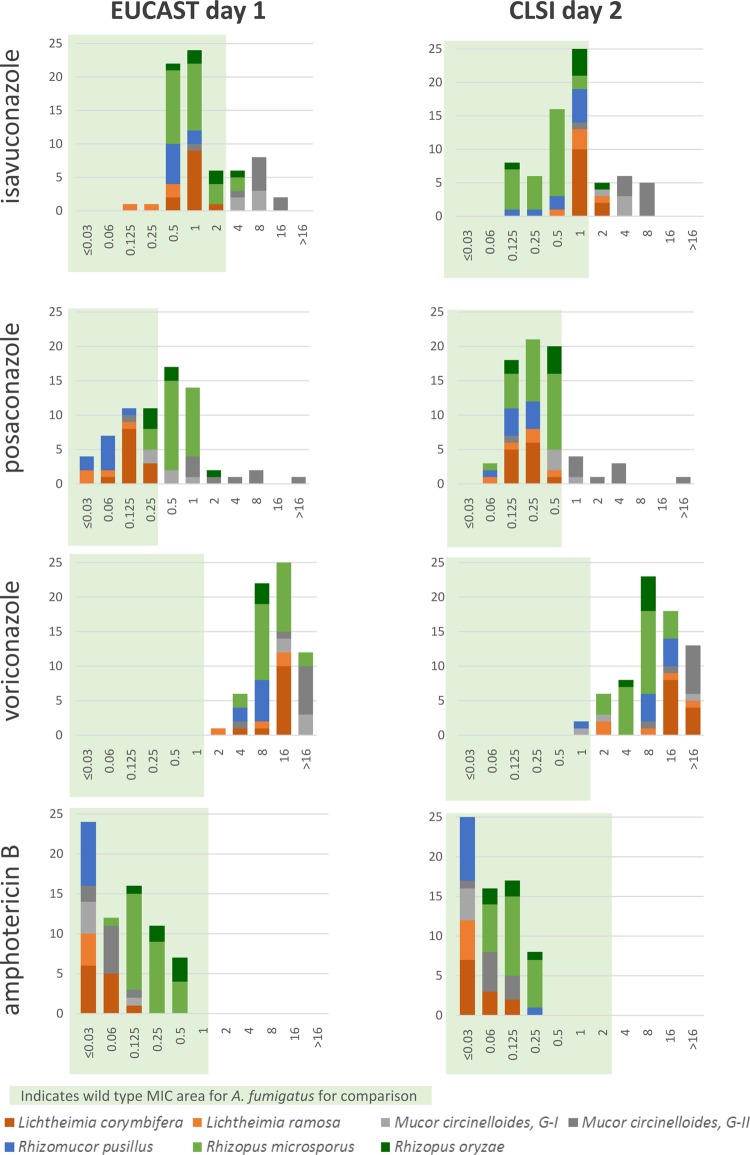
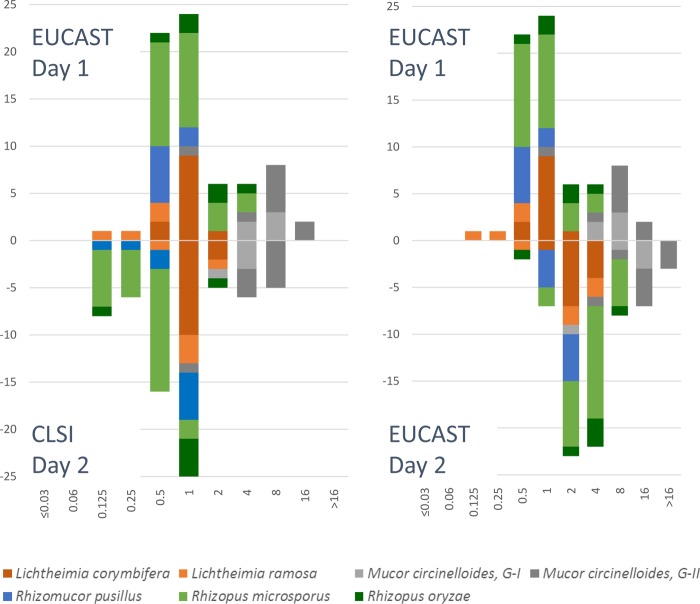
The in vitro activity of isavuconazole against Mucorales isolates measured by EUCAST E.Def 9.2 and CLSI M38-A2 methodologies was investigated in comparison with those of amphotericin B, posaconazole, and voriconazole. Seventy-two isolates were included: 12 of Lichtheimia corymbifera, 5 of Lichtheimia ramosa, 5 of group I and 9 of group II of Mucor circinelloides, 9 of Rhizomucor pusillus, 26 of Rhizopus microsporus, and 6 of Rhizopus oryzae. Species identification was confirmed by internal transcribed spacer (ITS) sequencing. EUCAST MICs were read on day 1 (EUCAST-d1) and day 2 (EUCAST-d2), and CLSI MICs were read on day 2 (CLSI-d2). Isavuconazole MIC50s (range) (mg/liter) by EUCAST-d1, CLSI-d2, and EUCAST-d2 were 1 (0.125 to 16), 1 (0.125 to 2), and 4 (0.5 to >16), respectively, across all isolates. The similar values for comparator drugs were as follows: posaconazole, 0.25 (≤ 0.03 to >16), 0.25 (0.06 to >16), and 1 (0.06 to >16); amphotericin, 0.06 (≤ 0.03 to 0.5), 0.06 (≤ 0.03 to 0.25), and 0.125 (≤ 0.03 to 1); voriconazole, 16 (2 to >16), 8 (1 to >16), and >16 (8 to >16), respectively. Isavuconazole activity varied by species: Lichtheimia corymbifera, 1 (0.5 to 2), 1 (1 to 2), and 2 (1 to 4); Lichtheimia ramosa, 0.25 (0.125 to 0.5), 1 (0.5 to 2), and 2 (0.5 to 4); Rhizomucor pusillus, 0.5 (0.5 to 1), 1 (0.125 to 1), and 2 (1 to 2); Rhizopus microsporus, 1 (0.5 to 4), 0.5 (0.125 to 1), and 4 (1 to 8); and Rhizopus oryzae, 1 (0.5 to 4), 1 (0.125 to 2), and 4 (0.5 to 8), respectively, were more susceptible than Mucor circinelloides: group I, 8 (4 to 8), 4 (2 to 4), and 16 (2 to 16), respectively, and group II, 8 (1 to 16), 8 (1 to 8), and 16 (4 to >16), respectively. This was also observed for posaconazole. The essential agreement was best between EUCAST-d1 and CLSI-d2 (75% to 83%). Isavuconazole displayed in vitro activity against Mucorales isolates with the exception of Mucor circinelloides. The MICs were in general 1 to 3 steps higher than those for posaconazole. However, in the clinical setting this may be compensated for by the higher exposure at standard dosing.
研究了依沙康唑对毛霉目分离株的体外活性,采用欧洲抗菌药物敏感性试验委员会(EUCAST)E.Def 9.2和美国临床和实验室标准协会(CLSI)M38 - A2方法进行测定,并与两性霉素B、泊沙康唑和伏立康唑进行比较。纳入了72株分离株:12株伞枝梨头霉、5株总状梨头霉、5株卷枝毛霉I组和9株卷枝毛霉II组、9株微小根毛霉、26株少根根霉和6株米根霉。通过内转录间隔区(ITS)测序确认菌种鉴定。EUCAST最低抑菌浓度(MIC)在第1天(EUCAST - d1)和第2天(EUCAST - d2)读取,CLSI MIC在第2天(CLSI - d2)读取。依沙康唑在EUCAST - d1、CLSI - d2和EUCAST - d2时的MIC50(范围)(mg/L)在所有分离株中分别为1(0.125至16)、1(0.125至2)和4(0.5至>16)。对照药物的相似值如下:泊沙康唑,0.25(≤0.03至>16)、0.25(0.06至>16)和1(0.06至>16);两性霉素,0.06(≤0.03至0.5)、0.06(≤0.03至0.25)和0.125(≤0.03至1);伏立康唑,16(2至>16)、8(1至>16)和>16(8至>16)。依沙康唑的活性因菌种而异:伞枝梨头霉,1(0.5至2)、1(1至2)和2(1至4);总状梨头霉,0.25(0.125至0.5)、1(0.5至2)和2(0.5至4);微小根毛霉,0.5(0.5至1)、1(0.125至1)和2(1至2);少根根霉,1(0.5至4)、0.5(0.125至1)和4(1至8);米根霉,1(0.5至4)、1(0.125至2)和4(0.5至8),分别比卷枝毛霉更敏感:I组,分别为8(4至8)、4(2至4)和16(2至16),II组,分别为8(1至16)、8(1至8)和16(