Lieu Christopher H, Klauck Peter J, Henthorn Patrick K, Tentler John J, Tan Aik-Choon, Spreafico Anna, Selby Heather M, Britt Blair C, Bagby Stacey M, Arcaroli John J, Messersmith Wells A, Pitts Todd M, Eckhardt S Gail
Department of Medicine, Division of Medical Oncology, University of Colorado Anschutz Medical Campus, Aurora, CO, USA.
Oncotarget. 2015 Oct 27;6(33):34561-72. doi: 10.18632/oncotarget.5949.
CRC is a significant cause of cancer mortality, and new therapies are needed for patients with advanced disease. TAK-733 is a highly potent and selective investigational novel MEK allosteric site inhibitor.
In a preclinical study of TAK-733, a panel of CRC cell lines were exposed to varying concentrations of the agent for 72 hours followed by a sulforhodamine B assay. Twenty patient-derived colorectal cancer xenografts were then treated with TAK-733 in vivo. Tumor growth inhibition index (TGII) was assessed to evaluate the sensitivity of the CRC explants to TAK-733 while linear regression was utilized to investigate the predictive effects of genotype on the TGII of explants.
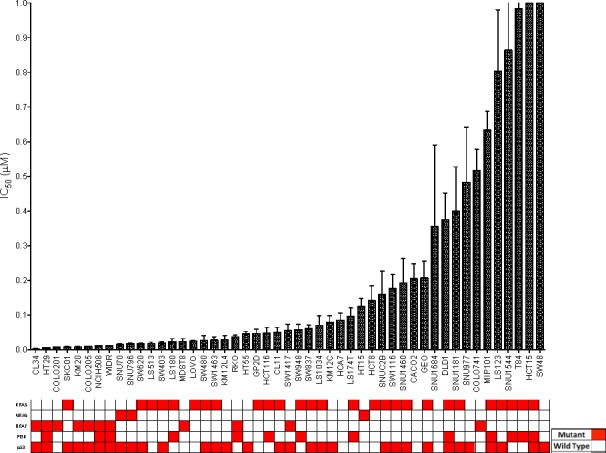
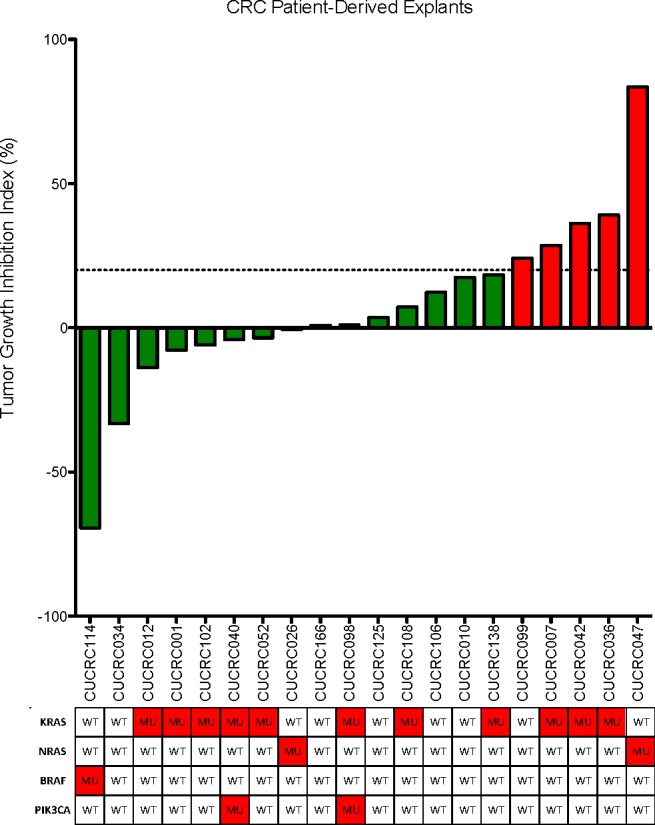
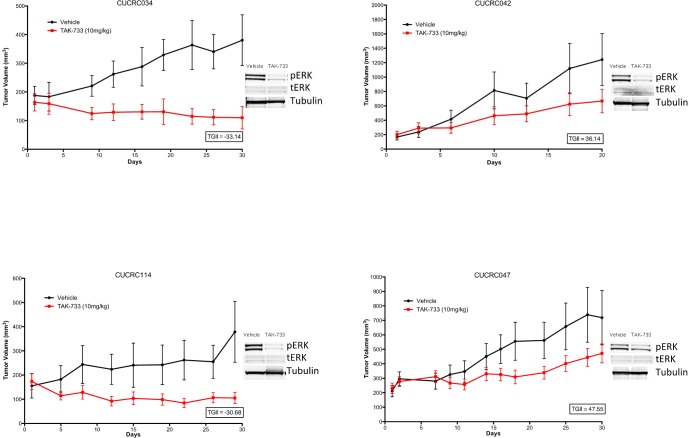
Fifty-four CRC cell lines were exposed to TAK-733, while 42 cell lines were deemed sensitive across a broad range of mutations. Eighty-two percent of the cell lines within the sensitive subset were BRAF or KRAS/NRAS mutant, whereas 80% of the cell lines within the sensitive subset were PIK3CA WT. Twenty patient-derived human tumor CRC explants were then treated with TAK-733. In total, 15 primary human tumor explants were found to be sensitive to TAK-733 (TGII ≤ 20%), including 9 primary human tumor explants that exhibited tumor regression (TGII > 100%). Explants with a BRAF/KRAS/NRAS mutant and PIK3CA wild-type genotype demonstrated increased sensitivity to TAK-733 with a median TGII of -6%. MEK-response gene signatures also correlated with responsiveness to TAK-733 in KRAS-mutant CRC.
The MEK inhibitor TAK-733 demonstrated robust antitumor activity against CRC cell lines and patient-derived tumor explants. While the preclinical activity observed in this study was considerable, single-agent efficacy in the clinic has been limited in CRC, supporting the use of these models in an iterative manner to elucidate resistance mechanisms that can guide rational combination strategies.
结直肠癌是癌症死亡的一个重要原因,晚期疾病患者需要新的治疗方法。TAK-733是一种高效且选择性的新型MEK变构位点抑制剂。
在TAK-733的临床前研究中,一组结直肠癌细胞系暴露于不同浓度的该药物72小时,随后进行磺酰罗丹明B检测。然后用TAK-733对20个患者来源的结直肠癌异种移植瘤进行体内治疗。评估肿瘤生长抑制指数(TGII)以评估结直肠癌外植体对TAK-733的敏感性,同时利用线性回归研究基因型对TAK-733外植体TGII的预测作用。
54个结直肠癌细胞系暴露于TAK-733,其中42个细胞系在广泛的突变范围内被认为敏感。敏感亚组中82%的细胞系为BRAF或KRAS/NRAS突变型,而敏感亚组中80%的细胞系为PIK3CA野生型。然后用TAK-733处理20个患者来源的人肿瘤结直肠癌外植体。总共发现15个原发性人肿瘤外植体对TAK-733敏感(TGII≤20%),其中9个原发性人肿瘤外植体出现肿瘤消退(TGII>100%)。具有BRAF/KRAS/NRAS突变和PIK3CA野生型基因型的外植体对TAK-733的敏感性增加,中位TGII为-6%。MEK反应基因特征也与KRAS突变型结直肠癌对TAK-733的反应性相关。
MEK抑制剂TAK-733对结直肠癌细胞系和患者来源的肿瘤外植体显示出强大的抗肿瘤活性。虽然本研究中观察到的临床前活性相当可观,但在临床上单药疗效在结直肠癌中有限,支持以迭代方式使用这些模型来阐明可指导合理联合策略的耐药机制。