Shapira Shiran, Ben-Amotz Oded, Sher Osnat, Kazanov Dina, Mashiah Jacob, Kraus Sarah, Gur Eyal, Arber Nadir
The Integrated Cancer Prevention Center, Tel Aviv Sourasky Medical Center, Tel Aviv, Israel; Sackler Faculty of Medicine, Tel Aviv University, Tel Aviv, Israel.
The Integrated Cancer Prevention Center, Tel Aviv Sourasky Medical Center, Tel Aviv, Israel; Department of Plastic and Reconstructive Surgery, Tel Aviv Sourasky Medical Center, Tel Aviv, Israel.
PLoS One. 2015 Oct 6;10(10):e0139787. doi: 10.1371/journal.pone.0139787. eCollection 2015.
Healthy individuals rarely have problems with wound healing. Most skin lesions heal rapidly and efficiently within one to two weeks. However, many medical and surgical complications can be attributed to deficiencies in wound repair. Open wounds have lost the barrier that protects tissues from bacterial invasion and allows the escape of vital fluids. Without expeditious healing, infections become more frequent. The CD24 gene encodes a heavily-glycosylated cell surface protein anchored to the membrane by phosphatidylinositol. CD24 plays an important role in the adaptive immune response and controls an important genetic checkpoint for homeostasis and autoimmune diseases in both mice and humans. We have previously shown that overexpression of CD24 results in increased proliferation and migration rates.
To examine the role of CD24 in the wound healing process.
An excisional model of wound healing was used and delayed wound healing was studied in genetically modified heat stable antigen (HSA/CD24)-deficient mice (HSA-/-) compared to wild-type (WT) mice.
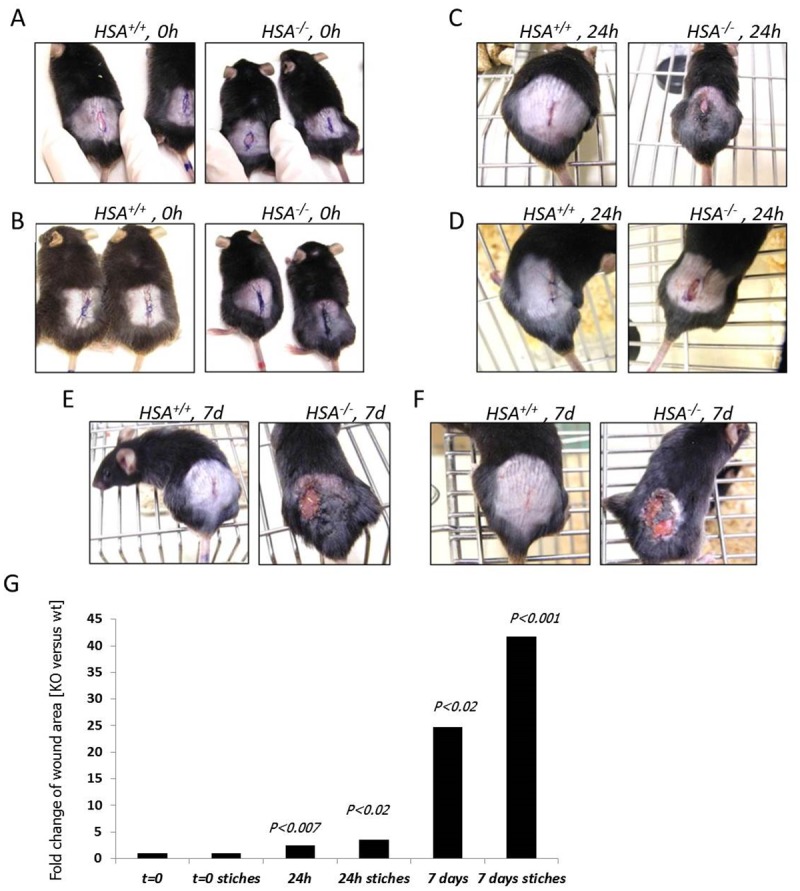
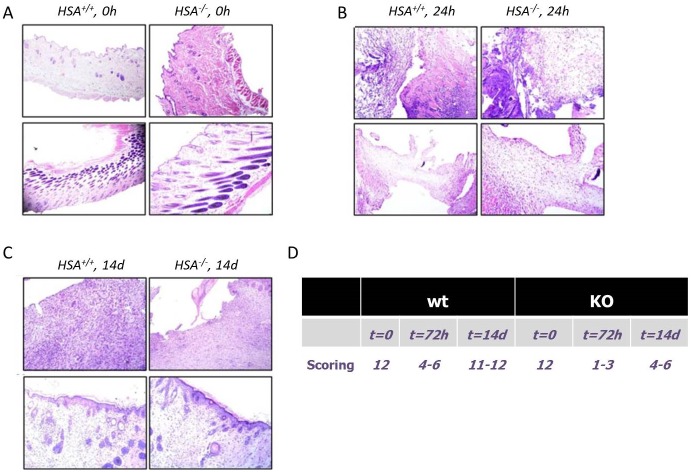
Large full-thickness skin wounds, excised on the back of mice, exhibited a significant delay in the formation of granulation tissue, and in wound closure when compared to their WTHSA+/+ littermates. Wounds were histologically analyzed and scored, based on the degree of cellular invasion, granulation tissue formation, vascularity, and re-epithelialization. Additionally, in stitched wounds, the HSA-/- mice failed to maintain their stitches; they did not hold and fell already 24 hours, revealing erythematous wound fields. Re-expression of HSA, delivered by lentivirus, restored the normal healing phenotype, within 24 hours post-injury, and even improved the healing in WT, and in BalbC mice.
Delayed wound-healing in the absence of HSA/CD24 suggests that CD24 plays an important role in this process. Increased expression of CD24, even in the normal state, may be used to enhance wound repair.
健康个体很少有伤口愈合问题。大多数皮肤损伤在一到两周内迅速且有效地愈合。然而,许多医学和手术并发症可归因于伤口修复缺陷。开放性伤口失去了保护组织免受细菌入侵并防止重要体液流失的屏障。如果不能迅速愈合,感染会更频繁发生。CD24基因编码一种通过磷脂酰肌醇锚定在膜上的高度糖基化细胞表面蛋白。CD24在适应性免疫反应中起重要作用,并控制小鼠和人类体内稳态及自身免疫性疾病的一个重要遗传检查点。我们之前已经表明,CD24的过表达会导致增殖和迁移速率增加。
研究CD24在伤口愈合过程中的作用。
使用伤口愈合的切除模型,与野生型(WT)小鼠相比,在基因改造的热稳定抗原(HSA/CD24)缺陷小鼠(HSA-/-)中研究延迟伤口愈合情况。
在小鼠背部切除的大面积全层皮肤伤口,与同窝野生型(WTHSA+/+)小鼠相比,肉芽组织形成和伤口闭合明显延迟。根据细胞浸润程度、肉芽组织形成、血管生成和再上皮化程度对伤口进行组织学分析和评分。此外,在缝合伤口中,HSA-/-小鼠无法固定缝线;缝线在24小时内就松开脱落,伤口部位出现红斑。通过慢病毒递送重新表达HSA,在受伤后24小时内恢复了正常愈合表型,甚至改善了WT小鼠和BalbC小鼠的愈合情况。
缺乏HSA/CD24时伤口愈合延迟表明CD24在此过程中起重要作用。即使在正常状态下增加CD24的表达也可用于增强伤口修复。