
垂柳热激因子基因家族:全基因组调查及发育和非生物胁迫下的表达谱分析
The heat shock factor gene family in Salix suchowensis: a genome-wide survey and expression profiling during development and abiotic stresses.
作者信息
Zhang Jin, Li Yu, Jia Hui-Xia, Li Jian-Bo, Huang Juan, Lu Meng-Zhu, Hu Jian-Jun
机构信息
State Key Laboratory of Tree Genetics and Breeding, Key Laboratory of Tree Breeding and Cultivation of the State Forestry Administration, Research Institute of Forestry, Chinese Academy of Forestry Beijing, China ; Co-Innovation Center for Sustainable Forestry in Southern China, Nanjing Forestry University Nanjing, China.
State Key Laboratory of Tree Genetics and Breeding, Key Laboratory of Tree Breeding and Cultivation of the State Forestry Administration, Research Institute of Forestry, Chinese Academy of Forestry Beijing, China.
出版信息
Front Plant Sci. 2015 Sep 16;6:748. doi: 10.3389/fpls.2015.00748. eCollection 2015.
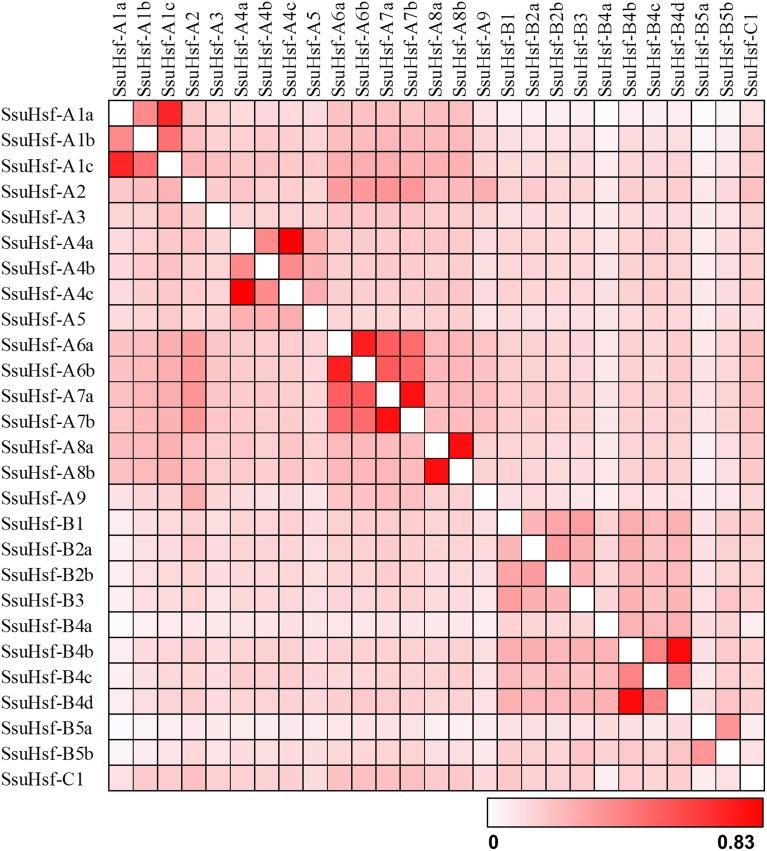
Heat shock transcription factors (Hsfs), which act as important transcriptional regulatory proteins, play crucial roles in plant developmental processes, and stress responses. Recently, the genome of the shrub willow Salix suchowensis was fully sequenced. In this study, a total of 27 non-redundant Hsf genes were identified from the S. suchowensis genome. Phylogenetic analysis revealed that the members of the SsuHsf family can be divided into three groups (class A, B, and C) based on their structural characteristics. Promoter analysis indicated that the SsuHsfs promoters included various cis-acting elements related to hormone and/or stress responses. Furthermore, the expression profiles of 27 SsuHsfs were analyzed in different tissues and under various stresses (heat, drought, salt, and ABA treatment) using RT-PCR. The results demonstrated that the SsuHsfs were involved in abiotic stress responses. Our results contribute to a better understanding of the complexity of the SsuHsf gene family, and will facilitate functional characterization in future studies.
热激转录因子(Hsfs)作为重要的转录调控蛋白,在植物发育过程和应激反应中发挥着关键作用。最近,杞柳(Salix suchowensis)的基因组已被完全测序。在本研究中,从杞柳基因组中总共鉴定出27个非冗余的Hsf基因。系统发育分析表明,SsuHsf家族成员可根据其结构特征分为三组(A类、B类和C类)。启动子分析表明,SsuHsfs启动子包含与激素和/或应激反应相关的各种顺式作用元件。此外,使用RT-PCR分析了27个SsuHsfs在不同组织以及各种胁迫(热、干旱、盐和ABA处理)下的表达谱。结果表明,SsuHsfs参与了非生物胁迫反应。我们的结果有助于更好地理解SsuHsf基因家族的复杂性,并将促进未来研究中的功能表征。




 Zotero 插件