
用于增加细胞毒素产生的交换胶囊:对新出现的emm89化脓性链球菌进化枝毒力的贡献
Trading Capsule for Increased Cytotoxin Production: Contribution to Virulence of a Newly Emerged Clade of emm89 Streptococcus pyogenes.
作者信息
Zhu Luchang, Olsen Randall J, Nasser Waleed, de la Riva Morales Ivan, Musser James M
机构信息
Center for Molecular and Translational Human Infectious Diseases Research, Houston Methodist Research Institute, Houston, Texas, USA Department of Pathology and Genomic Medicine, Houston Methodist Hospital, Houston, Texas, USA.
Center for Molecular and Translational Human Infectious Diseases Research, Houston Methodist Research Institute, Houston, Texas, USA Department of Pathology and Genomic Medicine, Houston Methodist Hospital, Houston, Texas, USA Escuela de Medicina y Ciencias de la Salud, Instituto Tecnológico y de Estudios Superiores de Monterrey, Monterrey, Nuevo León, México.
出版信息
mBio. 2015 Oct 6;6(5):e01378-15. doi: 10.1128/mBio.01378-15.
UNLABELLED
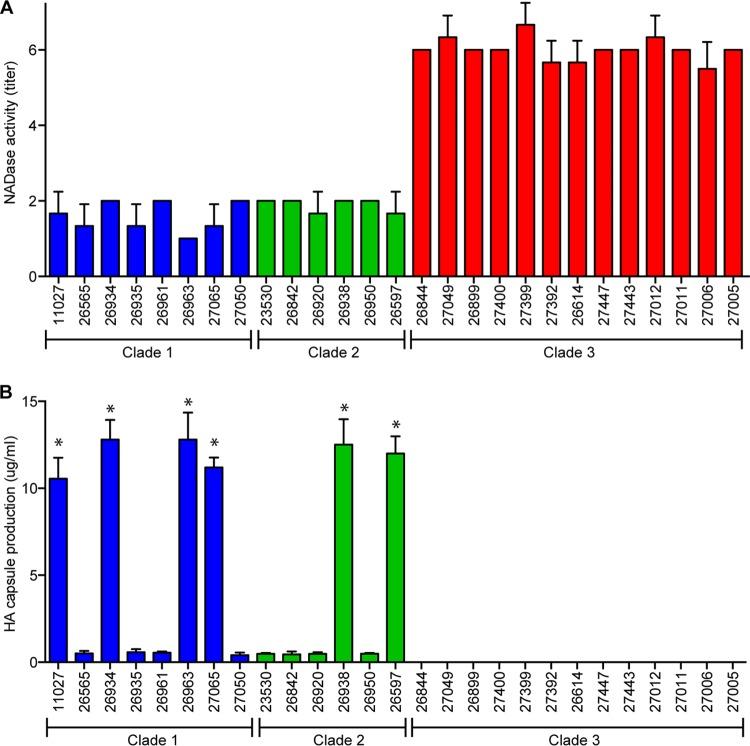
Strains of emm89 Streptococcus pyogenes have become one of the major causes of invasive infections worldwide in the last 10 years. We recently sequenced the genome of 1,125 emm89 strains and identified three major phylogenetic groups, designated clade 1, clade 2, and the epidemic clade 3. Epidemic clade 3 strains, which now cause the great majority of infections, have two distinct genetic features compared to clade 1 and clade 2 strains. First, all clade 3 organisms have a variant 3 nga promoter region pattern, which is associated with increased production of secreted cytolytic toxins SPN (S. pyogenes NADase) and SLO (streptolysin O). Second, all clade 3 strains lack the hasABC locus mediating hyaluronic acid capsule synthesis, whereas this locus is intact in clade 1 and clade 2 strains. We constructed isogenic mutant strains that produce different levels of SPN and SLO toxins and capsule (none, low, or high). Here we report that emm89 strains with elevated toxin production are significantly more virulent than low-toxin producers. Importantly, we also show that capsule production is dispensable for virulence in strains that already produce high levels of SPN and SLO. Our results provide new understanding about the molecular mechanisms contributing to the rapid emergence and molecular pathogenesis of epidemic clade 3 emm89 S. pyogenes.
IMPORTANCE
S. pyogenes (group A streptococcus [GAS]) causes pharyngitis ("strep throat"), necrotizing fasciitis, and other human infections. Serious infections caused by emm89 S. pyogenes strains have recently increased in frequency in many countries. Based on whole-genome sequence analysis of 1,125 strains recovered from patients on two continents, we discovered that a new emm89 clone, termed clade 3, has two distinct genetic features compared to its predecessors: (i) absence of the genes encoding antiphagocytic hyaluronic acid capsule virulence factor and (ii) increased production of the secreted cytolytic toxins SPN and SLO. emm89 S. pyogenes strains with the clade 3 phenotype (absence of capsule and high expression of SPN and SLO) are highly virulent in mice. These findings provide new understanding of how new virulent clones emerge and cause severe infections worldwide. This newfound knowledge of S. pyogenes virulence can be used to help understand future epidemics and conduct new translational research.
未标记
在过去10年中,化脓性链球菌emm89菌株已成为全球侵袭性感染的主要原因之一。我们最近对1125株emm89菌株的基因组进行了测序,并确定了三个主要的系统发育组,分别命名为进化枝1、进化枝2和流行的进化枝3。与进化枝1和进化枝2菌株相比,现在导致大多数感染的流行进化枝3菌株有两个明显的遗传特征。首先,所有进化枝3菌株都有一个变异的3 nga启动子区域模式,这与分泌性溶细胞毒素SPN(化脓性链球菌NAD酶)和SLO(链球菌溶血素O)的产量增加有关。其次,所有进化枝3菌株都缺乏介导透明质酸荚膜合成的hasABC基因座,而该基因座在进化枝1和进化枝2菌株中是完整的。我们构建了产生不同水平SPN和SLO毒素以及荚膜(无、低或高)的同基因突变菌株。在此我们报告,毒素产量升高的emm89菌株比低毒素产生者的毒力明显更强。重要的是,我们还表明,对于已经产生高水平SPN和SLO的菌株,荚膜产生对于毒力来说是可有可无的。我们的结果为流行进化枝3化脓性链球菌emm89的快速出现和分子发病机制的分子机制提供了新的认识。
重要性
化脓性链球菌(A组链球菌[GAS])可引起咽炎(“链球菌性喉炎”)、坏死性筋膜炎和其他人类感染。由化脓性链球菌emm89菌株引起的严重感染最近在许多国家的发病率有所增加。基于对从两大洲患者身上分离出的1125株菌株的全基因组序列分析,我们发现一个新出现的emm89克隆,称为进化枝3,与其前身相比有两个明显的遗传特征:(i)缺乏编码抗吞噬透明质酸荚膜毒力因子的基因,以及(ii)分泌性溶细胞毒素SPN和SLO的产量增加。具有进化枝3表型(无荚膜且SPN和SLO高表达)的化脓性链球菌emm89菌株在小鼠中具有高度毒力。这些发现为新的毒力克隆如何出现并在全球引起严重感染提供了新的认识。这种新发现的化脓性链球菌毒力知识可用于帮助理解未来的疫情并开展新的转化研究。



 Zotero 插件