Parry Luke, Vinther Jakob, Edgecombe Gregory D
Bristol Life Sciences Building, University of Bristol, 24 Tyndall Avenue, Bristol BS8 1TH, UK Department of Earth Sciences, Natural History Museum, Cromwell Road, London SW7 5BD, UK
Bristol Life Sciences Building, University of Bristol, 24 Tyndall Avenue, Bristol BS8 1TH, UK.
Biol Lett. 2015 Oct;11(10). doi: 10.1098/rsbl.2015.0763.
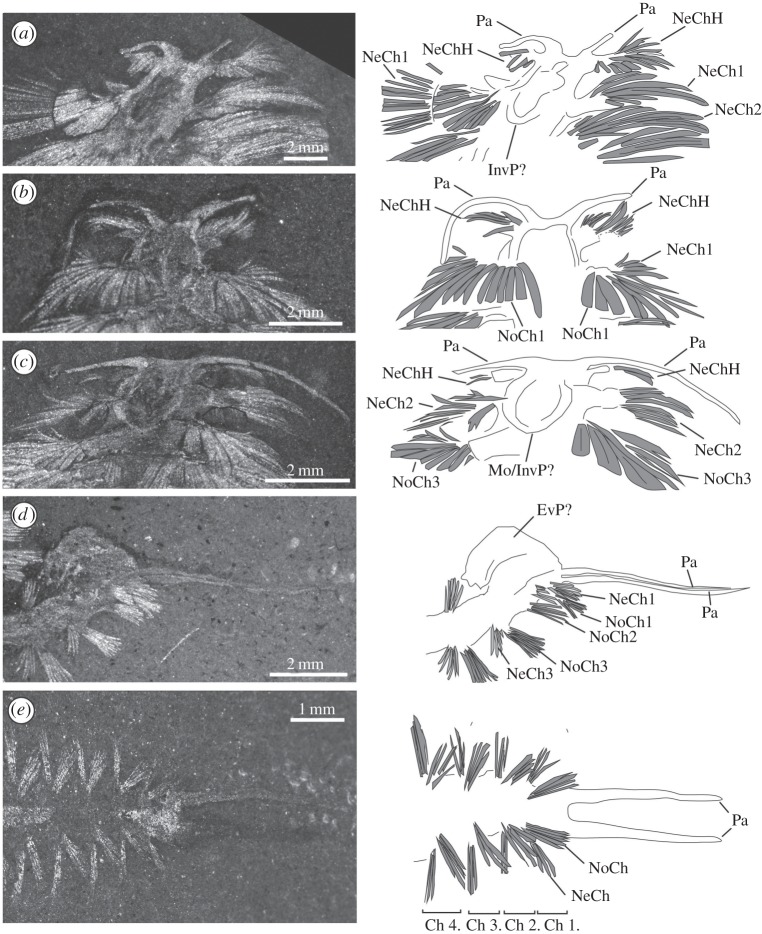
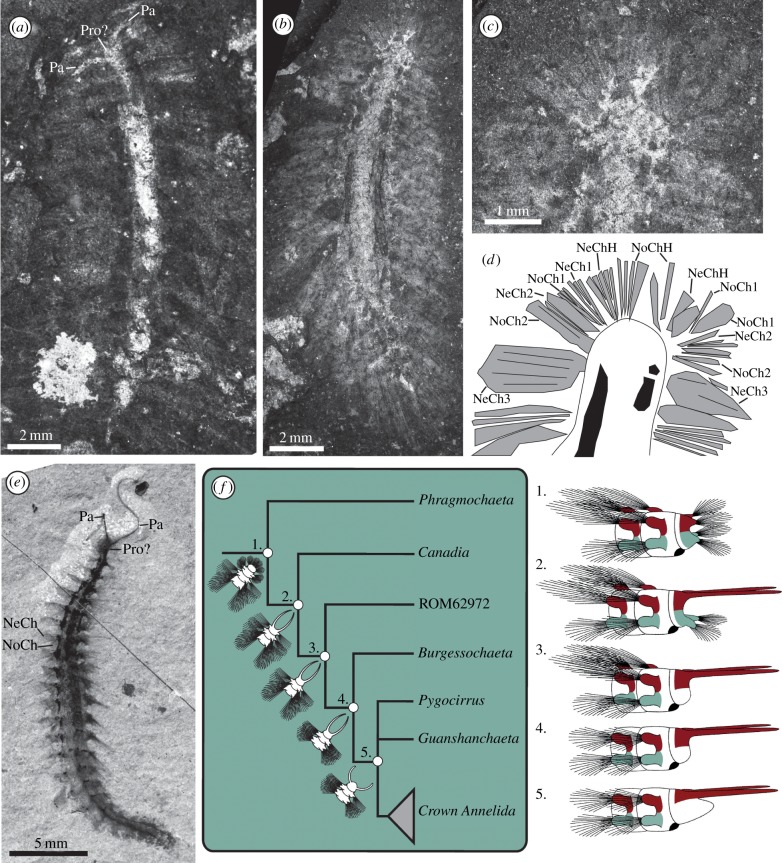
The oldest fossil annelids come from the Early Cambrian Sirius Passet and Guanshan biotas and Middle Cambrian Burgess Shale. While these are among the best preserved polychaete fossils, their relationship to living taxa is contentious, having been interpreted either as members of extant clades or as a grade outside the crown group. New morphological observations from five Cambrian species include the oldest polychaete with head appendages, a new specimen of Pygocirrus from Sirius Passet, and an undescribed form from the Burgess Shale. We propose that the palps of Canadia are on an anterior segment bearing neuropodia and that the head of Phragmochaeta is formed of a segment bearing biramous parapodia and chaetae. The unusual anatomy of these taxa suggests that the head is not differentiated into a prostomium and peristomium, that palps are derived from a modified parapodium and that the annelid head was originally a parapodium-bearing segment. Canadia, Phragmochaeta and the Marble Canyon annelid share the presence of protective notochaetae, interpreted as a primitive character state subsequently lost in Pygocirrus and Burgessochaeta, in which the head is clearly differentiated from the trunk.
最古老的环节动物化石来自早寒武世的锡里斯帕塞特生物群和关山生物群以及中寒武世的布尔吉斯页岩。虽然这些是保存最完好的多毛类化石之一,但它们与现存分类群的关系存在争议,被解释为现存类群的成员或冠群之外的一个演化阶段。来自五个寒武纪物种的新形态学观察结果包括最古老的具有头部附肢的多毛类动物、来自锡里斯帕塞特的一个新的帚毛虫标本以及来自布尔吉斯页岩的一个未描述的形态。我们认为加拿大虫的触须位于带有神经足的前部体节上,而扁毛虫的头部由一个带有双分支 parapodia 和刚毛的体节构成。这些分类群不寻常的解剖结构表明,头部没有分化为口前叶和围口节,触须源自经过改造的 parapodium,并且环节动物的头部最初是一个带有 parapodium 的体节。加拿大虫、扁毛虫和大理石峡谷环节动物都有保护性的背刚毛,这被解释为一种原始性状状态,在帚毛虫和布尔吉斯刚毛虫中后来丢失了,在后者中头部与躯干明显区分开来。