Mehta Shreya, de Reuver Philip R, Gill Preetjote, Andrici Juliana, D'Urso Lisa, Mittal Anubhav, Pavlakis Nick, Clarke Stephen, Samra Jaswinder S, Gill Anthony J
From Department of Gastrointestinal Surgery, Royal North Shore Hospital and North Shore Private Hospital, University of Sydney, New South Wales, Australia (SM, PDR, PG, AM, JSS); Department of Medical Oncology, Royal North Shore Hospital and North Shore Private Hospital, University of Sydney, New South Wales, Australia (NP, SC); Macquarie University Hospital, Macquarie University, New South Wales, Australia (JSS); and Department of Anatomical Pathology Royal North Shore Hospital, Cancer Diagnosis and Pathology Group, Kolling Institute of Medical Research, University of Sydney, New South Wales, Australia (JA, LDU, AJG).
Medicine (Baltimore). 2015 Oct;94(40):e1281. doi: 10.1097/MD.0000000000001281.
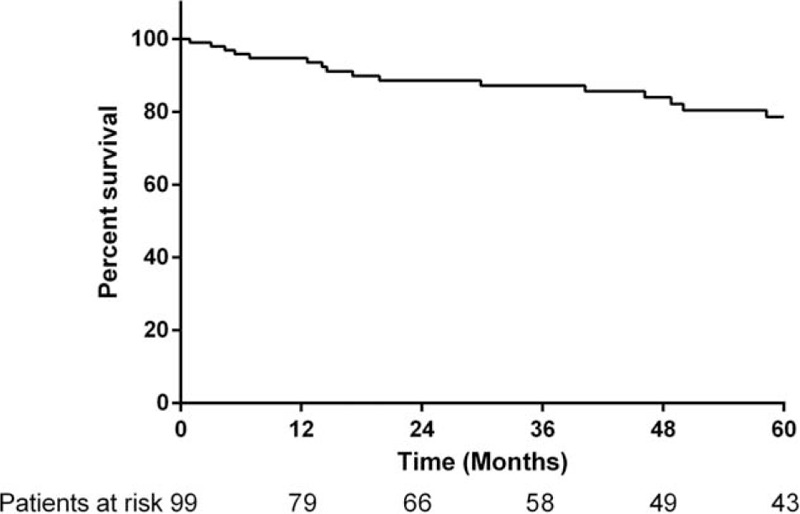
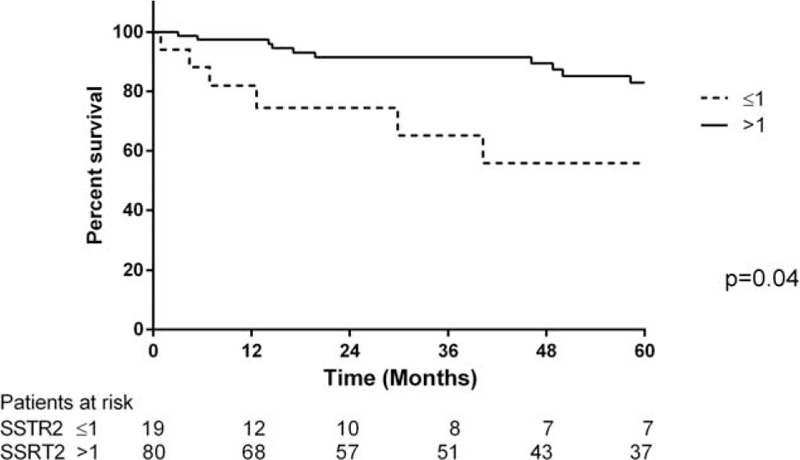
Somatostatin receptors (SSTR) are commonly expressed by neuroendocrine tumors. Expression of SSTR-2a and SSTR-5 may impact symptomatic management; however, the impact on survival is unclear. The aim of this study is to correlate SSTR-2a and SSTR-5 expression in pancreatic neuroendocrine tumors (PNETs) with survival. This study is designed to determine the prognostic significance of somatostatin receptors SSTR-2a and SSTR-5 in PNETs. This retrospective cohort study included cases of resected PNETs between 1992 and 2014. Clinical data, histopathology, expression of SSTR and Ki-67 by immunohistochemistry, and long-term survival were analyzed. A total of 99 cases were included in this study. The mean age was 57.8 years (18-87 years) and median tumor size was 25 mm (range 8-160 mm). SSTR-2a and SSTR-5 expression was scored as negative (n = 19, 19.2%; n = 75, 75.8%, respectively) and positive (n = 80, 80.1%; n = 24, 24.2%). The median follow-up was 49 months. SSTR-2a expression was associated with improved overall survival, with cumulative survival rates at 1, 3, and 5 years being 97.5%, 91.5%, and 82.9%, respectively. Univariate analysis demonstrated better survival in SSTR-2a positive patients (log rank P = 0.04). SSTR-5 expression was not associated with survival outcomes (log rank P = 0.94). Multivariate analysis showed that positive SSTR-2a expression is a stronger prognostic indicator for overall survival [Hazard Ratio (HR): 0.2, 95% Confidence interval (CI): 0.1-0.8] compared to high Ki-67 (HR: 0.8, 95% CI: 0.1-5.7). Expression of SSTR-2a is an independent positive prognostic factor for survival in PNETs.
生长抑素受体(SSTR)通常由神经内分泌肿瘤表达。SSTR-2a和SSTR-5的表达可能会影响症状管理;然而,其对生存的影响尚不清楚。本研究的目的是将胰腺神经内分泌肿瘤(PNETs)中SSTR-2a和SSTR-5的表达与生存情况相关联。本研究旨在确定生长抑素受体SSTR-2a和SSTR-5在PNETs中的预后意义。这项回顾性队列研究纳入了1992年至2014年间接受手术切除的PNETs病例。分析了临床数据、组织病理学、免疫组织化学检测的SSTR和Ki-67表达以及长期生存情况。本研究共纳入99例病例。平均年龄为57.8岁(18 - 87岁),肿瘤中位数大小为25 mm(范围8 - 160 mm)。SSTR-2a和SSTR-5表达分别被评为阴性(n = 19,19.2%;n = 75,75.8%)和阳性(n = 80,80.1%;n = 24,24.2%)。中位随访时间为49个月。SSTR-2a表达与总体生存率提高相关,1年、3年和5年的累积生存率分别为97.5%、91.5%和82.9%。单因素分析显示SSTR-2a阳性患者的生存情况更好(对数秩检验P = 0.04)。SSTR-5表达与生存结果无关(对数秩检验P = 0.94)。多因素分析表明,与高Ki-67(风险比[HR]:0.8,95%置信区间[CI]:0.1 - 5.7)相比,SSTR-2a阳性表达是总体生存更强的预后指标[HR:0.2,95% CI:0.1 - 0.8]。SSTR-2a的表达是PNETs生存的独立阳性预后因素。