Warren James R, Falster Michael O, Tran Bich, Jorm Louisa
Department of Computer Science, University of Auckland, Auckland, New Zealand.
Centre for Big Data Research in Health, University of New South Wales, Kensington, New South Wales, Australia.
PLoS One. 2015 Oct 8;10(10):e0140008. doi: 10.1371/journal.pone.0140008. eCollection 2015.
Deficiencies in medication adherence are a major barrier to effectiveness of chronic condition management. Continuity of primary care may promote adherence. We assessed the association of continuity of primary care with adherence to long-term medication as exemplified by statins.
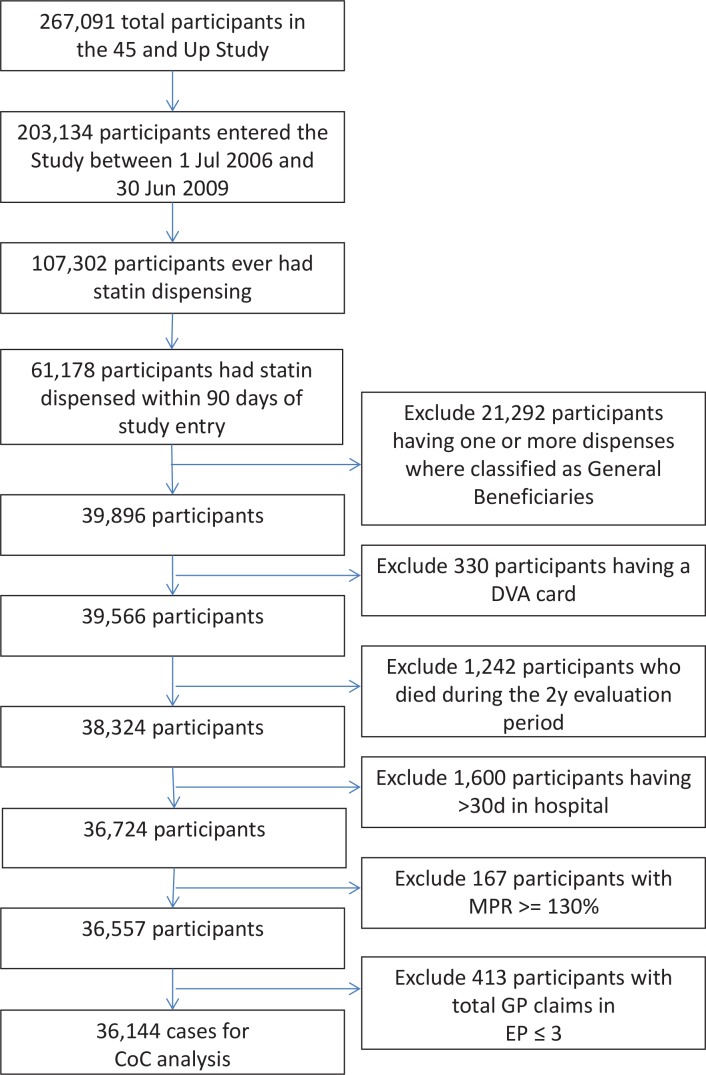
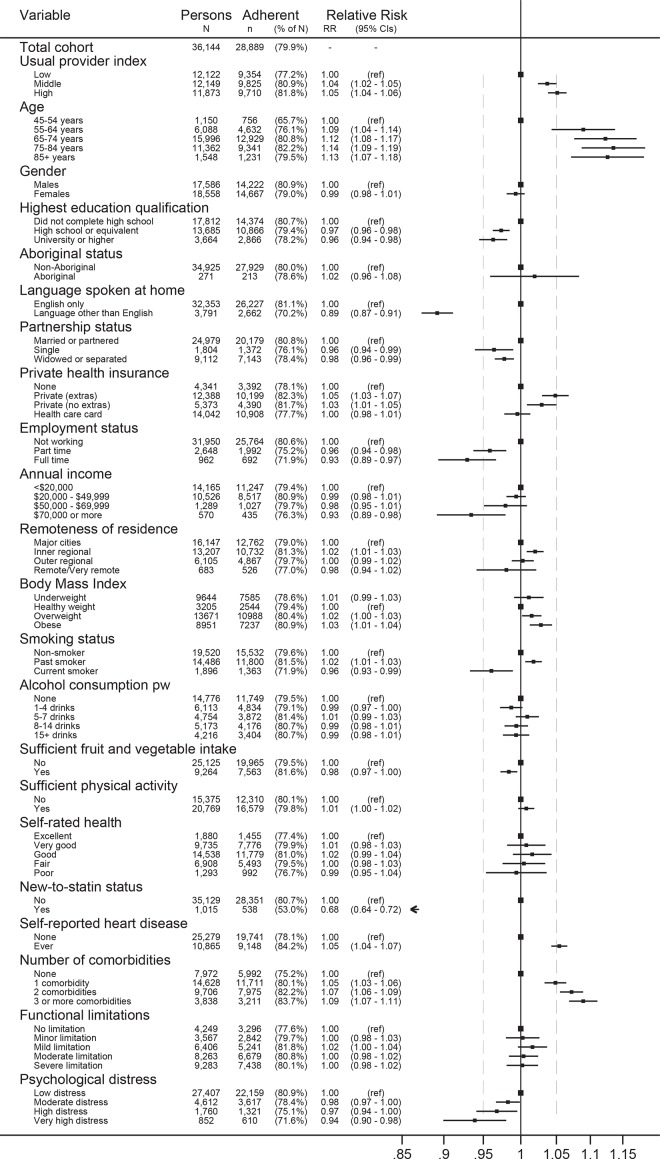
We linked data from a prospective study of 267,091 Australians aged 45 years and over to national data sets on prescription reimbursements, general practice claims, hospitalisations and deaths. For participants having a statin dispense within 90 days of study entry, we computed medication possession ratio (MPR) and usual provider continuity index (UPI) for the subsequent two years. We used multivariate Poisson regression to calculate the relative risk (RR) and 95% confidence interval (CI) for the association between tertiles of UPI and MPR adjusted for socio-demographic and health-related patient factors, including age, gender, remoteness of residence, smoking, alcohol intake, fruit and vegetable intake, physical activity, prior heart disease and speaking a language other than English at home. We performed a comparison approach using propensity score matching on a subset of the sample.
36,144 participants were eligible and included in the analysis among whom 58% had UPI greater than 75%. UPI was significantly associated with 5% increased MPR for statin adherence (95% CI 1.04-1.06) for highest versus lowest tertile. Dichotomised analysis using a cut-off of UPI at 75% showed a similar effect size. The association between UPI and statin adherence was independent of socio-demographic and health-related factors. Stratification analyses further showed a stronger association among those who were new to statins (RR 1.33, 95% CI 1.15-1.54).
Greater continuity of care has a positive association with medication adherence for statins which is independent of socio-demographic and health-related factors.
药物依从性不足是慢性病管理有效性的主要障碍。初级保健的连续性可能会促进依从性。我们评估了以他汀类药物为例的初级保健连续性与长期药物治疗依从性之间的关联。
我们将一项针对267,091名45岁及以上澳大利亚人的前瞻性研究数据与关于处方报销、全科医疗索赔、住院和死亡的国家数据集相链接。对于在研究入组后90天内有他汀类药物配药记录的参与者,我们计算了其后两年的药物持有率(MPR)和常规医疗服务提供者连续性指数(UPI)。我们使用多变量泊松回归来计算UPI三分位数与MPR之间关联的相对风险(RR)和95%置信区间(CI),并对社会人口统计学和与健康相关的患者因素进行了调整,这些因素包括年龄、性别、居住偏远程度、吸烟、饮酒、水果和蔬菜摄入量、身体活动、既往心脏病史以及在家中说英语以外的其他语言。我们在样本的一个子集中使用倾向得分匹配进行了比较分析。
36,144名参与者符合条件并纳入分析,其中58%的UPI大于75%。与最低三分位数相比,最高三分位数的UPI与他汀类药物依从性的MPR显著增加5%相关(95%CI 1.04 - 1.06)。使用UPI截断值75%进行的二分法分析显示了相似的效应大小。UPI与他汀类药物依从性之间的关联独立于社会人口统计学和与健康相关的因素。分层分析进一步显示,在他汀类药物新使用者中这种关联更强(RR 1.33,95%CI 1.15 - 1.54)。
更高的医疗服务连续性与他汀类药物的药物依从性呈正相关,且独立于社会人口统计学和与健康相关的因素。