Cai Shang-Dang, Chen Jian-She, Xi Zuo-Wu, Zhang Long-Jiang, Niu Ming-Liao, Gao Zong-Yue
Anorectal Branch, Henan Province Hospital of TCM, Zhengzhou, Henan 450002, P.R. China.
Center for Reproductive Medicine, Henan Province Hospital of TCM, Zhengzhou, Henan 450002, P.R. China.
Mol Med Rep. 2015 Nov;12(5):7396-402. doi: 10.3892/mmr.2015.4391. Epub 2015 Sep 30.
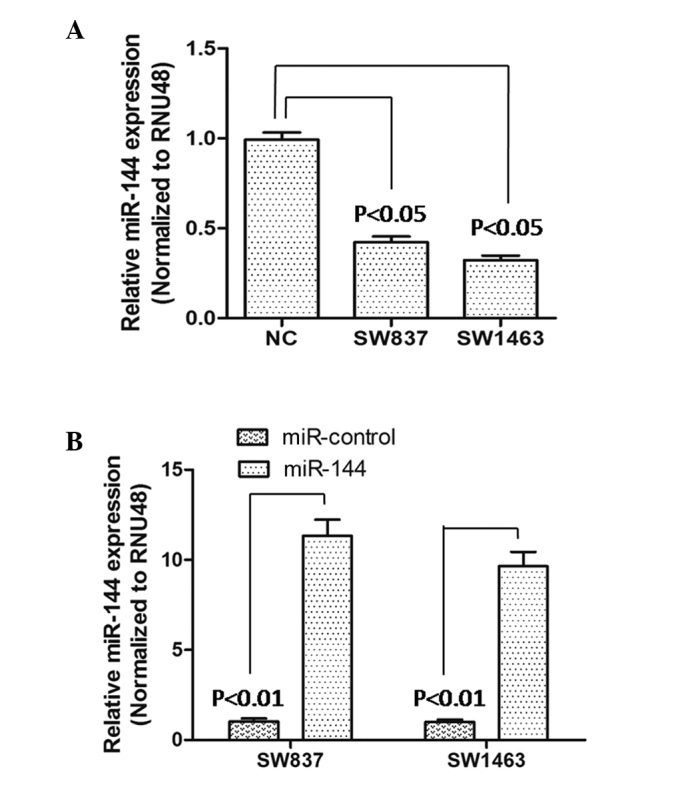
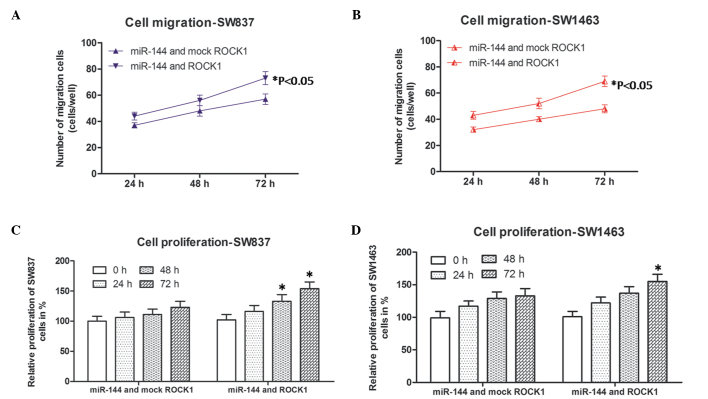
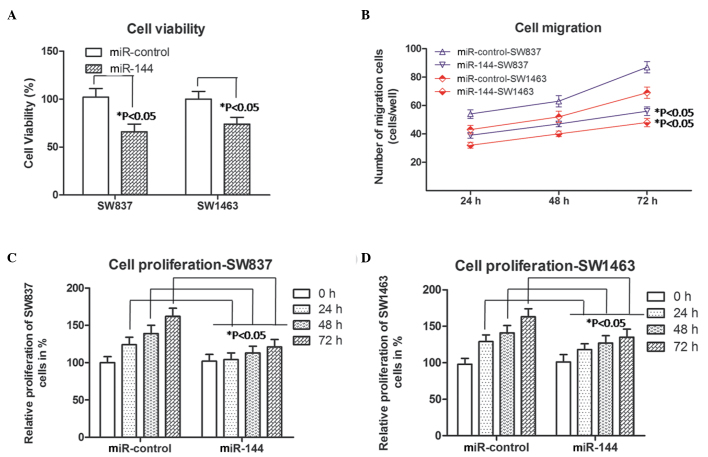
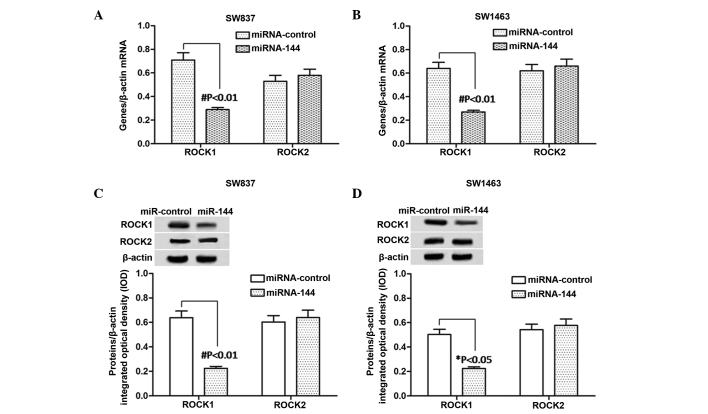
Cancer of the colon and rectum are two distinct entities, which require different treatment strategies and separate treatment. MicroRNAs (miRNAs) act as critical regulators of genes involved in several biological processes. Aberrant alterations of miRNAs have been found in several types of cancer, including colon cancer and rectal cancer. Extensive catalogues of downregulated miRNAs have been identified for colon cancer, whereas only limited data are available for rectal cancer. An example of miRNA profiling in a previous study found that miRNA (miR)‑144 showed aberrant expression and appeared to be rectal cancer‑specific, its expression not being reported in colon cancer. In the present study, the role of miR‑144 in rectal cancer was investigated. SW837 and SW1463 cell lines were selected as rectal cell carcinoma cells. Using reverse transcription-quantitative polymerase chain reaction, western blot, BrdU, cell migration and cell viability assays, it was found that the expression levels of miR‑144 were significantly reduced in the SW837 and SW1463 cell lines, and the overexpression of miR‑144 suppressed rectal cancer cell viability, migration and proliferation. In addition, Rho‑associated coiled‑coil containing protein kinase 1 (ROCK1) was identified as a target of miR‑144 in the rectal cancer cells. The supplementation of ROCK1 markedly restored the cell migration and proliferation, which was inhibited by miR‑144. Together, the data of the present study demonstrated that miR‑144 acts as a tumor suppressor by targeting ROCK1, and indicates the potential of miR‑144 as a novel biomarker and target in the treatment of rectal cancer.
结肠癌和直肠癌是两种不同的疾病,需要不同的治疗策略和单独的治疗方法。微小RNA(miRNA)作为参与多种生物学过程的基因的关键调节因子。在包括结肠癌和直肠癌在内的几种癌症中发现了miRNA的异常改变。已经确定了大量下调的miRNA用于结肠癌,而关于直肠癌的数据有限。先前一项研究中的miRNA谱分析示例发现,miRNA(miR)-144表现出异常表达,似乎是直肠癌特异性的,其在结肠癌中未被报道。在本研究中,研究了miR-144在直肠癌中的作用。选择SW837和SW1463细胞系作为直肠癌细胞。通过逆转录定量聚合酶链反应、蛋白质印迹、BrdU、细胞迁移和细胞活力测定,发现SW837和SW1463细胞系中miR-1十四4的表达水平显著降低,miR-144的过表达抑制了直肠癌细胞的活力、迁移和增殖。此外,含Rho相关卷曲螺旋的蛋白激酶1(ROCK1)被确定为直肠癌细胞中miR-144的靶标。补充ROCK1显著恢复了被miR-144抑制的细胞迁移和增殖。总之,本研究的数据表明,miR-144通过靶向ROCK1发挥肿瘤抑制作用,并表明miR-144作为直肠癌治疗中的新型生物标志物和靶点的潜力。