Esen Ebru, Sizmaz Selcuk, Demircan Nihal
Department of Ophthalmolgy, School of Medicine, Çukurova University, Adana, Turkey.
Indian J Ophthalmol. 2015 Jul;63(7):616-8. doi: 10.4103/0301-4738.167121.
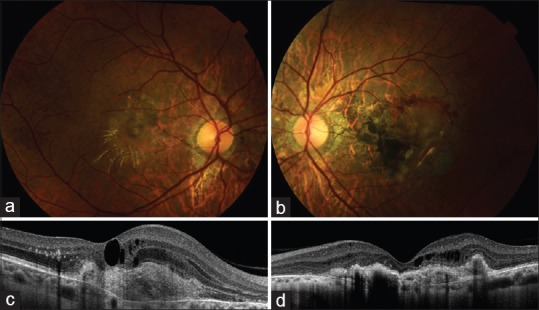
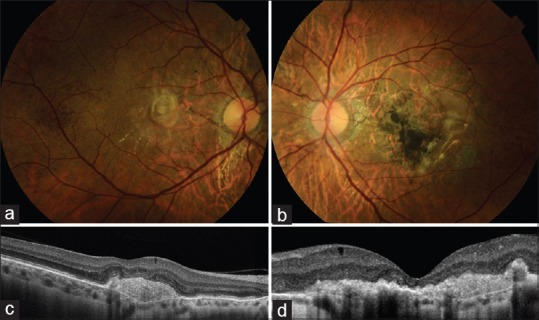
In this study, we reported the clinical results of switching from ranibizumab to aflibercept for the treatment of an insufficient responder with choroidal neovascularization (CNV) secondary to angioid streaks (AS). A 39-year-old female patient with CNV secondary to AS had bilateral persistent intraretinal and subretinal fluid on the optical coherence tomography despite prior intravitreal 0.5 mg ranibizumab injections. The therapy was switched to intravitreal injection of aflibercept. The patient received a loading dose of three intravitreal 2 mg aflibercept injections at 4-week intervals for both eyes. Morphological and functional effects were observed as early as 1-week after the first injection. After the third aflibercept injection, her visual acuity improved, intraretinal and subretinal fluid resolved, and central macular thickness reduced in both eyes. This is an early, but encouraging and promising result indicating that aflibercept might be a good alternative management for CNV secondary to AS that is insufficiently responding to prior ranibizumab injections.
在本研究中,我们报告了将雷珠单抗转换为阿柏西普治疗血管样条纹(AS)继发脉络膜新生血管(CNV)反应不足患者的临床结果。一名39岁女性患者,继发于AS的CNV,尽管之前玻璃体内注射过0.5mg雷珠单抗,但光学相干断层扫描显示双眼仍存在持续性视网膜内和视网膜下液。治疗改为玻璃体内注射阿柏西普。患者双眼每隔4周接受3次玻璃体内注射2mg阿柏西普的负荷剂量。早在首次注射后1周就观察到了形态学和功能效应。第三次注射阿柏西普后,她的视力提高,视网膜内和视网膜下液消退,双眼黄斑中心厚度降低。这是一个早期但令人鼓舞且有前景的结果,表明阿柏西普可能是AS继发CNV对先前雷珠单抗注射反应不足的一种良好替代治疗方法。