Department of Health and Social Care, The Open University, Walton Hall, Milton Keynes, MK7 6AA, UK.
Department of Psychological Medicine, School of Medicine, Level 12 Auckland City Hospital Support Building, University of Auckland, Private Bag 92019, Auckland, 1142, New Zealand.
Trials. 2015 Oct 12;16:457. doi: 10.1186/s13063-015-0982-9.
Mental health disorders are common and disabling for young people because of the potential to disrupt key developmental tasks. Implementation of evidence-based psychosocial therapies in New Zealand is limited, owing to the inaccessibility, length, and cost of training in these therapies. Furthermore, most therapies address one problem area at a time, although comorbidity and changing clinical needs commonly occur in practice. A more flexible approach is needed. The Modular Approach to Therapy for Children with Anxiety, Depression, Trauma, or Conduct Problems (MATCH-ADTC) is designed to overcome these challenges; it provides a range of treatment modules addressing different problems, within a single training program. A clinical trial of MATCH-ADTC in the USA showed that MATCH-ADTC outperformed usual care and standard evidence-based treatment on several clinical measures. We aim to replicate these findings and evaluate the impact of providing training and supervision in MATCH-ADTC to: (1) improve clinical outcomes for youth attending mental health services; (2) increase the amount of evidence-based therapy content; (3) increase the efficiency of service delivery.
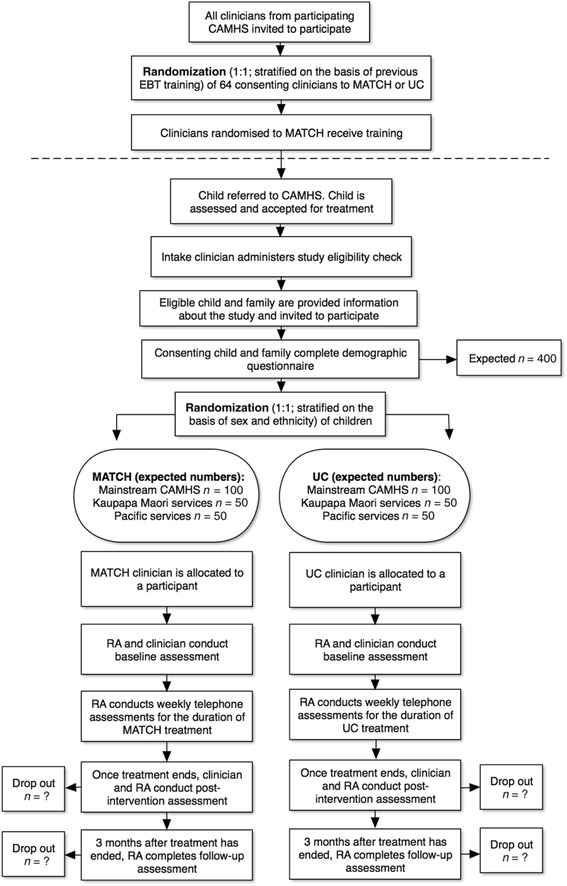
This is an assessor-blinded multi-site effectiveness randomized controlled trial. Randomization occurs at two levels: (1) clinicians (≥60) are randomized to intervention or usual care; (2) youth participants (7-14 years old) accepted for treatment in child and adolescent mental health services (with a primary disorder that includes anxiety, depression, trauma-related symptoms, or disruptive behavior) are randomly allocated to receive MATCH-ADTC or usual care. Youth participants are recruited from 'mainstream', Māori-specific, and Pacific-specific child and adolescent mental health services. We originally planned to recruit 400 youth participants, but this has been revised to 200 participants. Centralized computer randomization ensures allocation concealment. The primary outcome measures are: (i) the difference in trajectory of change of clinical severity between groups (using the parent-rated Brief Problem Monitor); (ii) clinicians' use of evidence-based treatment procedures during therapy sessions; (iii) total time spent by clinicians delivering therapy.
If MATCH-ADTC demonstrates effectiveness it could offer a practical efficient method to increase access to evidence-based therapies, and improve outcomes for youth attending secondary care services.
Australian and New Zealand Clinical Trials Registry ACTRN12614000297628 .
由于可能会干扰关键的发展任务,心理健康障碍在年轻人中很常见且会致残。由于这些疗法的不可及性、培训的长度和成本,新西兰实施基于证据的心理社会疗法受到限制。此外,尽管在实践中通常会出现共病和不断变化的临床需求,但大多数疗法一次只解决一个问题领域。需要更灵活的方法。儿童焦虑、抑郁、创伤或行为问题的模块化治疗方法(MATCH-ADTC)旨在克服这些挑战;它提供了一系列治疗模块,针对不同的问题,在单个培训计划中。在美国对 MATCH-ADTC 的临床试验表明,MATCH-ADTC 在多项临床指标上优于常规护理和标准循证治疗。我们旨在复制这些发现,并评估提供 MATCH-ADTC 的培训和监督对以下方面的影响:(1)改善接受心理健康服务的年轻人的临床结果;(2)增加循证治疗内容的数量;(3)提高服务提供的效率。
这是一项评估者盲法多地点有效性随机对照试验。随机化发生在两个层面上:(1)临床医生(≥60 岁)随机分配到干预组或常规护理组;(2)接受儿童和青少年心理健康服务治疗的青年参与者(7-14 岁,主要障碍包括焦虑、抑郁、创伤相关症状或行为障碍)被随机分配接受 MATCH-ADTC 或常规护理。青年参与者是从“主流”、毛利人特定和太平洋特定的儿童和青少年心理健康服务中招募的。我们最初计划招募 400 名青年参与者,但已修订为 200 名参与者。集中式计算机随机化确保了分配的隐藏。主要结局指标是:(i)两组之间临床严重程度变化轨迹的差异(使用父母评定的简短问题监测器);(ii)临床医生在治疗期间使用循证治疗程序的情况;(iii)临床医生提供治疗的总时间。
如果 MATCH-ADTC 证明有效,它可以提供一种实用高效的方法来增加对循证治疗的可及性,并改善接受二级保健服务的年轻人的结果。
澳大利亚和新西兰临床试验注册 ACTRN12614000297628 。