Li Hong-Jun, Bai Wen-Jun, Dai Yu-Tian, Xu Wen-Ping, Wang Chia-Ning, Li Han-Zhong
Department of Urology, Peking Union Medical College Hospital, Beijing 100730, China.
Department of Urology, Peking University People's Hospital, Beijing 100044, China.
Asian J Androl. 2016 Sep-Oct;18(5):773-9. doi: 10.4103/1008-682X.159719.
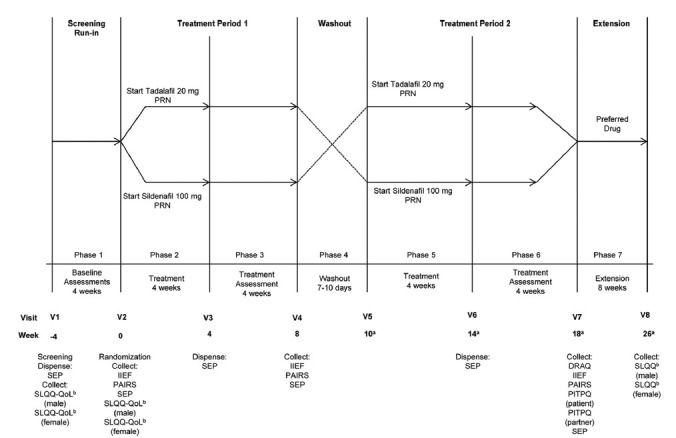
The impact of erectile dysfunction is distressing to both males and their female partners, but less attention has been paid to identify female partners' preferred treatment and sexual quality of life outcomes. The present analysis explores female partners' treatment preference for erectile dysfunction in Chinese Men. This was a phase 4, randomized, open-label, multicenter, crossover study in Chinese men with erectile dysfunction who were naïve to phosphodiesterase type 5 inhibitor treatments. Eligible patients were randomized to sequential 20-mg tadalafil/100-mg sildenafil or 100-mg sildenafil/20-mg tadalafil for 8 weeks each. Of 418 patients, female partners of 64 patients agreed to enter the study; of 64 patients who entered the study with female partners, 63 were randomized, and 62 completed the study. Baseline demographics and disease characteristics were comparable between treatment groups. Significantly more couples preferred tadalafil compared with sildenafil overall (75.4% vs 24.6%; P < 0.001), and irrespective of erectile dysfunction severity at baseline (P ≤ 0.005). Significant improvements in sexual quality of life scores were reported at endpoint (Visit 8) in male patients and female partners in both tadalafil and sildenafil treatment groups (P < 0.001). Significantly higher mean changes from baseline were observed for male patients in the tadalafil group compared with the sildenafil group for the erectile function (P = 0.013) and overall satisfaction (P = 0.019) International Index for Erectile Function domains and the spontaneity domain (P < 0.001) of the Psychological and Interpersonal Relationship Scale. No major safety concerns were reported during the study. Though both treatments were effective, safe, and tolerable, more couples preferred tadalafil compared with sildenafil.
勃起功能障碍对男性及其女性伴侣都会造成困扰,但对于确定女性伴侣偏爱的治疗方法以及性生活质量结果,人们关注较少。本分析探讨了中国男性勃起功能障碍患者女性伴侣的治疗偏好。这是一项针对未接受过5型磷酸二酯酶抑制剂治疗的中国勃起功能障碍男性患者的4期随机、开放标签、多中心交叉研究。符合条件的患者被随机分为两组,分别依次接受20毫克他达拉非/100毫克西地那非或100毫克西地那非/20毫克他达拉非治疗,每组治疗8周。在418名患者中,64名患者的女性伴侣同意参与研究;在这64名有女性伴侣参与研究的患者中,63名被随机分组,62名完成了研究。治疗组之间的基线人口统计学和疾病特征具有可比性。总体而言,与西地那非相比,更多夫妻更喜欢他达拉非(75.4%对24.6%;P<0.001),且与基线时勃起功能障碍的严重程度无关(P≤0.005)。在他达拉非和西地那非治疗组中,男性患者及其女性伴侣在研究终点(第8次访视)时的性生活质量评分均有显著改善(P<0.001)。与西地那非组相比,他达拉非组男性患者在勃起功能(P=0.013)、总体满意度(P=0.019)的国际勃起功能指数领域以及心理和人际关系量表的自发性领域(P<0.001)方面,从基线开始的平均变化显著更高。研究期间未报告重大安全问题。虽然两种治疗方法都有效、安全且耐受性良好,但与西地那非相比,更多夫妻更喜欢他达拉非。