Hammond Gerald R V, Takasuga Shunsuke, Sasaki Takehiko, Balla Tamas
Department of Cell Biology, University of Pittsburgh School of Medicine, Pittsburgh, PA, United States of America; Program in Developmental Neuroscience, Eunice Kennedy Shriver National Institute of Child Health and Human Development, National Institutes of Health, Bethesda, MD, 20892, United States of America.
Department of Medical Biology, Graduate School of Medicine, Akita University, Akita, Japan.
PLoS One. 2015 Oct 13;10(10):e0139957. doi: 10.1371/journal.pone.0139957. eCollection 2015.
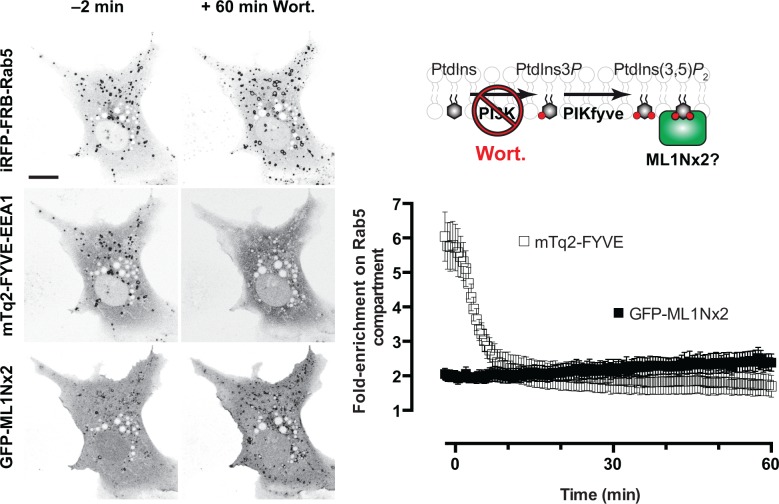
Phosphatidylinositol (3,5)-bisphosphate (PtdIns(3,5)P2) is a quantitatively minor phospholipid in eukaryotic cells that plays a fundamental role in regulating endocytic membrane traffic. Despite its clear importance for cellular function and organism physiology, mechanistic details of its biology have so far not been fully elucidated. In part, this is due to a lack of experimental tools that specifically probe for PtdIns(3,5)P2 in cells to unambiguously identify its dynamics and site(s) of action. In this study, we have evaluated a recently reported PtdIns(3,5)P2 biosensor, GFP-ML1Nx2, for its veracity as such a probe. We report that, in live cells, the localization of this biosensor to sub-cellular compartments is largely independent of PtdIns(3,5)P2, as assessed after pharmacological, chemical genetic or genomic interventions that block the lipid's synthesis. We therefore conclude that it is unwise to interpret the localization of ML1Nx2 as a true and unbiased biosensor for PtdIns(3,5)P2.
磷脂酰肌醇(3,5)-二磷酸(PtdIns(3,5)P2)是真核细胞中一种含量较少的磷脂,在调节内吞膜运输中起重要作用。尽管其对细胞功能和生物体生理功能的重要性已明确,但迄今为止其生物学机制细节尚未完全阐明。部分原因在于缺乏能在细胞中特异性探测PtdIns(3,5)P2以明确识别其动态变化和作用位点的实验工具。在本研究中,我们评估了最近报道的一种PtdIns(3,5)P2生物传感器GFP-ML1Nx2作为此类探针的准确性。我们报告称,在活细胞中,经药理学、化学遗传学或基因组干预阻断该脂质合成后评估发现,这种生物传感器在亚细胞区室中的定位很大程度上独立于PtdIns(3,5)P2。因此,我们得出结论,将ML1Nx2的定位解释为PtdIns(3,5)P2的真实且无偏倚的生物传感器是不明智的。