Cai Yiying, Leck Hui, Lim Tze Peng, Teo Jocelyn, Lee Winnie, Hsu Li Yang, Koh Tse Hsien, Tan Thuan Tong, Tan Thean-Yen, Kwa Andrea Lay-Hoon
Department of Pharmacy, Singapore General Hospital, Singapore, Singapore.
Department of Infectious Diseases, National University Health Systems, Singapore, Singapore.
PLoS One. 2015 Oct 13;10(10):e0140446. doi: 10.1371/journal.pone.0140446. eCollection 2015.
Current in vitro combination testing methods involve enumeration by bacterial plating, which is labor-intensive and time-consuming. Measurement of bioluminescence, released when bacterial adenosine triphosphate binds to firefly luciferin-luciferase, has been proposed as a surrogate for bacterial counts. We developed an ATP bioluminescent combination testing assay with a rapid turnaround time of 24h to determine effective antibiotic combinations.
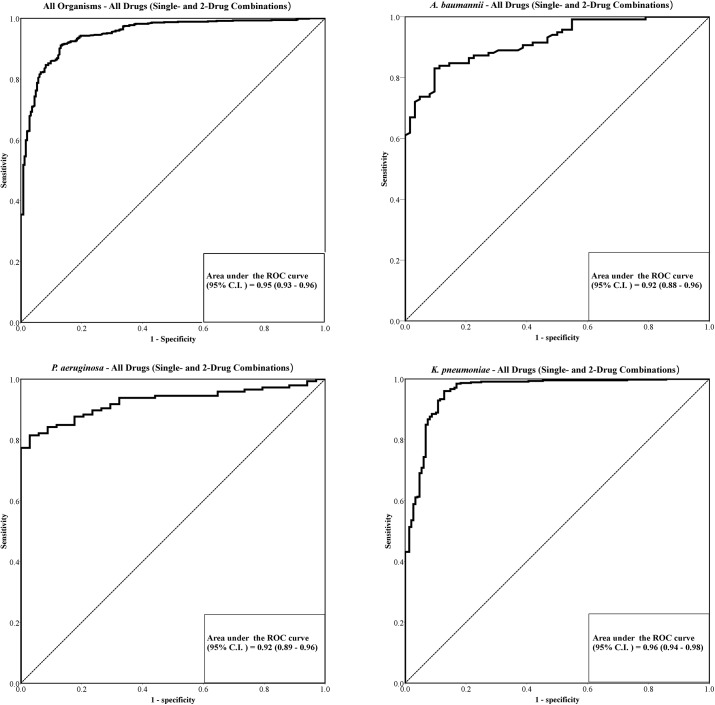
100 strains of carbapenem-resistant (CR) GNB [30 Acinetobacter baumannii (AB), 30 Pseudomonas aeruginosa (PA) and 40 Klebsiella pneumoniae (KP)] were used. Bacterial suspensions (105 CFU/ml) were added to 96-well plates containing clinically achievable concentrations of multiple single and two-antibiotic combinations. At 24h, the luminescence intensity of each well was measured. Receiver operator characteristic curves were plotted to determine optimal luminescence threshold (TRLU) to discriminate between inhibitory/non-inhibitory combinations when compared to viable plating. The unweighted accuracy (UA) [(sensitivity + specificity)/2] of TRLU values was determined. External validation was further done using 50 additional CR-GNB.
Predictive accuracies of TRLU were high for when all antibiotic combinations and species were collectively analyzed (TRLU = 0.81, UA = 89%). When individual thresholds for each species were determined, UA remained high. Predictive accuracy was highest for KP (TRLU = 0.81, UA = 91%), and lowest for AB (TRLU = 0.83, UA = 87%). Upon external validation, high overall accuracy (91%) was observed. The assay distinguished inhibitory/non-inhibitory combinations with UA of 80%, 94% and 93% for AB, PA and KP respectively.
We developed an assay that is robust at identifying useful combinations with a rapid turn-around time of 24h, and may be employed to guide the timely selection of effective antibiotic combinations.
当前的体外联合检测方法涉及通过细菌平板计数,这既费力又耗时。有人提出,当细菌三磷酸腺苷与萤火虫荧光素 - 荧光素酶结合时释放的生物发光测量可作为细菌计数的替代方法。我们开发了一种周转时间为24小时的快速ATP生物发光联合检测方法,以确定有效的抗生素组合。
使用了100株耐碳青霉烯类革兰氏阴性菌(CR - GNB)[30株鲍曼不动杆菌(AB)、30株铜绿假单胞菌(PA)和40株肺炎克雷伯菌(KP)]。将细菌悬液(105 CFU/ml)加入含有临床可达到浓度的多种单一抗生素和两种抗生素组合的96孔板中。24小时后,测量每个孔的发光强度。绘制受试者工作特征曲线,以确定与活菌平板计数相比,区分抑制性/非抑制性组合的最佳发光阈值(TRLU)。确定TRLU值的未加权准确性(UA)[(敏感性 + 特异性)/2]。使用另外50株CR - GNB进行进一步的外部验证。
当对所有抗生素组合和菌种进行综合分析时,TRLU的预测准确性很高(TRLU = 0.81,UA = 89%)。当确定每个菌种的个体阈值时,UA仍然很高。KP的预测准确性最高(TRLU = 0.81,UA = 91%),AB的最低(TRLU = 0.83,UA = 87%)。经过外部验证,观察到总体准确性较高(91%)。该检测方法区分抑制性/非抑制性组合的UA分别为AB的80%、PA的94%和KP的93%。
我们开发了一种检测方法,该方法在识别有用组合方面表现稳健,周转时间为24小时,可用于指导及时选择有效的抗生素组合。