Zeidan A M, Sekeres M A, Garcia-Manero G, Steensma D P, Zell K, Barnard J, Ali N A, Zimmerman C, Roboz G, DeZern A, Nazha A, Jabbour E, Kantarjian H, Gore S D, Maciejewski J P, List A, Komrokji R
Department of Internal Medicine, Section of Hematology, Yale Comprehensive Cancer Center, Yale University, New Haven, CT, USA.
Leukemia Program, Department of Translational Hematology and Oncology Research, Cleveland Clinic, Cleveland, OH, USA.
Leukemia. 2016 Mar;30(3):649-57. doi: 10.1038/leu.2015.283. Epub 2015 Oct 14.
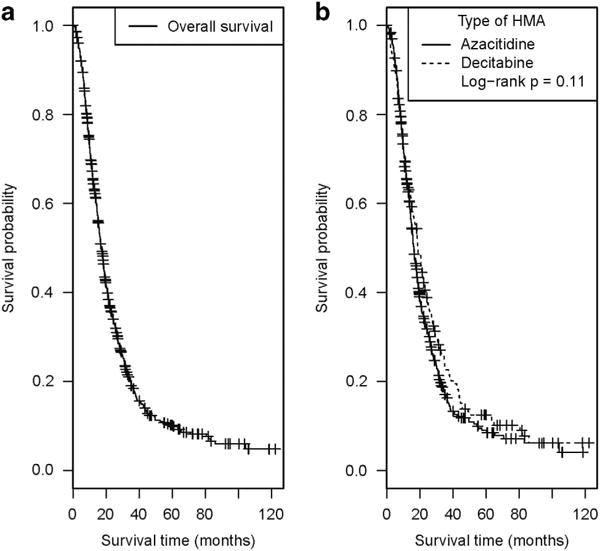
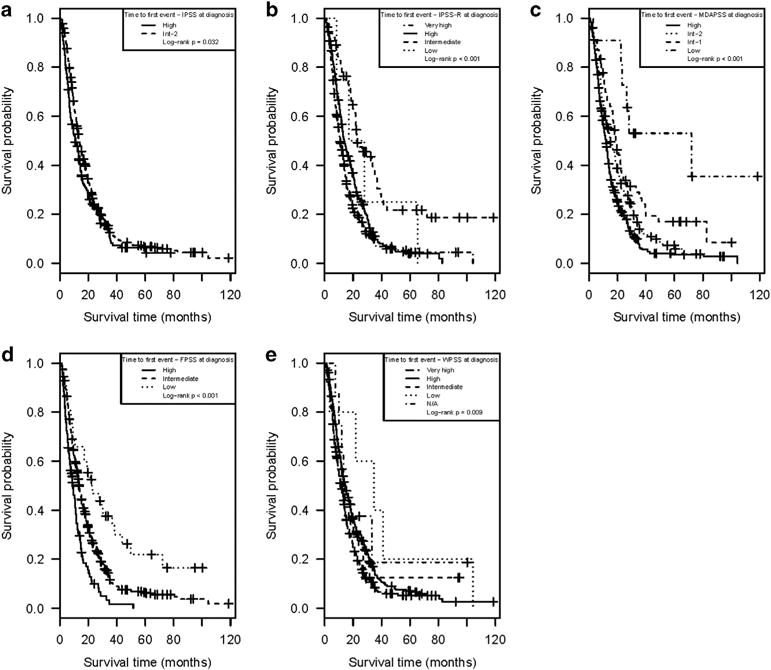
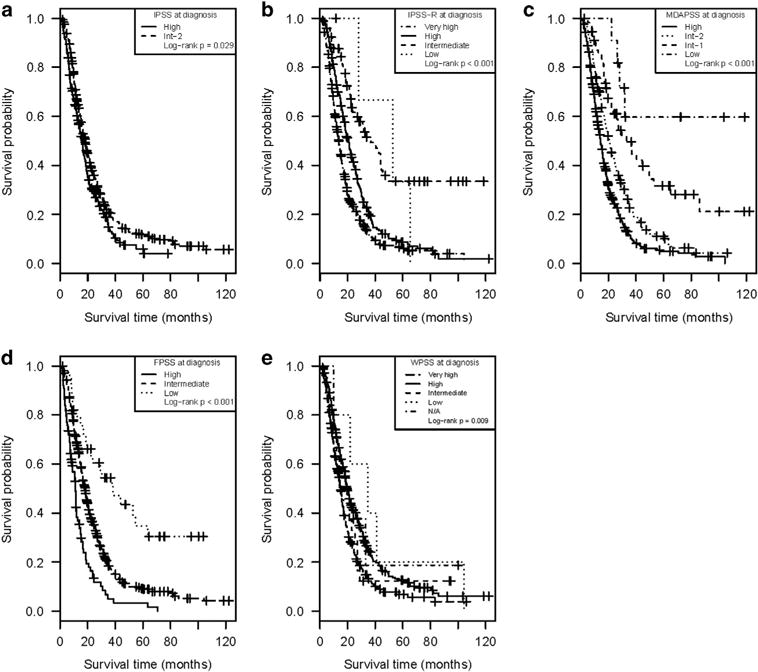
Established prognostic tools in patients with myelodysplastic syndromes (MDS) were largely derived from untreated patient cohorts. Although azanucleosides are standard therapies for higher-risk (HR)-MDS, the relative prognostic performance of existing prognostic tools among patients with HR-MDS receiving azanucleoside therapy is unknown. In the MDS Clinical Research Consortium database, we compared the prognostic utility of the International Prognostic Scoring System (IPSS), revised IPSS (IPSS-R), MD Anderson Prognostic Scoring System (MDAPSS), World Health Organization-based Prognostic Scoring System (WPSS) and the French Prognostic Scoring System (FPSS) among 632 patients who presented with HR-MDS and were treated with azanucleosides as the first-line therapy. Median follow-up from diagnosis was 15.7 months. No prognostic tool predicted the probability of achieving an objective response. Nonetheless, all five tools were associated with overall survival (OS, P=0.025 for the IPSS, P=0.011 for WPSS and P<0.001 for the other three tools). The corrected Akaike Information Criteria, which were used to compare OS with the different prognostic scoring systems as covariates (lower is better) were 4138 (MDAPSS), 4156 (FPSS), 4196 (IPSS-R), 4186 (WPSS) and 4196 (IPSS). Patients in the highest-risk groups of the prognostic tools had a median OS from diagnosis of 11-16 months and should be considered for up-front transplantation or experimental approaches.
骨髓增生异常综合征(MDS)患者中已确立的预后工具大多来自未经治疗的患者队列。虽然氮杂核苷是高危(HR)-MDS的标准疗法,但现有预后工具在接受氮杂核苷治疗的HR-MDS患者中的相对预后性能尚不清楚。在MDS临床研究联盟数据库中,我们比较了国际预后评分系统(IPSS)、修订后的IPSS(IPSS-R)、MD安德森预后评分系统(MDAPSS)、世界卫生组织预后评分系统(WPSS)和法国预后评分系统(FPSS)在632例表现为HR-MDS并接受氮杂核苷作为一线治疗的患者中的预后效用。从诊断开始的中位随访时间为15.7个月。没有预后工具能预测达到客观缓解的概率。尽管如此,所有这五种工具都与总生存期(OS)相关(IPSS的P = 0.025,WPSS的P = 0.011,其他三种工具的P < 0.001)。用于将OS与不同预后评分系统作为协变量进行比较的校正后赤池信息准则(越低越好)分别为4138(MDAPSS)、4156(FPSS)、4196(IPSS-R)、4186(WPSS)和4196(IPSS)。预后工具中最高风险组的患者从诊断开始的中位OS为11 - 16个月,应考虑进行早期移植或实验性治疗方法。