Hameed Saif, Pal Rahul, Fatima Zeeshan
Amity Institute of Biotechnology, Amity University Haryana, Gurgaon (Manesar)-122413, India.
Open Microbiol J. 2015 Aug 31;9:91-7. doi: 10.2174/1874285801509010091. eCollection 2015.
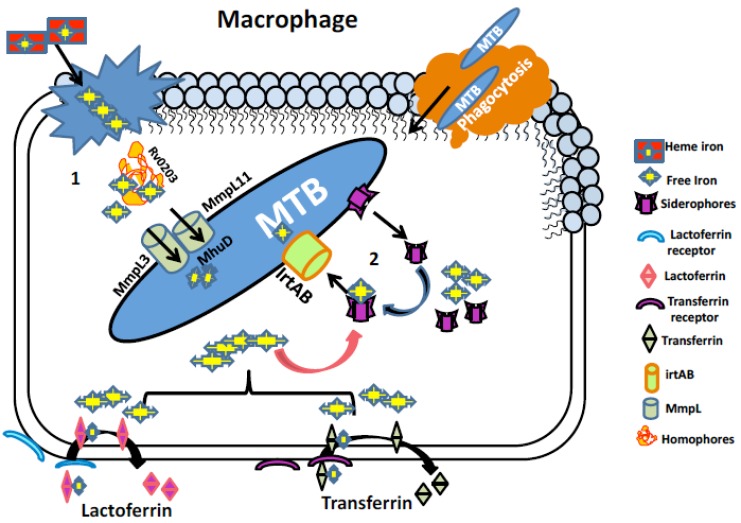
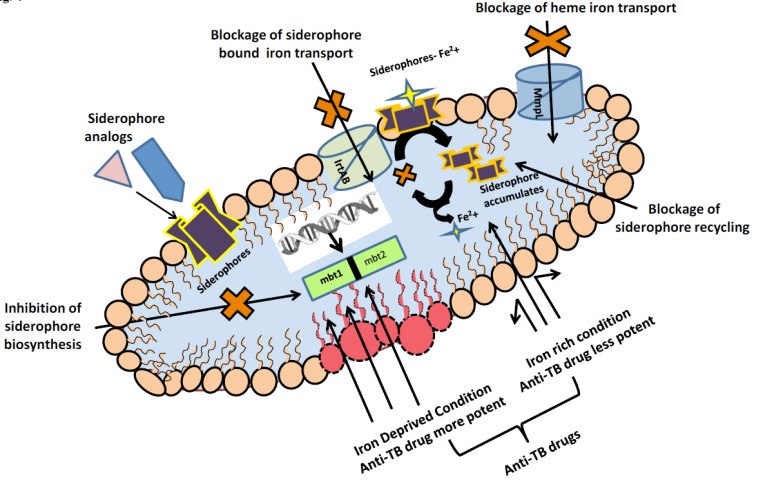
Continuous deployment of antitubercular drugs in treating Tuberculosis (TB) caused by Mycobacterium tuberculosis (MTB) has led to the emergence of drug resistance resulting in cross-resistance to many unrelated drugs, a phenomenon termed as Multi-Drug Resistance (MDR-TB). Despite reasonable documentation of major factors which contribute to MDR mechanisms, it appears unavoidable to consider novel mechanisms combating MDR. The ability of pathogenic MTB, to sense and become accustomed to changes in the host environment is essential for its survival and confers the basis of their success as dreadful pathogen. One such significant environmental factor that MTB must surmount is iron limitation, since they encounter diverse anatomical sites during the establishment of infection within the host. Considering the importance of MTB, being the second most common cause of mortality, this review focuses on gaining insights of iron acquisition mechanisms in MTB and how it can be exploited as efficient anti-mycobacterial drug target.
在治疗由结核分枝杆菌(MTB)引起的结核病(TB)过程中持续使用抗结核药物,已导致耐药性的出现,进而产生对许多不相关药物的交叉耐药性,这一现象被称为多重耐药结核病(MDR-TB)。尽管对导致MDR机制的主要因素已有合理记录,但考虑对抗MDR的新机制似乎是不可避免的。致病性MTB感知并适应宿主环境变化的能力对其生存至关重要,也是其作为可怕病原体成功的基础。MTB必须克服的一个重要环境因素是铁限制,因为它们在宿主体内建立感染过程中会遇到不同的解剖部位。鉴于MTB作为第二大致死原因的重要性,本综述着重深入了解MTB中的铁获取机制以及如何将其开发为有效的抗分枝杆菌药物靶点。