Abroun Saeid, Saki Najmaldin, Ahmadvand Mohammad, Asghari Farahnaz, Salari Fatemeh, Rahim Fakher
Department of Hematology, Faculty of Medical Sciences, Tarbiat Modares University, Tehran, Iran.
Health Research Institute, Research Center of Thalassemia and Hemoglobinopathy, Jundishapur University of Medical Sciences, Ahvaz, Iran.
Cell J. 2015 Fall;17(3):395-411. doi: 10.22074/cellj.2015.1. Epub 2015 Oct 7.
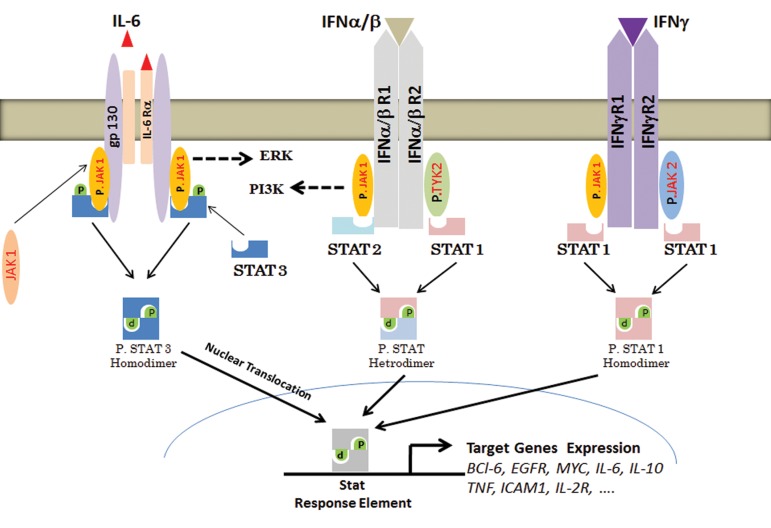
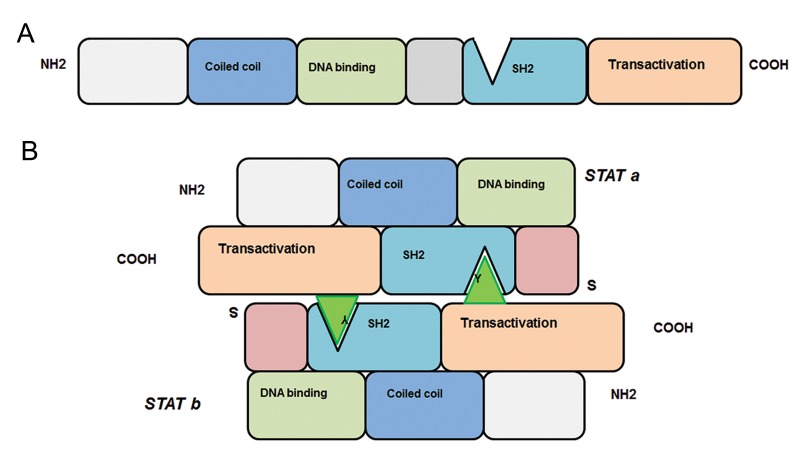
Signal transducers and activators of transcription (STATs) are cytoplasmic transcription factors that have a key role in cell fate. STATs, a protein family comprised of seven members, are proteins which are latent cytoplasmic transcription factors that convey signals from the cell surface to the nucleus through activation by cytokines and growth factors. The signaling pathways have diverse biological functions that include roles in cell differentiation, proliferation, development, apoptosis, and inflammation which place them at the center of a very active area of research. In this review we explain Janus kinase (JAK)/STAT signaling and focus on STAT3, which is transient from cytoplasm to nucleus after phosphorylation. This procedure controls fundamental biological processes by regulating nuclear genes controlling cell proliferation, survival, and development. In some hematopoietic disorders and cancers, overexpression and activation of STAT3 result in high proliferation, suppression of cell differentiation and inhibition of cell maturation. This article focuses on STAT3 and its role in malignancy, in addition to the role of microRNAs (miRNAs) on STAT3 activation in certain cancers.
信号转导与转录激活因子(STATs)是一类在细胞命运决定中起关键作用的细胞质转录因子。STATs是一个由七个成员组成的蛋白质家族,是潜在的细胞质转录因子,可通过细胞因子和生长因子的激活将信号从细胞表面传递至细胞核。这些信号通路具有多种生物学功能,包括在细胞分化、增殖、发育、凋亡和炎症中发挥作用,这使其处于一个非常活跃的研究领域的核心位置。在本综述中,我们将解释JAK/STAT信号传导,并重点关注STAT3,它在磷酸化后从细胞质短暂转移至细胞核。这一过程通过调节控制细胞增殖、存活和发育的核基因来控制基本的生物学过程。在某些血液系统疾病和癌症中,STAT3的过度表达和激活会导致高增殖、细胞分化抑制和细胞成熟抑制。本文除了关注微小RNA(miRNAs)在某些癌症中对STAT3激活的作用外,还重点探讨了STAT3及其在恶性肿瘤中的作用。