Ivashkiv Lionel B, Hu Xiaoyu
Arthritis and Tissue Degeneration Program, Hospital for Special Surgery, Graduate Program in Immunology, Weill Graduate School of Medical Sciences of Cornell University, New York, New York, USA.
Arthritis Res Ther. 2004;6(4):159-68. doi: 10.1186/ar1197. Epub 2004 Jun 21.
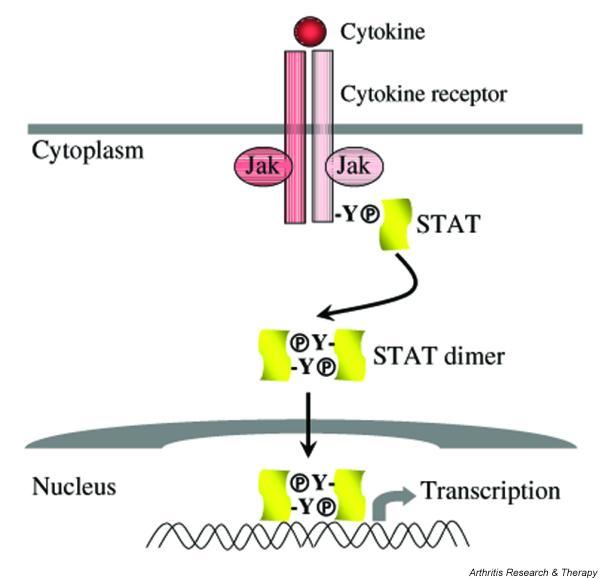
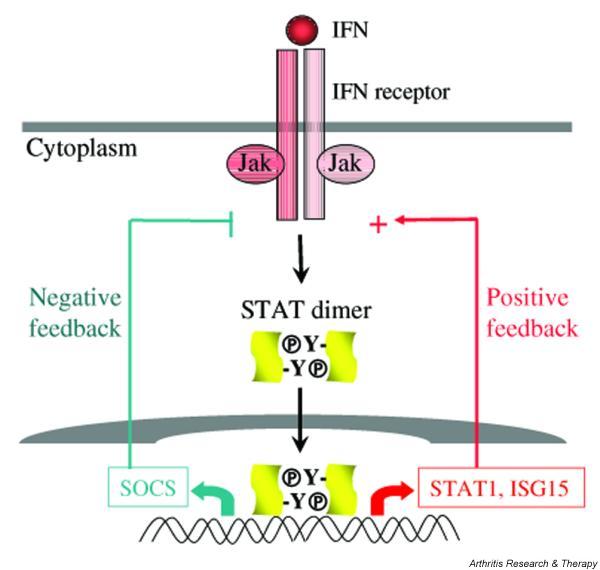
A variety of cytokines and growth factors use the Janus kinase (Jak)-STAT signaling pathway to transmit extracellular signals to the nucleus. STATs (signal transducers and activators of transcription) are latent cytoplasmic transcription factors. There are seven mammalian STATs and they have critical, nonredundant roles in mediating cellular transcriptional responses to cytokines. The physiological roles of STATs have been elucidated by analysis of mice rendered deficient in STAT genes. STAT activation is regulated and can be modulated in a positive or negative fashion; it can be reprogrammed to drive different cellular responses. Several auto-regulatory and signaling crosstalk mechanisms for regulating Jak-STAT signaling have been described. Understanding and manipulation of the function of STATs will help in the development of therapeutic strategies for diseases that are regulated by cytokines.
多种细胞因子和生长因子利用Janus激酶(Jak)-信号转导子和转录激活子(STAT)信号通路将细胞外信号传递至细胞核。STAT是潜在的细胞质转录因子。哺乳动物中有七种STAT,它们在介导细胞对细胞因子的转录反应中发挥关键且不可替代的作用。通过对STAT基因缺陷小鼠的分析,已阐明了STAT的生理作用。STAT的激活受到调控,可通过正向或负向方式进行调节;它可以被重新编程以驱动不同的细胞反应。已经描述了几种用于调节Jak-STAT信号传导的自调节和信号串扰机制。理解和操纵STAT的功能将有助于开发针对由细胞因子调节的疾病的治疗策略。