Peifer Martin, Hertwig Falk, Roels Frederik, Dreidax Daniel, Gartlgruber Moritz, Menon Roopika, Krämer Andrea, Roncaioli Justin L, Sand Frederik, Heuckmann Johannes M, Ikram Fakhera, Schmidt Rene, Ackermann Sandra, Engesser Anne, Kahlert Yvonne, Vogel Wenzel, Altmüller Janine, Nürnberg Peter, Thierry-Mieg Jean, Thierry-Mieg Danielle, Mariappan Aruljothi, Heynck Stefanie, Mariotti Erika, Henrich Kai-Oliver, Gloeckner Christian, Bosco Graziella, Leuschner Ivo, Schweiger Michal R, Savelyeva Larissa, Watkins Simon C, Shao Chunxuan, Bell Emma, Höfer Thomas, Achter Viktor, Lang Ulrich, Theissen Jessica, Volland Ruth, Saadati Maral, Eggert Angelika, de Wilde Bram, Berthold Frank, Peng Zhiyu, Zhao Chen, Shi Leming, Ortmann Monika, Büttner Reinhard, Perner Sven, Hero Barbara, Schramm Alexander, Schulte Johannes H, Herrmann Carl, O'Sullivan Roderick J, Westermann Frank, Thomas Roman K, Fischer Matthias
Department of Translational Genomics, Center of Integrated Oncology Cologne-Bonn, Medical Faculty, University of Cologne, 50931 Cologne, Germany.
Center for Molecular Medicine Cologne (CMMC), University of Cologne, 50931 Cologne, Germany.
Nature. 2015 Oct 29;526(7575):700-4. doi: 10.1038/nature14980. Epub 2015 Oct 14.
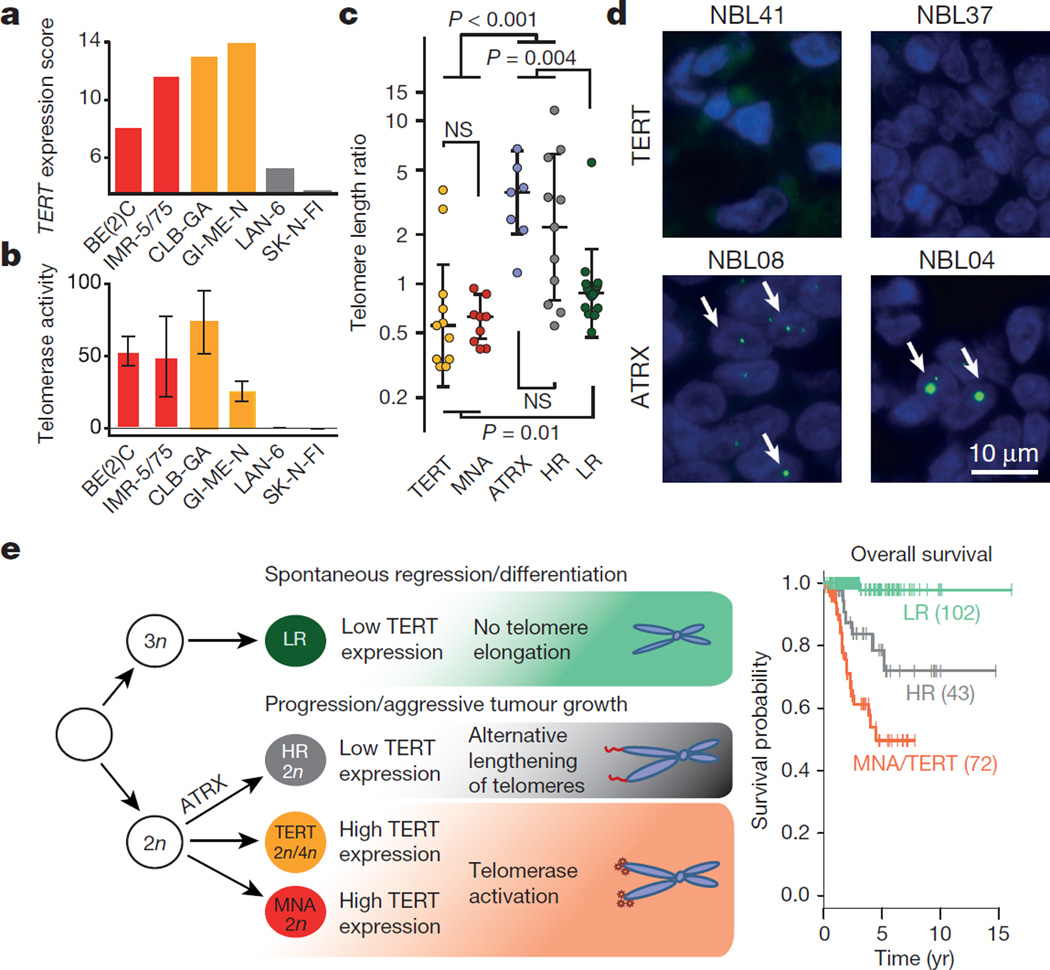
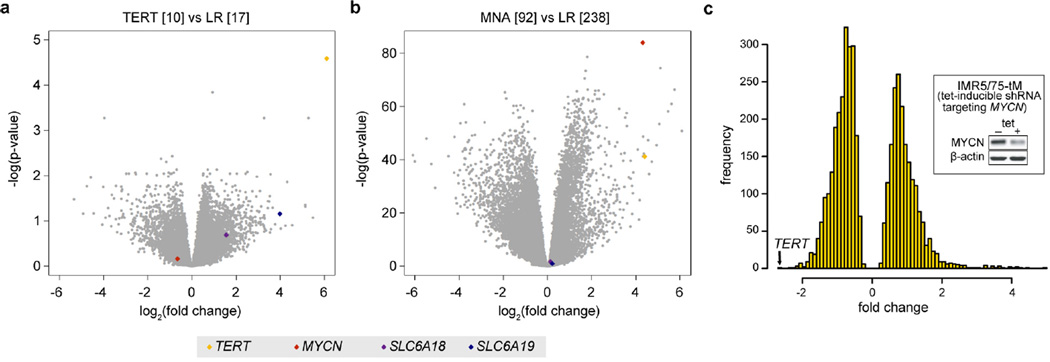
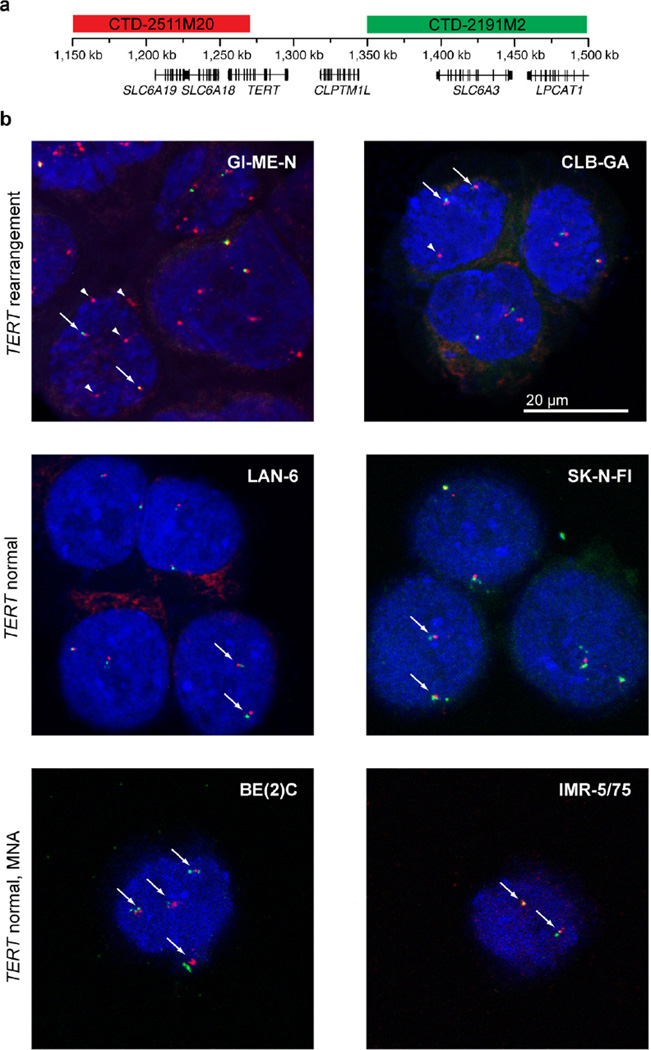
Neuroblastoma is a malignant paediatric tumour of the sympathetic nervous system. Roughly half of these tumours regress spontaneously or are cured by limited therapy. By contrast, high-risk neuroblastomas have an unfavourable clinical course despite intensive multimodal treatment, and their molecular basis has remained largely elusive. Here we have performed whole-genome sequencing of 56 neuroblastomas (high-risk, n = 39; low-risk, n = 17) and discovered recurrent genomic rearrangements affecting a chromosomal region at 5p15.33 proximal of the telomerase reverse transcriptase gene (TERT). These rearrangements occurred only in high-risk neuroblastomas (12/39, 31%) in a mutually exclusive fashion with MYCN amplifications and ATRX mutations, which are known genetic events in this tumour type. In an extended case series (n = 217), TERT rearrangements defined a subgroup of high-risk tumours with particularly poor outcome. Despite a large structural diversity of these rearrangements, they all induced massive transcriptional upregulation of TERT. In the remaining high-risk tumours, TERT expression was also elevated in MYCN-amplified tumours, whereas alternative lengthening of telomeres was present in neuroblastomas without TERT or MYCN alterations, suggesting that telomere lengthening represents a central mechanism defining this subtype. The 5p15.33 rearrangements juxtapose the TERT coding sequence to strong enhancer elements, resulting in massive chromatin remodelling and DNA methylation of the affected region. Supporting a functional role of TERT, neuroblastoma cell lines bearing rearrangements or amplified MYCN exhibited both upregulated TERT expression and enzymatic telomerase activity. In summary, our findings show that remodelling of the genomic context abrogates transcriptional silencing of TERT in high-risk neuroblastoma and places telomerase activation in the centre of transformation in a large fraction of these tumours.
神经母细胞瘤是一种起源于交感神经系统的儿童恶性肿瘤。大约一半的此类肿瘤会自发消退或通过有限的治疗得以治愈。相比之下,高危神经母细胞瘤尽管接受了强化的多模式治疗,其临床病程仍不理想,其分子基础在很大程度上仍不清楚。在此,我们对56例神经母细胞瘤(高危组,n = 39;低危组,n = 17)进行了全基因组测序,发现了影响端粒酶逆转录酶基因(TERT)近端5p15.33染色体区域的复发性基因组重排。这些重排仅发生在高危神经母细胞瘤中(12/39,31%),且与MYCN扩增和ATRX突变以互斥方式出现,而后两者是该肿瘤类型中已知的遗传事件。在一个扩大的病例系列(n = 217)中,TERT重排定义了一个预后特别差的高危肿瘤亚组。尽管这些重排的结构多样性很大,但它们均导致TERT大量转录上调。在其余高危肿瘤中,MYCN扩增的肿瘤中TERT表达也升高,而在无TERT或MYCN改变的神经母细胞瘤中存在端粒替代延长现象,这表明端粒延长是定义该亚型的核心机制。5p15.33重排使TERT编码序列与强增强子元件并列,导致受影响区域发生大规模染色质重塑和DNA甲基化。携带重排或扩增MYCN的神经母细胞瘤细胞系显示TERT表达上调和端粒酶活性增强,这支持了TERT的功能作用。总之,我们的研究结果表明,基因组背景的重塑消除了高危神经母细胞瘤中TERT的转录沉默,并使端粒酶激活成为这些肿瘤中很大一部分发生转化的核心环节。