de Roode Jacobus C, Lefèvre Thierry
Department of Biology, Emory University, 1510 Clifton Road, Atlanta, GA 30322, USA.
MIVEGEC (UM1-UM2-CNRS 5290-IRD 224), Centre IRD, 911 Av. Agropolis-BP 64501, Montpellier 34394, France.
Insects. 2012 Aug 15;3(3):789-820. doi: 10.3390/insects3030789.
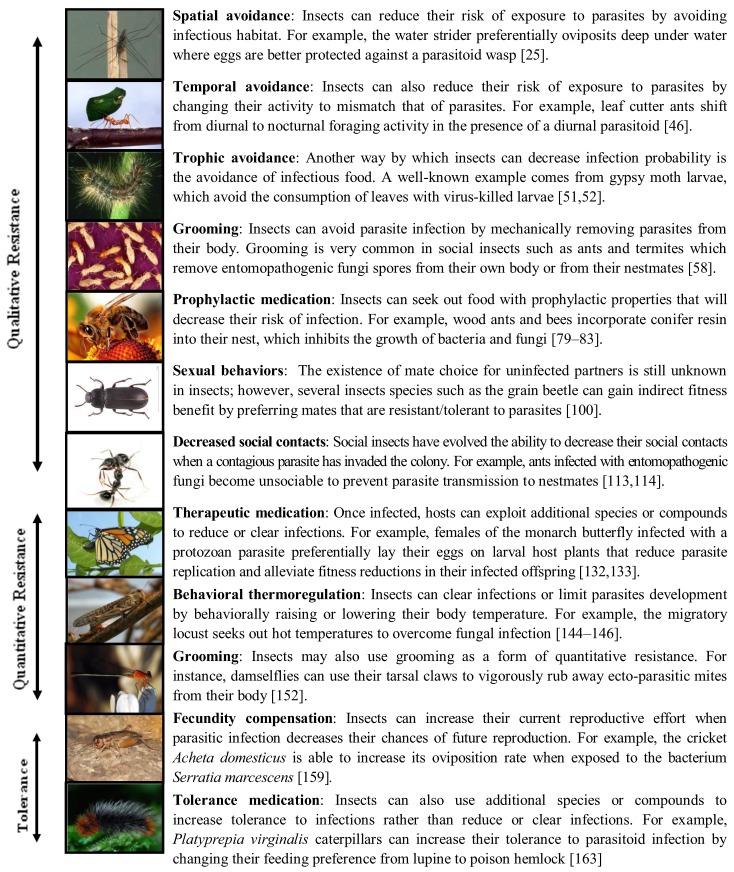
Parasites can dramatically reduce the fitness of their hosts, and natural selection should favor defense mechanisms that can protect hosts against disease. Much work has focused on understanding genetic and physiological immunity against parasites, but hosts can also use behaviors to avoid infection, reduce parasite growth or alleviate disease symptoms. It is increasingly recognized that such behaviors are common in insects, providing strong protection against parasites and parasitoids. We review the current evidence for behavioral immunity in insects, present a framework for investigating such behavior, and emphasize that behavioral immunity may act through indirect rather than direct fitness benefits. We also discuss the implications for host-parasite co-evolution, local adaptation, and the evolution of non-behavioral physiological immune systems. Finally, we argue that the study of behavioral immunity in insects has much to offer for investigations in vertebrates, in which this topic has traditionally been studied.
寄生虫会显著降低其宿主的健康状况,自然选择应会青睐能够保护宿主抵御疾病的防御机制。许多研究工作都集中在了解针对寄生虫的遗传和生理免疫方面,但宿主也可以利用行为来避免感染、减少寄生虫生长或减轻疾病症状。人们越来越认识到,这种行为在昆虫中很常见,能为抵御寄生虫和寄生蜂提供强大保护。我们综述了昆虫行为免疫的现有证据,提出了一个研究此类行为的框架,并强调行为免疫可能通过间接而非直接的适应性益处发挥作用。我们还讨论了其对宿主 - 寄生虫共同进化、局部适应以及非行为生理免疫系统进化的影响。最后,我们认为昆虫行为免疫的研究可为传统上研究该主题的脊椎动物研究提供很多借鉴。