El-Jawhari Jehan J, Sanjurjo-Rodríguez Clara, Jones Elena, Giannoudis Peter V
Academic Unit of Musculoskeletal Disease, Leeds Institute of Rheumatic and Musculoskeletal Medicine, St. James University Hospital, University of Leeds, LS9 7TF, Leeds, United Kingdom.
NIHR, Leeds Biomedical Research Unit, Chapel Allerton Hospital, University of Leeds, LS7 4SA, Leeds, United Kingdom.
J Orthop Res. 2016 Apr;34(4):597-606. doi: 10.1002/jor.23070. Epub 2015 Dec 1.
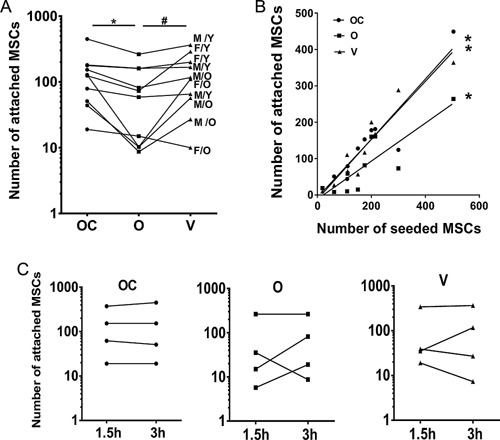
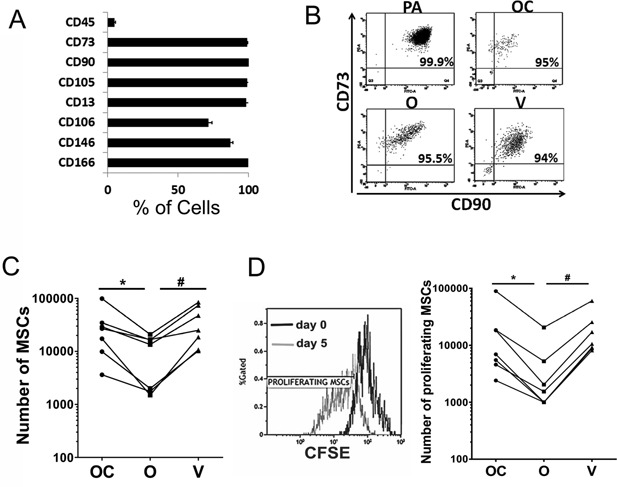
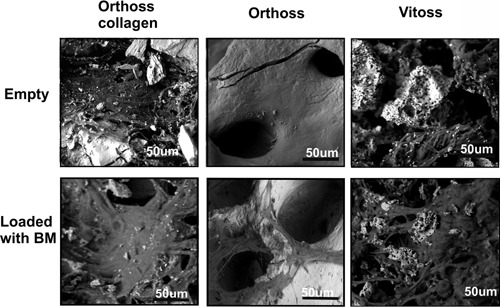
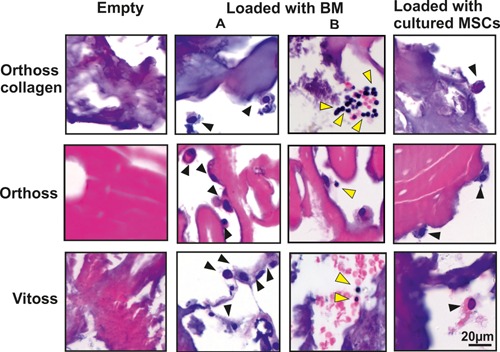
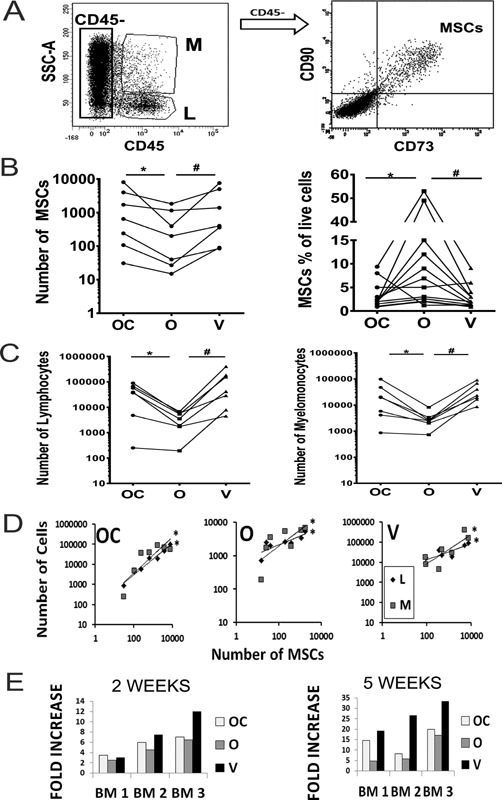
Large bone defects are ideally treated with autografts, which have many limitations. Therefore, osteoconductive scaffolds loaded with autologous bone marrow (BM) aspirate are increasingly used as alternatives. The purpose of this study was to compare the growth of multipotential stromal cells (MSCs) from unprocessed BM on a collagen-containing bovine bone scaffold (Orthoss(®) Collagen) with a non-collagen-containing bovine bone scaffold, Orthoss(®) . Another collagen-containing synthetic scaffold, Vitoss(®) was included in the comparison. Colonization of scaffolds by BM MSCs (n = 23 donors) was evaluated using microscopy, colony forming unit-fibroblast assay and flow-cytometry. The number of BM MSCs initially attached to Orthoss(®) Collagen and Vitoss(®) was similar but greater than Orthoss(®) (p = 0.001 and p = 0.041, respectively). Furthermore, the number of MSCs released from Orthoss(®) Collagen and Vitoss(®) after 2-week culture was also higher compared to Orthoss(®) (p = 0.010 and p = 0.023, respectively). Interestingly, collagen-containing scaffolds accommodated larger numbers of lymphocytic and myelomonocytic cells. Additionally, the proliferation of culture-expanded MSCs on Orthoss(®) collagen and Vitoss(®) was greater compared to Orthoss(®) (p = 0.047 and p = 0.004, respectively). Collectively, collagen-containing scaffolds were superior in supporting the attachment and proliferation of MSCs when they were loaded with unprocessed BM aspirates. This highlights the benefit of collagen incorporation into bone scaffolds for use with autologous bone marrow aspirates as autograft substitutes.
大型骨缺损理想的治疗方法是使用自体骨移植,但自体骨移植存在诸多局限性。因此,负载自体骨髓抽吸物的骨传导支架越来越多地被用作替代方案。本研究的目的是比较未处理骨髓中的多能基质细胞(MSC)在含胶原蛋白的牛骨支架(Orthoss® Collagen)与不含胶原蛋白的牛骨支架Orthoss®上的生长情况。另一种含胶原蛋白的合成支架Vitoss®也被纳入比较。使用显微镜、集落形成单位 - 成纤维细胞测定法和流式细胞术评估骨髓间充质干细胞(n = 23名供体)在支架上的定植情况。最初附着在Orthoss® Collagen和Vitoss®上的骨髓间充质干细胞数量相似,但多于Orthoss®(分别为p = 0.001和p = 0.041)。此外,培养2周后从Orthoss® Collagen和Vitoss®释放的间充质干细胞数量也高于Orthoss®(分别为p = 0.010和p = 0.023)。有趣的是,含胶原蛋白的支架容纳了更多的淋巴细胞和髓单核细胞。此外,与Orthoss®相比,培养扩增的间充质干细胞在Orthoss®胶原蛋白和Vitoss®上的增殖能力更强(分别为p = 0.047和p = 0.004)。总体而言,当负载未处理的骨髓抽吸物时,含胶原蛋白的支架在支持间充质干细胞的附着和增殖方面更具优势。这突出了将胶原蛋白掺入骨支架中与自体骨髓抽吸物一起用作自体移植替代物的益处。