Lee Dae-Won, Han Sae-Won, Cha Yongjun, Lee Kyung-Hun, Kim Tae-Yong, Oh Do-Youn, Im Seock-Ah, Bang Yung-Jue, Park Ji Won, Ryoo Seung-Bum, Jeong Seung-Yong, Kang Gyeong Hoon, Park Kyu Joo, Kim Tae-You
Department of Internal Medicine, Seoul National University Hospital, 101 Daehang-Ro, Jongno-Gu, Seoul, 110-744, South Korea.
Cancer Research Institute, Seoul National University, Seoul, South Korea.
BMC Cancer. 2015 Oct 14;15:690. doi: 10.1186/s12885-015-1704-0.
Asian population has different body mass index (BMI) profile compared to Caucasian population. However, the effect of obesity and body weight gain in Asian colorectal cancer patients treated with adjuvant chemotherapy has not been studied thus far.
We have analyzed the association between disease-free survival (DFS) and obesity/body weight change during treatment in Korean stage III or high-risk stage II colorectal cancer patients treated with adjuvant 5-fluorouracil/ leucovorin/oxaliplatin. BMI was classified according to WHO Asia-Pacific classification. Weight change was calculated by comparing body weights measured at the last chemotherapy cycle and before surgery.
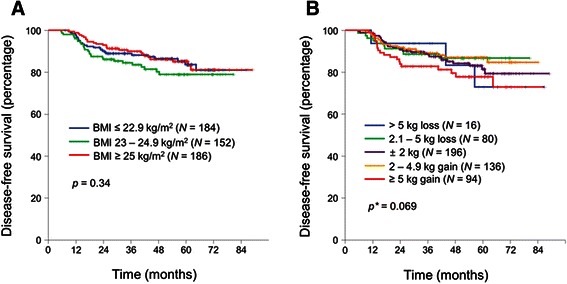
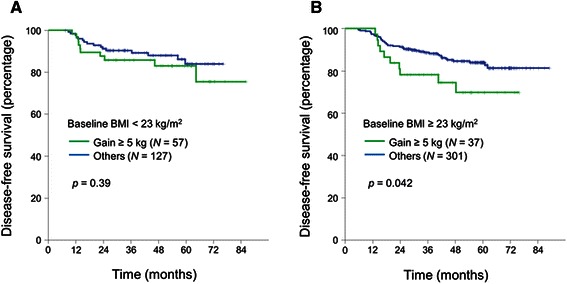
Among a total of 522 patients, 35.7 % of patients were obese (BMI ≥ 25 kg/m(2)) and 29.1 % were overweight (BMI, 23-24.9 kg/m(2)) before surgery. 18.0 % of patients gained ≥ 5 kg and 26.1 % gained 2-4.9 kg during the adjuvant chemotherapy period. Baseline BMI or body weight change was not associated with DFS in the overall study population. However, body weight gain (≥5 kg) was associated with inferior DFS (adjusted hazard ratio 2.04, 95 % confidence interval 1.02-4.08, p = 0.043) in overweight and obese patients (BMI ≥ 23.0 kg/m(2)).
In Korean colorectal cancer patients treated with adjuvant FOLFOX chemotherapy, body weight gain during the treatment period has a negative prognostic influence in overweight and obese patients.
与白种人群相比,亚洲人群具有不同的体重指数(BMI)特征。然而,迄今为止尚未研究肥胖和体重增加对接受辅助化疗的亚洲结直肠癌患者的影响。
我们分析了接受辅助性5-氟尿嘧啶/亚叶酸钙/奥沙利铂治疗的韩国III期或高危II期结直肠癌患者的无病生存期(DFS)与治疗期间肥胖/体重变化之间的关联。BMI根据世界卫生组织亚太地区分类进行划分。通过比较最后一个化疗周期和手术前测量的体重来计算体重变化。
在总共522例患者中,35.7%的患者在手术前肥胖(BMI≥25kg/m²),29.1%的患者超重(BMI为23-24.9kg/m²)。在辅助化疗期间,18.0%的患者体重增加≥5kg,26.1%的患者体重增加2-4.9kg。在整个研究人群中,基线BMI或体重变化与DFS无关。然而,在超重和肥胖患者(BMI≥23.0kg/m²)中,体重增加(≥5kg)与较差的DFS相关(调整后的风险比为2.04,95%置信区间为1.02-4.08,p=0.043)。
在接受辅助性FOLFOX化疗的韩国结直肠癌患者中,治疗期间体重增加对超重和肥胖患者的预后有负面影响。