Blizard Institute (Neuroscience) (J.P., G.D., M.M., D.B., K.S.), Queen Mary University of London, Barts and The London School of Medicine and Dentistry, London, UK; Oxford University Medical School (J.P.), John Radcliffe Hospital, Oxford, UK; London School of Hygiene and Tropical Medicine (D.R.A.), London, UK; Centre for Health Services Research (S.P.), Leeds Institute of Health Sciences, University of Leeds, Leeds, UK; Barts Health NHS Trust (B.P.T., M.M., K.S.), The Royal London Hospital, London, UK; Stem Cell Centre (G.J.), Lund University, Lund, Sweden; and Queen Square Multiple Sclerosis Centre (J.C.), Department of Neuroinflammation, UCL Institute of Neurology, University College London and National Hospital for Neurology and Neurosurgery, University College London Hospitals NHS Foundation Trust, London UK.
Neurol Neuroimmunol Neuroinflamm. 2015 Oct 1;2(6):e158. doi: 10.1212/NXI.0000000000000158. eCollection 2015 Dec.
To compare the cancer risk of cladribine and other disease-modifying drugs (DMDs) in trials of people with relapsing multiple sclerosis (pwRMS).
Meta-analysis of phase III trials of licensed DMDs for pwRMS and a phase III trial of cladribine (CLARITY). Cancer rates were compared using Fisher exact test.
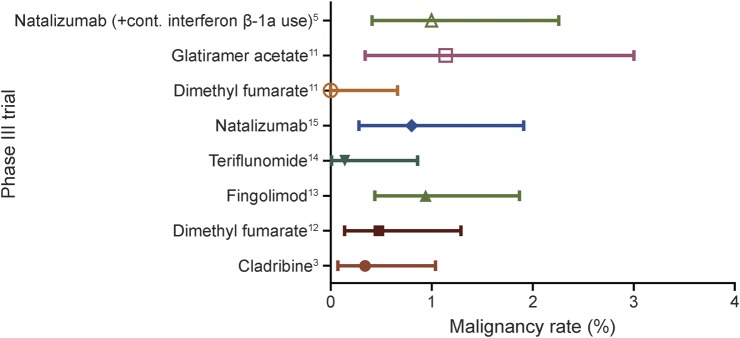
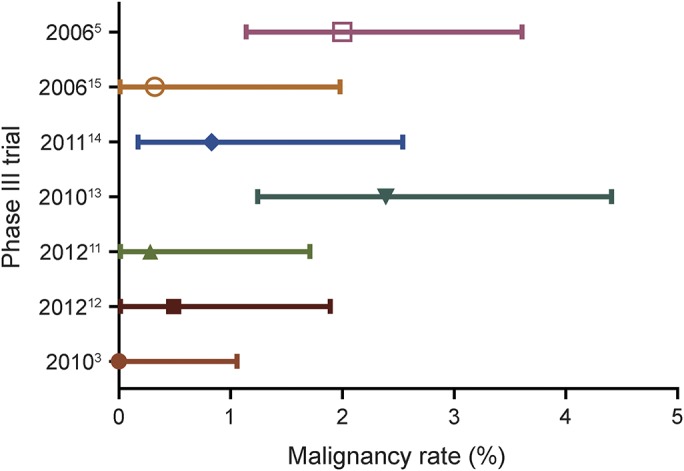
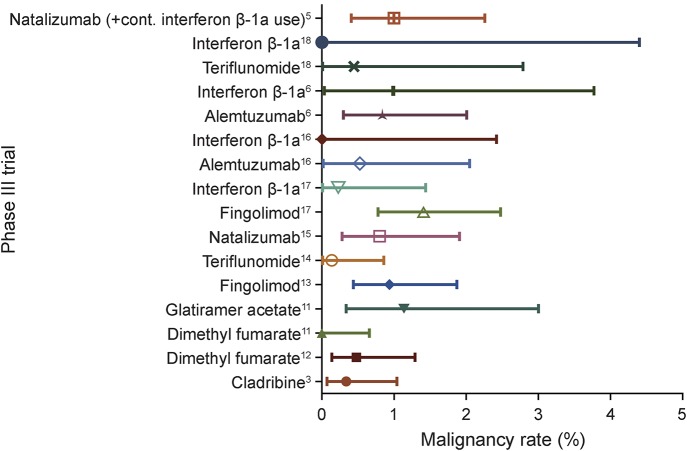
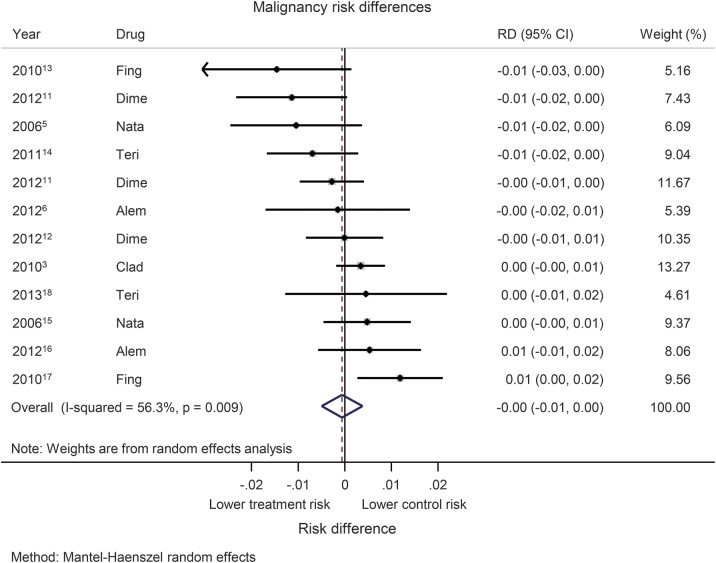
Eleven trials were included. Investigated treatments included cladribine, dimethyl fumarate, fingolimod, teriflunomide, natalizumab, alemtuzumab, and glatiramer acetate. The cancer rate in the CLARITY treatment group (0.34%) was not increased compared to all other treatment groups, whether including placebo-controlled trials only (0.6%, p = 0.4631) or all trials, i.e., including those with an active comparator arm (0.67%, p = 0.3669). No cancer was reported in the CLARITY placebo group, whereas the combined cancer rate of all other placebo groups was 1.19% (p = 0.0159). The cancer rate of zero in the CLARITY placebo group was also lower than that in the phase III trial of cladribine in people with clinically isolated syndrome (ORACLE MS, 2.91%, p = 0.0012). In fact, no difference was detected between cancer rates in the treatment groups of CLARITY (0.34%) and ORACLE MS (0.49%) (p = 0.6546).
Our study does not support an increased cancer risk from cladribine in the doses used in CLARITY and ORACLE MS, which previously contributed to refusal of market authorization of cladribine in Europe. Longer-term follow-up is required to assess the safety profile of cladribine, as well as currently licensed DMDs, to definitively assess cancer risk.
比较氯法拉滨与其他疾病修正药物(DMD)在复发型多发性硬化症(pwRMS)患者临床试验中的癌症风险。
对获批用于 pwRMS 的 DMD 的 III 期试验和氯法拉滨(CLARITY)的 III 期试验进行荟萃分析。使用 Fisher 确切检验比较癌症发生率。
纳入 11 项试验。所研究的治疗药物包括氯法拉滨、富马酸二甲酯、芬戈莫德、特立氟胺、那他珠单抗、阿仑单抗和醋酸格拉替雷。CLARITY 治疗组(0.34%)的癌症发生率与所有其他治疗组相比并未增加,无论仅纳入安慰剂对照试验(0.6%,p=0.4631)还是所有试验,即包括有活性对照臂的试验(0.67%,p=0.3669)。CLARITY 安慰剂组未报告癌症,而所有其他安慰剂组的联合癌症发生率为 1.19%(p=0.0159)。CLARITY 安慰剂组的癌症发生率为 0 也低于伴有临床孤立综合征的氯法拉滨 III 期试验(ORACLE MS,2.91%,p=0.0012)。事实上,CLARITY(0.34%)和 ORACLE MS(0.49%)治疗组之间的癌症发生率无差异(p=0.6546)。
我们的研究不支持 CLARITY 和 ORACLE MS 中所用剂量的氯法拉滨增加癌症风险,此前这一风险导致氯法拉滨在欧洲被拒绝上市。需要进行更长时间的随访,以评估氯法拉滨和目前已获批准的 DMD 的安全性概况,从而明确评估癌症风险。