von Allmen Regula S, Weiss Salome, Tevaearai Hendrik T, Kuemmerli Christoph, Tinner Christian, Carrel Thierry P, Schmidli Juerg, Dick Florian
Department of Vascular Surgery, Kantonsspital St. Gallen, 9007 St. Gallen, Switzerland; Department of Cardiovascular Surgery, University Hospital and University of Bern, 3010 Bern, Switzerland.
Department of Cardiovascular Surgery, University Hospital and University of Bern, 3010 Bern, Switzerland.
PLoS One. 2015 Oct 15;10(10):e0140817. doi: 10.1371/journal.pone.0140817. eCollection 2015.
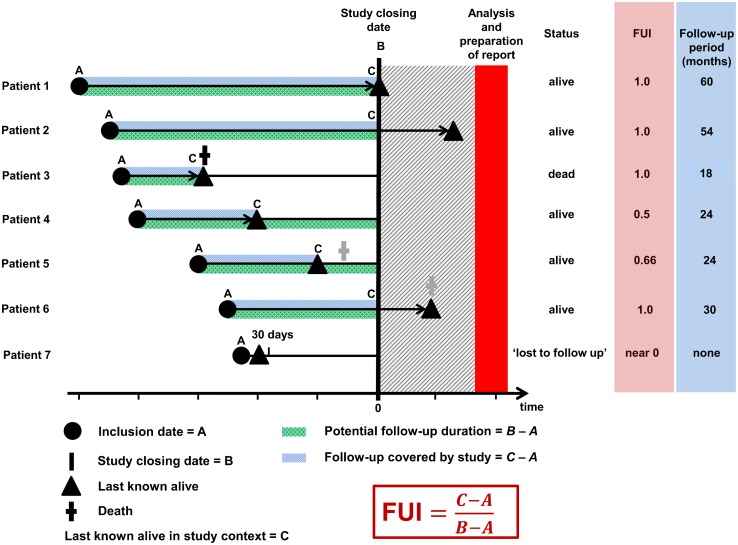
Current reporting guidelines do not call for standardised declaration of follow-up completeness, although study validity depends on the representativeness of measured outcomes. The Follow-Up Index (FUI) describes follow-up completeness at a given study end date as ratio between the investigated and the potential follow-up period. The association between FUI and the accuracy of survival-estimates was investigated.
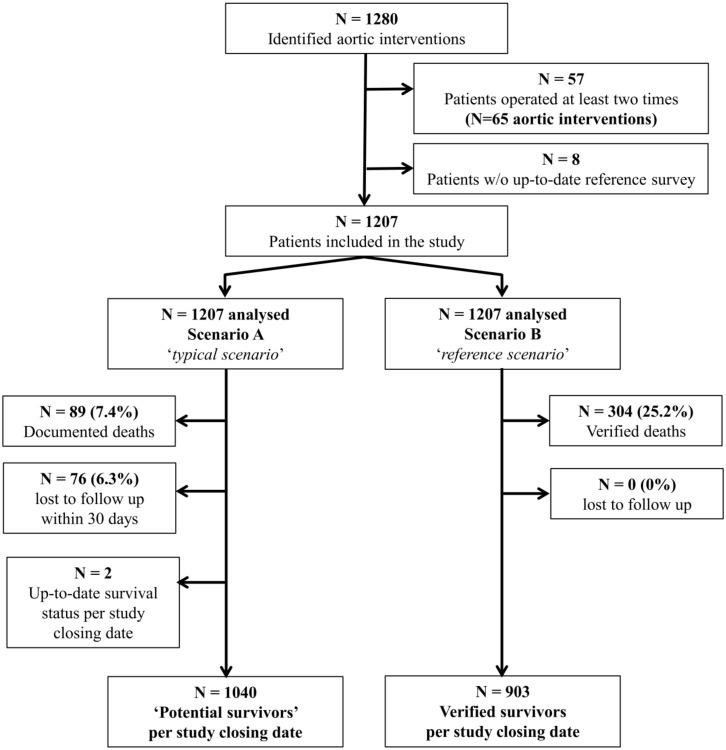
FUI and Kaplan-Meier estimates were calculated twice for 1207 consecutive patients undergoing aortic repair during an 11-year period: in a scenario A the population's clinical routine follow-up data (available from a prospective registry) was analysed conventionally. For the control scenario B, an independent survey was completed at the predefined study end. To determine the relation between FUI and the accuracy of study findings, discrepancies between scenarios regarding FUI, follow-up duration and cumulative survival-estimates were evaluated using multivariate analyses.
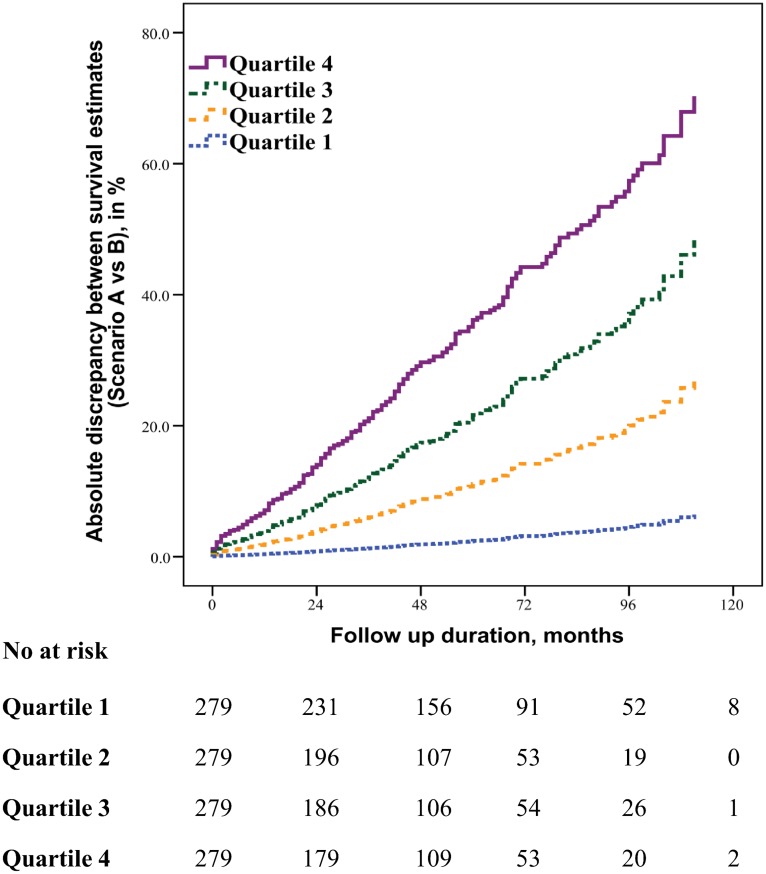
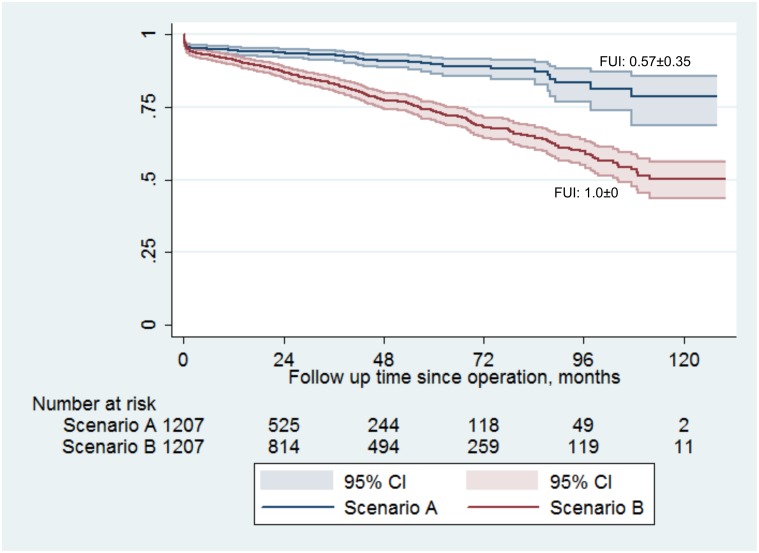
Scenario A noted 89 deaths (7.4%) during a mean considered follow-up of 30±28months. Scenario B, although analysing the same study period, detected 304 deaths (25.2%, P<0.001) as it scrutinized the complete follow-up period (49±32months). FUI (0.57±0.35 versus 1.00±0, P<0.001) and cumulative survival estimates (78.7% versus 50.7%, P<0.001) differed significantly between scenarios, suggesting that incomplete follow-up information led to underestimation of mortality. Degree of follow-up completeness (i.e. FUI-quartiles and FUI-intervals) correlated directly with accuracy of study findings: underestimation of long-term mortality increased almost linearly by 30% with every 0.1 drop in FUI (adjusted HR 1.30; 95%-CI 1.24;1.36, P<0.001).
Follow-up completeness is a pre-requisite for reliable outcome assessment and should be declared systematically. FUI represents a simple measure suited as reporting standard. Evidence lacking such information must be challenged as potentially flawed by selection bias.
尽管研究的有效性取决于所测量结果的代表性,但当前的报告指南并未要求对随访完整性进行标准化声明。随访指数(FUI)将给定研究结束日期的随访完整性描述为已调查随访期与潜在随访期之间的比率。本研究调查了FUI与生存估计准确性之间的关联。
在11年期间,对1207例连续接受主动脉修复的患者,FUI和Kaplan-Meier估计值计算了两次:在情景A中,按常规分析人群的临床常规随访数据(可从前瞻性登记处获得)。对于对照情景B,在预定义的研究结束时完成了一项独立调查。为了确定FUI与研究结果准确性之间的关系,使用多变量分析评估了情景之间在FUI、随访持续时间和累积生存估计方面的差异。
情景A在平均30±28个月的随访期内记录了89例死亡(7.4%)。情景B虽然分析的是相同的研究期,但由于审查了完整的随访期(49±32个月),检测到304例死亡(25.2%,P<0.001)。情景之间的FUI(0.57±0.35对1.00±0,P<0.001)和累积生存估计值(78.7%对50.7%,P<0.001)存在显著差异,表明随访信息不完整导致死亡率被低估。随访完整性程度(即FUI四分位数和FUI区间)与研究结果的准确性直接相关:FUI每下降0.1,长期死亡率的低估几乎线性增加30%(调整后HR 1.30;95%CI 1.24;1.36,P<0.001)。
随访完整性是可靠结果评估的先决条件,应进行系统声明。FUI是一种适合作为报告标准的简单测量方法。缺乏此类信息的证据必须受到质疑,因为可能存在选择偏倚导致的缺陷。