Qiu Yun, Mao Ren, Zhang Sheng-Hong, Li Man-Ying, Guo Jing, Chen Bai-Li, He Yao, Zeng Zhi-Rong, Chen Min-Hu
From the Department of Gastroenterology, First Affiliated Hospital of Sun Yat-Sen University, Guangzhou, People's Republic of China.
Medicine (Baltimore). 2015 Oct;94(41):e1513. doi: 10.1097/MD.0000000000001513.
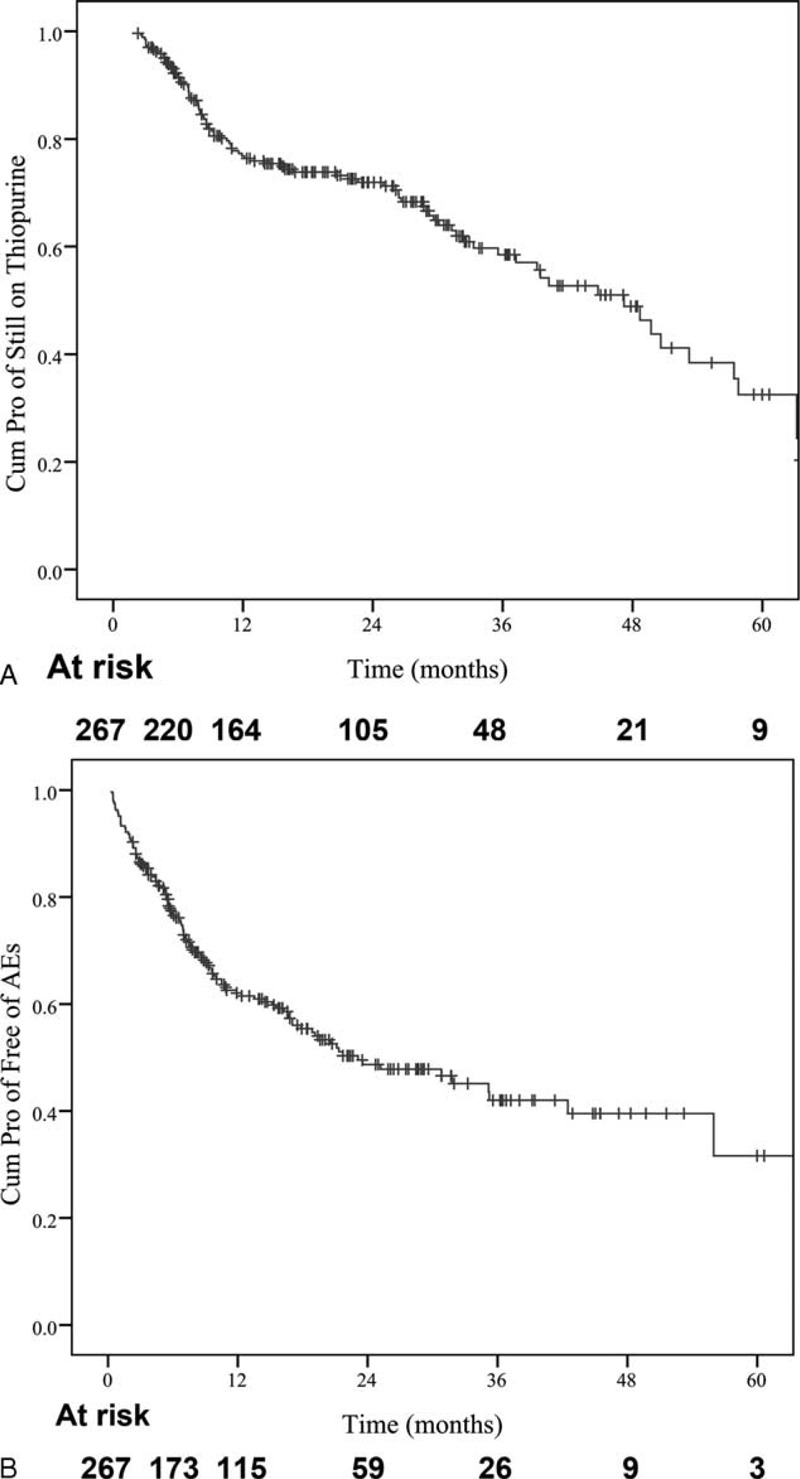
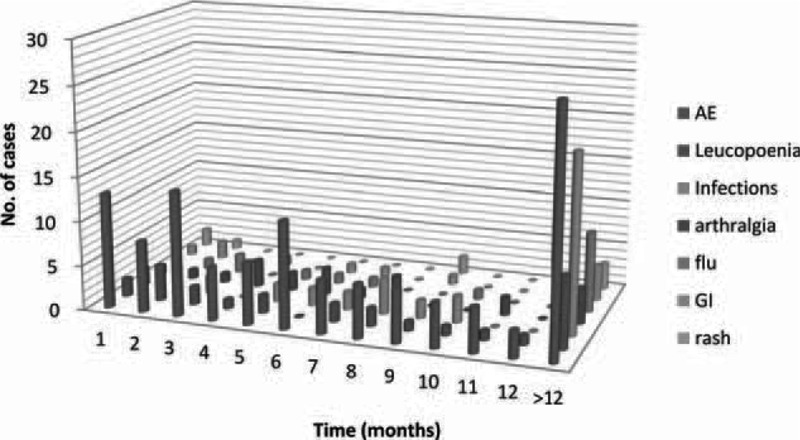
Thiopurines have been associated with both clinical improvement and mucosal healing in treating Crohn disease (CD). Unfortunately, the high rate of adverse events (AEs) leading to drug withdrawal represents a major limitation in the use of these drugs.To evaluate the safety of thiopurines in patients with CD. To identify predictive factors associated with the development of thiopurine-induced AEs and withdrawal.This longitudinal cohort study examined patients from a university-based IBD referral center. Time-to-event analysis was performed with the Kaplan-Meier curve. Cox regression analysis was performed to identify potential predictive factors of AEs.Two hundred sixty-seven CD patients on thiopurines were included. A total of 143 AEs occurred at a median of 7.4 months (interquartile range, 3.7-15.3 months) after starting treatment. The cumulative incidence of AEs was 26%, with an annual risk of 4.3% per patient-year of treatment. The most frequent was leucopenia (41/267, 15.36%), followed by infections (29/267, 10.86%). Independent factors predictive of leucopenia were lower baseline hemoglobin (hazard ratio (HR), 0.34; 95% confidence interval (CI) 0.18-0.67) and the concomitant use of 5-aminosalicylic acid (HR, 3.05; 95% CI 1.44-8.76). Of the 28.44% (76/267) CD patients discontinued therapy, 14.61% due to AEs. A lower body mass index, the presence of extraintestinal manifestation, and the incidence of leucopenia independently predicted thiopurine withdrawal. In total, 37.5% of these patients restarted thiopurines and 52.3% of them had AEs again.About a quarter of patients on thiopurine therapy had AEs during follow-up and 1 of 7 patients had to discontinue thiopurines due to AEs.
硫嘌呤类药物在治疗克罗恩病(CD)时与临床改善及黏膜愈合均有关联。遗憾的是,导致停药的高不良事件(AE)发生率成为这些药物使用的主要限制因素。为评估硫嘌呤类药物在CD患者中的安全性。识别与硫嘌呤类药物诱导的AE及停药相关的预测因素。这项纵向队列研究对来自一所大学的炎症性肠病(IBD)转诊中心的患者进行了检查。采用Kaplan-Meier曲线进行事件发生时间分析。进行Cox回归分析以识别AE的潜在预测因素。纳入了267例接受硫嘌呤类药物治疗的CD患者。开始治疗后,共发生143起AE,中位时间为7.4个月(四分位间距,3.7 - 15.3个月)。AE的累积发生率为26%,每位患者每年的治疗风险为4.3%。最常见的是白细胞减少症(41/267,15.36%),其次是感染(29/267,10.86%)。预测白细胞减少症的独立因素是较低的基线血红蛋白水平(风险比(HR),0.34;95%置信区间(CI)0.18 - 0.67)以及同时使用5-氨基水杨酸(HR,3.05;95%CI 1.44 - 8.76)。在28.44%(76/267)停止治疗的CD患者中,14.61%是由于AE。较低的体重指数、肠外表现的存在以及白细胞减少症的发生率可独立预测硫嘌呤类药物停药。总体而言,这些患者中有37.5%重新开始使用硫嘌呤类药物,其中52.3%再次出现AE。约四分之一接受硫嘌呤类药物治疗的患者在随访期间出现AE,每7名患者中有1名因AE而不得不停用硫嘌呤类药物。