Matsuoka Katsuyoshi
Division of Gastroenterology and Hepatology, Department of Internal Medicine, Toho University Sakura Medical Center, Sakura, Japan.
Intest Res. 2020 Jul;18(3):275-281. doi: 10.5217/ir.2020.00002. Epub 2020 Jun 3.
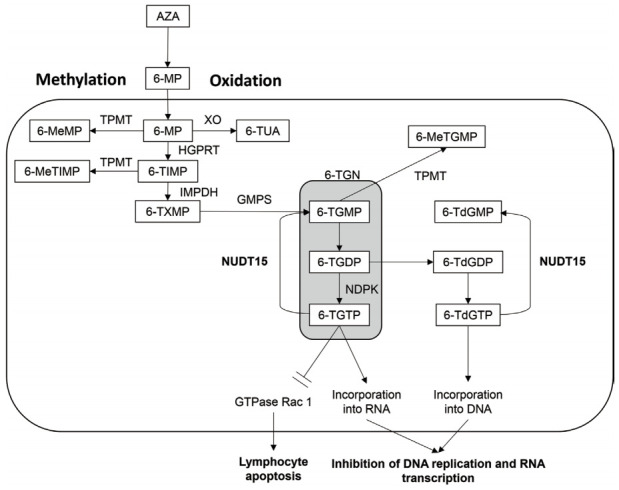
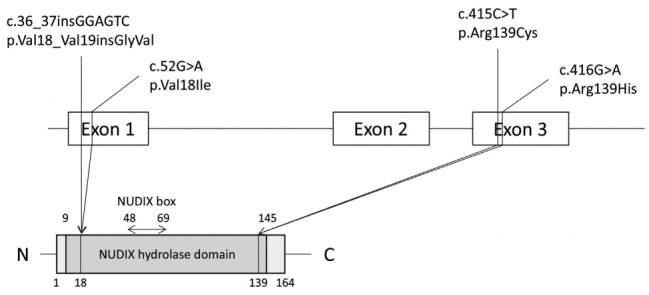
Thiopurine has been used to maintain remission and to reduce antidrug antibody formation in monoclonal antibody therapy in patients with inflammatory bowel disease (IBD). The use of thiopurine is limited by side effects such as leukopenia. Thiopurine S-methyltransferase (TPMT) variants are associated with thiopurine-induced leukopenia in Westerners, but the frequency of the risk alleles is low in Asians. Recently, a variant in the nudix hydrolase 15 (NUDT15) gene (R139C, c.415C > T) was reported to be associated with early severe leukopenia in Asians. NUDT15 is an enzyme that converts 6-thio-(deoxy)guanosine triphosphate (6-T(d)GTP) to 6-thio-(deoxy)guanosine monophosphate (6-T(d)GMTP). The R139C variant impairs the stability of the protein and increases incorporation of 6-TGTP and 6-TdGTP into RNA and DNA, respectively, resulting in leukopenia. The frequency of C/C, C/T, and T/T are approximately 80%, 20%, and 1%, respectively in East Asians. Early leukopenia occurred in less than 3% of patients with C/C and in around 20% of those with C/T, whereas it occurred in almost all patients with T/T. Patients homozygous for this variant also develop severe hair loss. The measurement of NUDT15 R139C can increase the safety of thiopurine dramatically and is a successful example of personalized medicine in the field of IBD.
硫嘌呤已被用于维持炎症性肠病(IBD)患者在单克隆抗体治疗中的缓解状态并减少抗药抗体的形成。硫嘌呤的使用受到白细胞减少等副作用的限制。在西方人中,硫嘌呤甲基转移酶(TPMT)变体与硫嘌呤诱导的白细胞减少有关,但在亚洲人中,风险等位基因的频率较低。最近,有报道称,核苷二磷酸连接酶水解酶15(NUDT15)基因的一个变体(R139C,c.415C>T)与亚洲人早期严重白细胞减少有关。NUDT15是一种将6-硫代(脱氧)鸟苷三磷酸(6-T(d)GTP)转化为6-硫代(脱氧)鸟苷单磷酸(6-T(d)GMTP)的酶。R139C变体损害了蛋白质的稳定性,分别增加了6-TGTP和6-TdGTP掺入RNA和DNA的量,从而导致白细胞减少。在东亚人中,C/C、C/T和T/T的频率分别约为80%、20%和1%。C/C患者中早期白细胞减少的发生率不到3%,C/T患者中约为20%,而几乎所有T/T患者都会出现早期白细胞减少。该变体的纯合子患者还会出现严重脱发。检测NUDT15 R139C可显著提高硫嘌呤的安全性,是IBD领域个性化医疗的一个成功范例。