Borges Ana Luiza Vilela, OlaOlorun Funmilola, Fujimori Elizabeth, Hoga Luiza Akiko Komura, Tsui Amy Ong
Department of Public Health Nursing, University of São Paulo School of Nursing, São Paulo, Brazil.
School of Nursing, University of São Paulo, Av. Dr. Enéas Carvalho de Aguiar, 419, cep 05403-000, São Paulo, Brazil.
Reprod Health. 2015 Oct 15;12:94. doi: 10.1186/s12978-015-0087-7.
Although it is well known that post-abortion contraceptive use is high when family planning services are provided following spontaneous or induced abortions, this relationship remains unclear in Brazil and similar settings with restrictive abortion laws. Our study aims to assess whether contraceptive use is associated with access to family planning services in the six-month period post-abortion, in a setting where laws towards abortion are highly restrictive.
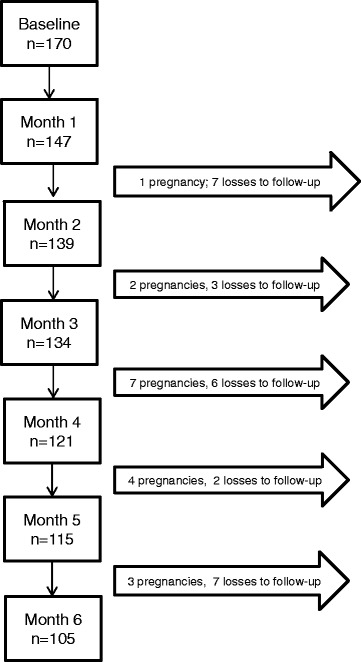
This prospective cohort study recruited 147 women hospitalized for emergency treatment following spontaneous or induced abortion in Brazil. These women were then followed up for six months (761 observations). Women responded to monthly telephone interviews about contraceptive use and the utilization of family planning services (measured by the utilization of medical consultation and receipt of contraceptive counseling). Generalized Estimating Equations were used to analyze the effect of family planning services and other covariates on contraceptive use over the six-month period post-abortion.
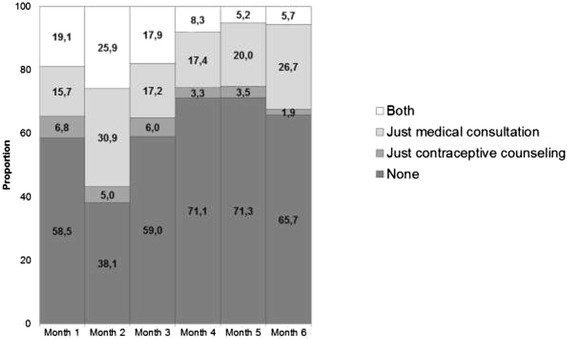
Women who reported utilization of both medical consultation and contraceptive counseling in the same month had higher odds of reporting contraceptive use during the six-month period post-abortion, when compared with those who did not use these family planning services [adjusted aOR = 1.93, 95 % Confidence Interval: 1.13-3.30]. Accessing either service alone did not contribute to contraceptive use. Age (25-34 vs. 15-24 years) was also statistically associated with contraceptive use. Pregnancy planning status, desire to have more children and education did not contribute to contraceptive use.
In restrictive abortion settings, family planning services offered in the six-month post-abortion period contribute to contraceptive use, if not restricted to simple counseling. Medical consultation, in the absence of contraceptive counseling, makes no difference. Immediate initiation of a contraceptive that suits women's pregnancy intention following an abortion is recommended, as well as a wide range of contraceptive methods, including long-acting reversible methods, even in restrictive abortion laws contexts.
虽然众所周知,在自然流产或人工流产后提供计划生育服务时,流产后避孕措施的使用率很高,但在巴西以及类似有着严格堕胎法律的环境中,这种关系仍不明确。我们的研究旨在评估在堕胎法律高度严格的背景下,避孕措施的使用与流产后六个月内获得计划生育服务之间是否存在关联。
这项前瞻性队列研究招募了147名在巴西因自然流产或人工流产而住院接受紧急治疗的女性。随后对这些女性进行了为期六个月的随访(共761次观察)。女性每月接受电话访谈,内容涉及避孕措施的使用情况以及计划生育服务的利用情况(通过医疗咨询的利用情况和接受避孕咨询来衡量)。使用广义估计方程来分析计划生育服务和其他协变量对流产后六个月内避孕措施使用情况的影响。
与未使用这些计划生育服务的女性相比,报告在同一个月既接受了医疗咨询又接受了避孕咨询的女性在流产后六个月内报告使用避孕措施的几率更高[调整后的优势比(aOR)= 1.93,95%置信区间:1.13 - 3.30]。仅使用其中一项服务对避孕措施的使用并无促进作用。年龄(25 - 34岁与15 - 24岁)在统计学上也与避孕措施的使用有关。怀孕计划状态、生育更多子女的意愿以及教育程度对避孕措施的使用并无影响。
在堕胎限制严格的环境中,流产后六个月内提供的计划生育服务有助于避孕措施的使用,但前提是不限于简单的咨询。在没有避孕咨询的情况下,医疗咨询并无作用。建议在流产后立即开始使用适合女性怀孕意愿的避孕措施,以及提供广泛多样的避孕方法,包括长效可逆避孕方法,即使是在堕胎法律严格的背景下。