Kwan Tsz Ho, Wong Ngai Sze, Lee Shui Shan
Jockey Club School of Public Health and Primary Care, The Chinese University of Hong Kong, Shatin, Hong Kong.
Stanley Ho Centre for Emerging Infectious Diseases, The Chinese University of Hong Kong, Shatin, Hong Kong.
Harm Reduct J. 2015 Oct 16;12:30. doi: 10.1186/s12954-015-0072-z.
The low-threshold methadone maintenance treatment (MMT) programme in Hong Kong has been in place for about 40 years. Assessment of the participation pattern of methadone users may inform future programme development to achieve effective harm reduction.
Longitudinal clinical data of methadone users who first registered for MMT in the year 2008 in Hong Kong were retrieved after ethical and institutional approval. Participation pattern of this cohort was evaluated by examining users' frequency of attendance and then the overall retention rate. A subgroup of consistent users who remained on treatment in 2012 and/or 2013 was analysed. Comparison was made between high- and low-frequency users, and among high/moderate and low consistency users, to test their correlations with socio-demographics and social connectivity.
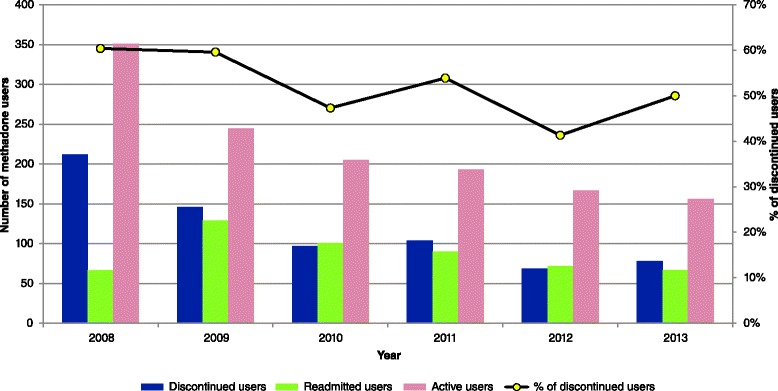
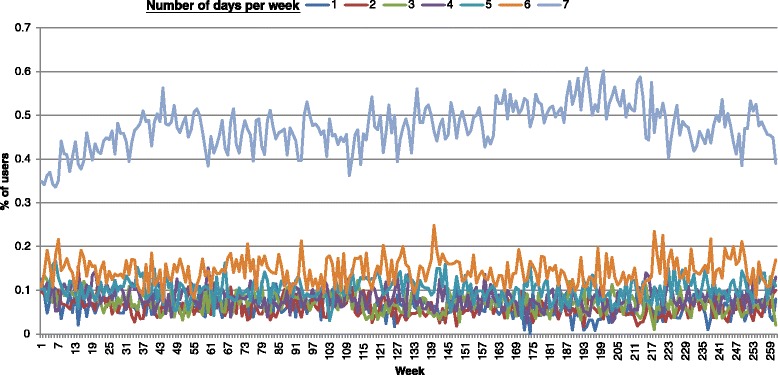
The cohort of methadone users registering in the year 2008 was composed of 351 persons, 77 % of whom were ethnic Chinese, with a median age of 34 and the duration of heroin dependency of 6 years. The participation pattern of methadone users was highly variable, with a 6-year retention rate of 38 %. Discontinuations or 'breaks' of >28 days had occurred in 212 (60 %) methadone users. About one third (n = 117) were high-frequency users who had attended more than twice a week for at least 90 % of their treatment periods. The dosages received by high-frequency users were generally higher. Of those continuing on treatment in the fifth and/or sixth year (n = 185), 30 (16 %), 29 (16 %) and 126 (68 %) gave a high, moderate and low level of consistency as defined by the lengths of breaks. High/moderate consistency users had a longer history of heroin use and a higher degree of connectivity with other users by social network analysis.
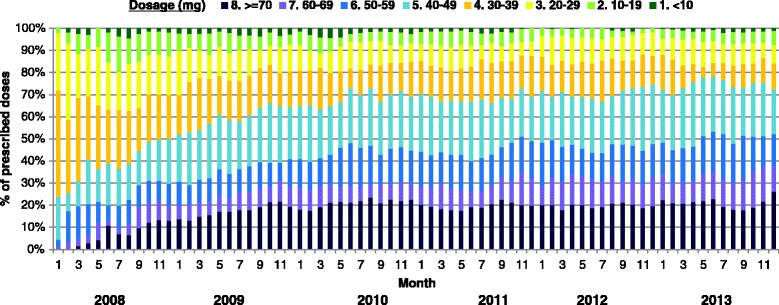
Despite the variability of frequency and consistency of attendance of drug users enrolling in the low-threshold MMT programme in Hong Kong, a consistent pattern could be seen in the proportional distribution of dosage and participation efforts. Whereas an adequate dosage was a potential predictor of optimal frequency of attendance, demographics and connectivity had varied between continued users with different levels of consistency.
香港的低门槛美沙酮维持治疗(MMT)项目已实施约40年。评估美沙酮使用者的参与模式可为未来项目发展提供参考,以实现有效的减少危害目标。
在获得伦理和机构批准后,检索了2008年首次在香港注册接受MMT的美沙酮使用者的纵向临床数据。通过检查使用者的就诊频率,然后计算总体留存率,来评估该队列的参与模式。分析了2012年和/或2013年仍在接受治疗的持续使用者亚组。对高频和低频使用者,以及高/中度和低一致性使用者进行比较,以检验他们与社会人口统计学和社会联系的相关性。
2008年注册的美沙酮使用者队列由351人组成,其中77%为华裔,中位年龄为34岁,海洛因依赖时间为6年。美沙酮使用者的参与模式差异很大,6年留存率为38%。212名(60%)美沙酮使用者出现了持续28天以上的停药或“中断”情况。约三分之一(n = 117)为高频使用者,他们在至少90%的治疗期内每周就诊超过两次。高频使用者接受的剂量通常更高。在第五年和/或第六年仍继续接受治疗的人(n = 185)中,根据中断时长定义,30人(16%)、29人(16%)和126人(68%)的一致性水平分别为高、中、低。通过社会网络分析,高/中度一致性使用者有更长的海洛因使用史,与其他使用者的联系程度更高。
尽管香港低门槛MMT项目中吸毒者的就诊频率和一致性存在差异,但在剂量分布和参与程度的比例上可以看出一种一致的模式。适当的剂量可能是最佳就诊频率的一个潜在预测因素,而人口统计学和联系程度在不同一致性水平的持续使用者之间有所不同。