Braun Sebastian, Bauer Inge, Pannen Benedikt, Werdehausen Robert
Department of Anaesthesiology, University Hospital Düsseldorf, Moorenstr. 5, 40225, Düsseldorf, Germany.
BMC Anesthesiol. 2015 Oct 17;15:151. doi: 10.1186/s12871-015-0135-4.
Temozolomide (TMZ) induces a G2/M cell cycle arrest and is used for treatment of paediatric tumours, especially neuroblastomas. Patients treated with TMZ frequently receive midazolam for sedation prior to surgery and other interventions. Previous studies suggested both cytoprotective and apoptosis-inducing properties of midazolam. Therefore, the impact of midazolam on TMZ-induced cytotoxicity was investigated in vitro.
Human neuroblastoma cells were incubated with midazolam alone, as a pretreatment prior to incubation with TMZ or a coincubation of both. Cell viability and proliferation was analysed (XTT and BrdU assay) after 24 h and flowcytometric cell cycle analysis was performed after 24 and 48 h.
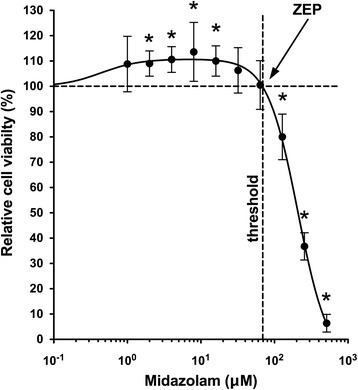
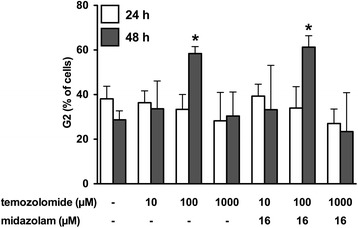
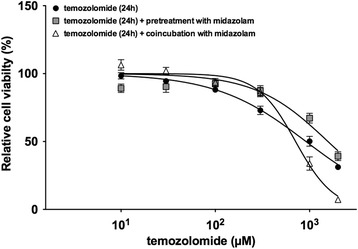
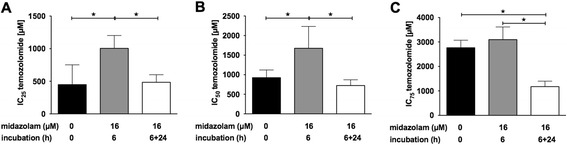
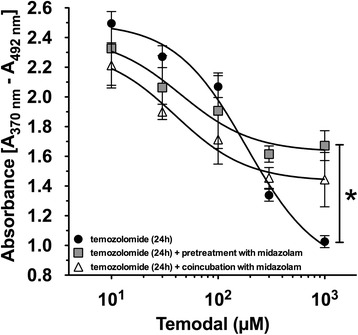
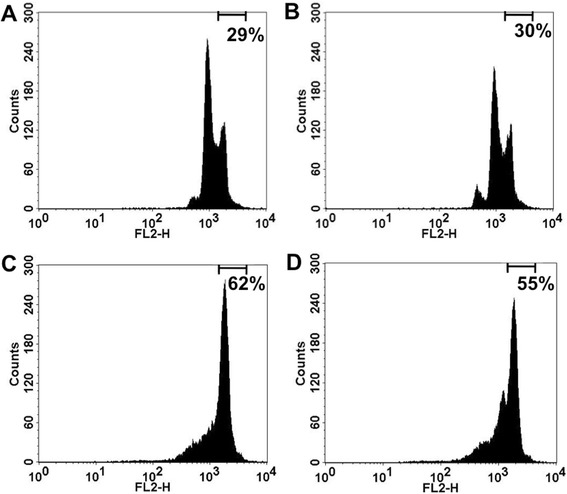
Midazolam alone increased cell viability at lower concentrations (2, 4, 8, 16 μM), whereas higher concentrations (128, 256, 512 μM) reduced cell viability. Pretreatment with midazolam 6 h prior to TMZ incubation reduced cytotoxic effects (IC25 1005 ± 197 μM; IC50 1676 ± 557 μM; P < 0.05) compared to incubation with TMZ alone (IC25 449 ± 304 μM; IC50 925 ± 196 μM) and reduced the antiproliferative effect of TMZ (1000 μM) by 43.9 % (P < 0.05). In contrast, cytotoxic effects of TMZ were increased (IC75 1175 ± 221 μM vs. 2764 ± 307 μM; P < 0.05) when midazolam pretreatment was followed by coincubation of midazolam and TMZ. Cell cycle analysis revealed increased fractions of cells in G2/M phase after TMZ treatment (100 μM; 48 h), irrespective of midazolam pretreatment.
Midazolam causes a hormetic dose-response relationship in human neuroblastoma cells. Pretreatment with midazolam reduces the cytotoxic and antiproliferative effects of TMZ without interfering with G2/M cell cycle arrest. In contrast, subsequent midazolam coincubation increases overall cytotoxicity.
替莫唑胺(TMZ)可诱导G2/M期细胞周期阻滞,用于治疗小儿肿瘤,尤其是神经母细胞瘤。接受TMZ治疗的患者在手术和其他干预前常接受咪达唑仑镇静。先前的研究表明咪达唑仑具有细胞保护和诱导凋亡的特性。因此,在体外研究了咪达唑仑对TMZ诱导的细胞毒性的影响。
将人神经母细胞瘤细胞单独与咪达唑仑孵育,或在与TMZ孵育前进行预处理,或两者同时孵育。24小时后分析细胞活力和增殖情况(XTT和BrdU检测),并在24小时和48小时后进行流式细胞术细胞周期分析。
单独使用咪达唑仑在较低浓度(2、4、8、16μM)时可提高细胞活力,而较高浓度(128、256、512μM)则降低细胞活力。与单独使用TMZ孵育相比(IC25 449±304μM;IC50 925±196μM),在TMZ孵育前6小时用咪达唑仑预处理可降低细胞毒性作用(IC25 1005±197μM;IC50 1676±557μM;P<0.05),并使TMZ(1000μM)的抗增殖作用降低43.9%(P<0.05)。相反,当咪达唑仑预处理后再将咪达唑仑与TMZ同时孵育时,TMZ的细胞毒性作用增强(IC75 1175±221μM对2764±307μM;P<0.05)。细胞周期分析显示,无论是否进行咪达唑仑预处理,TMZ处理后(浓度为100μM;48小时)处于G2/M期的细胞比例均增加。
咪达唑仑在人神经母细胞瘤细胞中呈现剂量效应关系。咪达唑仑预处理可降低TMZ的细胞毒性和抗增殖作用,而不干扰G2/M期细胞周期阻滞。相反,随后同时使用咪达唑仑会增加总体细胞毒性。