Peng Jin, Feng Yanjun, Rinaldi Gabriel, Levine Paul, Easley Samantha, Martinez Elizabeth, Hashmi Salman, Sadeghi Nader, Brindley Paul J, Mulvenna Jason P, Bethony Jeffrey M, Plieskatt Jordan L
Department of Microbiology, Immunology and Tropical Medicine, School of Medicine and Health Science, George Washington University, Washington DC, USA ; Research Center for Neglected Diseases of Poverty, School of Medicine and Health Science, George Washington University, Washington DC, USA.
Department of Epidemiology and Biostatistics, The George Washington University School of Public Health and Health Services, Washington DC 20037, USA.
Genom Data. 2014 Aug 27;2:285-9. doi: 10.1016/j.gdata.2014.08.005. eCollection 2014 Dec.
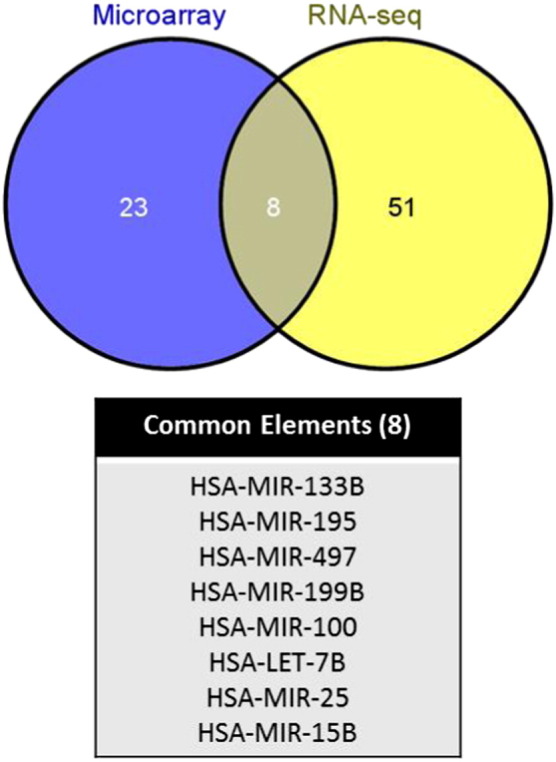
Nasopharyngeal carcinoma (NPC) is a non-lymphomatous, squamous-cell carcinoma that occurs in the epithelial lining of the nasopharynx. Nasopharyngeal carcinoma has a geographically well-defined distribution worldwide, with the highest prevalence in China, Southeast Asia, and Northern Africa. Symptoms of nascent NPC may be unapparent or trivial, with diagnosis based on the histopathology of biopsied tissue following endoscopy of the nasopharynx. The tumor node metastasis (TNM) staging system is the benchmark for the prognosis of NPC and guides treatment strategy. However, there is a consensus that the TNM system is not sufficiently specific for the prognosis of NPC, as it does not reflect the biological heterogeneity of this tumor, making another biomarker for the detection of NPC a priority. We have previously reported on different approaches for microRNA (miRNA) biomarker discovery for Formalin Fixed Paraffin Embedded (FFPE) NPC tissue samples by both a targeted (microarray) and an untargeted (small RNA-Seq) discovery platform. Both miRNA discovery platforms produced similar results, narrowing the miRNA signature to 1-5% of the known mature human miRNAs, with untargeted (small RNA-Seq approach) having the advantage of indicating "unknown" miRNAs associated with NPC. Both miRNA profiles strongly associated with NPC, providing two potential discovery platforms for biomarker signatures for NPC. Herein, we provide a detailed description of the methods that we used to interrogate FFPE samples to discover biomarkers for NPC.
鼻咽癌(NPC)是一种发生于鼻咽部上皮的非淋巴瘤性鳞状细胞癌。鼻咽癌在全球范围内具有明确的地理分布特征,在中国、东南亚和北非地区发病率最高。早期鼻咽癌的症状可能不明显或很轻微,其诊断基于鼻咽部内镜检查后活检组织的组织病理学检查结果。肿瘤淋巴结转移(TNM)分期系统是鼻咽癌预后的基准,并指导治疗策略。然而,人们普遍认为TNM系统对鼻咽癌预后的特异性不足,因为它没有反映出该肿瘤的生物学异质性,因此寻找另一种鼻咽癌检测生物标志物成为当务之急。我们之前曾报道过通过靶向(微阵列)和非靶向(小RNA测序)发现平台,针对福尔马林固定石蜡包埋(FFPE)鼻咽癌组织样本发现微小RNA(miRNA)生物标志物的不同方法。两种miRNA发现平台都产生了相似的结果,将miRNA特征缩小到已知成熟人类miRNA的1 - 5%,其中非靶向(小RNA测序方法)具有能够指示与鼻咽癌相关的“未知”miRNA的优势。两种miRNA谱都与鼻咽癌密切相关,为鼻咽癌生物标志物特征提供了两个潜在的发现平台。在此,我们详细描述了我们用于检测FFPE样本以发现鼻咽癌生物标志物的方法。