Lee Eonju, Kim Tae Gyu, Park Hee Chul, Yu Jeong Il, Lim Do Hoon, Nam Heerim, Lee Hyebin, Lee Joon Hyeok
Department of Radiation Oncology, Samsung Medical Center, Sungkyunkwan University School of Medicine, Seoul, Korea.
Department of Radiation Oncology, Samsung Medical Center, Sungkyunkwan University School of Medicine, Seoul, Korea. ; Department of Radiation Oncology, Samsung Changwon Hospital, Sungkyunkwan University School of Medicine, Changwon, Korea.
Radiat Oncol J. 2015 Sep;33(3):217-25. doi: 10.3857/roj.2015.33.3.217. Epub 2015 Sep 30.
To investigate the outcomes of patients with spinal metastases from hepatocellular carcinoma (HCC), who were treated by stereotactic body radiotherapy (SBRT).
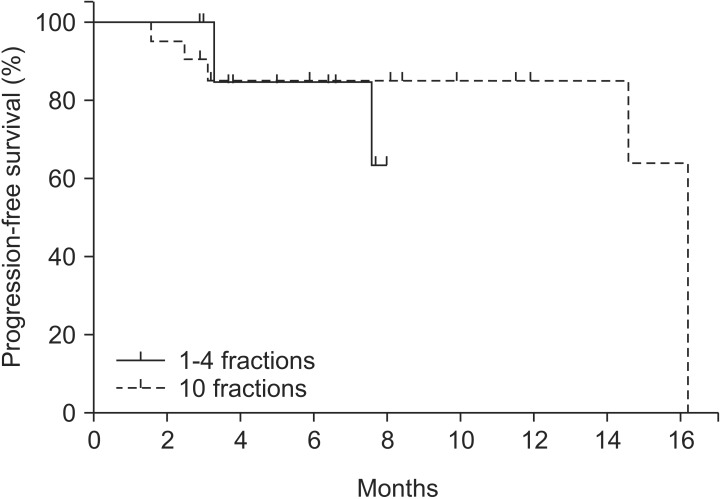
This retrospective study evaluated 23 patients who underwent SBRT from October 2008 to August 2012 for 36 spinal metastases from HCC. SBRT consisted of approximately 2 fractionation schedules, which were 18 to 40 Gy in 1 to 4 fractions for group A lesions (n = 15) and 50 Gy in 10 fractions for group B lesions (n = 21).
The median follow-up period was 7 months (range, 2 to 16 months). Seven patients developed grade 1 or 2 gastrointestinal toxicity, and one developed grade 2 leucopenia. Compression fractures occurred in association with 25% of the lesions, with a median time to fracture of 2 months. Pain relief occurred in 92.3% and 68.4% of group A and B lesions, respectively. Radiologic response (complete and partial response) occurred in 80.0% and 61.9% of group A and B lesions, respectively. The estimated 1-year spinal-tumor progression-free survival rate was 78.5%. The median overall survival period and 1-year overall survival rate were 9 months (range, 2 to 16 months) and 25.7%, respectively.
SBRT for spinal metastases from HCC is well tolerated and effective at providing pain relief and radiologic response. Because compression fractures develop at a high rate following SBRT for spinal metastases from primary HCC, careful follow up of the patient is required.
探讨接受立体定向体部放疗(SBRT)治疗的肝细胞癌(HCC)脊柱转移患者的治疗结果。
这项回顾性研究评估了2008年10月至2012年8月期间接受SBRT治疗的23例患者,这些患者共有36处HCC脊柱转移灶。SBRT包括两种分次放疗方案,A组病变(n = 15)采用1至4次分割,每次18至40 Gy,B组病变(n = 21)采用10次分割,共50 Gy。
中位随访期为7个月(范围2至16个月)。7例患者出现1级或2级胃肠道毒性,1例出现2级白细胞减少。25%的病变发生了压缩性骨折,骨折发生的中位时间为2个月。A组和B组病变的疼痛缓解率分别为92.3%和68.4%。A组和B组病变的放射学缓解(完全缓解和部分缓解)率分别为80.0%和61.9%。估计1年脊柱肿瘤无进展生存率为78.5%。中位总生存期和1年总生存率分别为9个月(范围2至16个月)和25.7%。
SBRT治疗HCC脊柱转移耐受性良好,在缓解疼痛和放射学缓解方面有效。由于原发性HCC脊柱转移接受SBRT治疗后压缩性骨折发生率较高,因此需要对患者进行密切随访。