Pascual Juan C, Palomares Nerea, Ibáñez Ángela, Portella Maria J, Arza Rocío, Reyes Raquel, Feliu-Soler Albert, Díaz-Marsá Marina, Saiz-Ruiz Jerónimo, Soler Joaquim, Carrasco Jose L
Department of Psychiatry, Hospital de la Santa Creu i Sant Pau, Barcelona, Spain.
Centro de Investigación Biomédica en Red de Salud Mental (CIBERSAM), Institut d'Investigació Biomèdica - Sant Pau (IIB-Sant Pau), Universitat Autònoma de Barcelona, Av. Sant Antoni Ma Claret 167, 08025, Barcelona, Spain.
BMC Psychiatry. 2015 Oct 21;15:255. doi: 10.1186/s12888-015-0640-5.
Follow-up studies revealed that subjects with borderline personality disorder (BPD) present high rates of clinical remission, although psychosocial functioning often remains impaired. The aim of this study is to evaluate the efficacy of a cognitive rehabilitation intervention versus a psychoeducational program on psychosocial functioning in subjects with BPD.
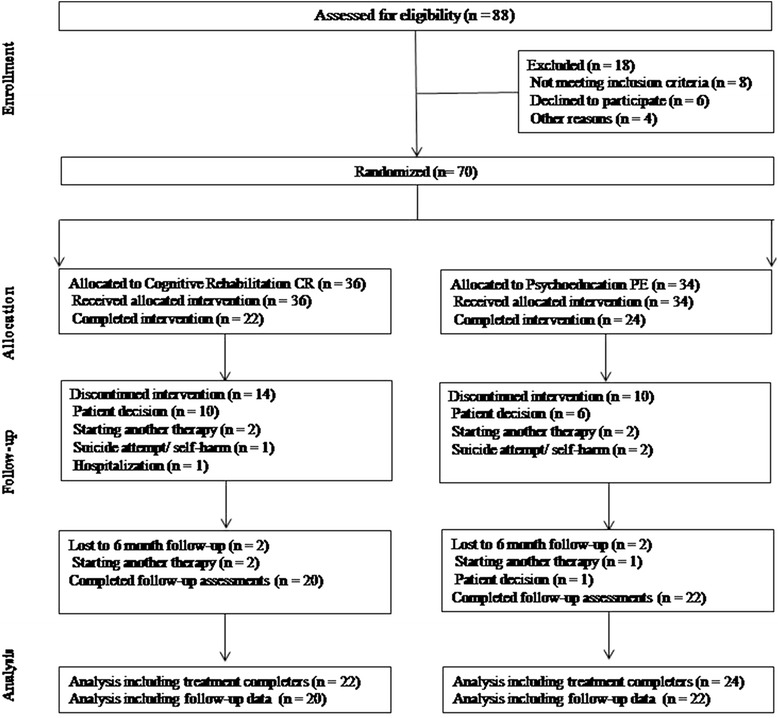
A multicenter, randomized, and positive-controlled clinical trial was conducted. Seventy outpatients with BPD were randomized to cognitive rehabilitation or psychoeducational group interventions. Participants were evaluated after completion of the intervention period (16 weeks) and after the follow-up period (6 months). Psychosocial functioning, clinical and neuropsychological outcomes were evaluated.
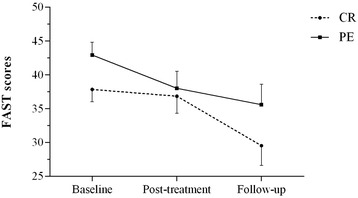
No main effects of group or group x time were observed on functionality but a significant effect of time was found. Post-hoc analyses showed that only cognitive rehabilitation increased psychosocial functioning significantly at endpoint. Psychoeducation showed a significant enhancement of depressive symptoms.
Cognitive rehabilitation and psychoeducational interventions appeared to show good efficacy in improving disabilities in daily life in subjects with BPD. These interventions are easily implemented in mental health settings and have the advantage of improving general functioning and clinical symptoms.
Clinicaltrials.gov: NCT02033044. Registered 9 January 2014.
随访研究表明,边缘性人格障碍(BPD)患者的临床缓解率较高,尽管其心理社会功能往往仍受损。本研究旨在评估认知康复干预与心理教育项目对BPD患者心理社会功能的疗效。
开展了一项多中心、随机、阳性对照临床试验。70名BPD门诊患者被随机分配至认知康复或心理教育组干预。在干预期(16周)结束后及随访期(6个月)结束后对参与者进行评估。评估心理社会功能、临床及神经心理学结果。
未观察到组间或组×时间对功能的主要影响,但发现时间有显著影响。事后分析表明,仅认知康复在终点时显著提高了心理社会功能。心理教育显示抑郁症状有显著改善。
认知康复和心理教育干预似乎在改善BPD患者日常生活中的功能障碍方面显示出良好疗效。这些干预措施在心理健康环境中易于实施,且具有改善总体功能和临床症状的优势。
Clinicaltrials.gov:NCT02033044。于2014年1月9日注册。