van Honk Jack, Bos Peter A, Terburg David, Heany Sarah, Stein Dan J
Department of Psychiatry, University of Cape Town, South Africa; Department of Psychology, Utrecht University, the Netherlands; Institute of Infectious Diseases, and Molecular Medicine, University of Cape Town, South Africa.
Department of Psychiatry, University of Cape Town, South Africa; Department of Psychology, Utrecht University, the Netherlands.
Dialogues Clin Neurosci. 2015 Sep;17(3):287-93. doi: 10.31887/DCNS.2015.17.3/jhonk.
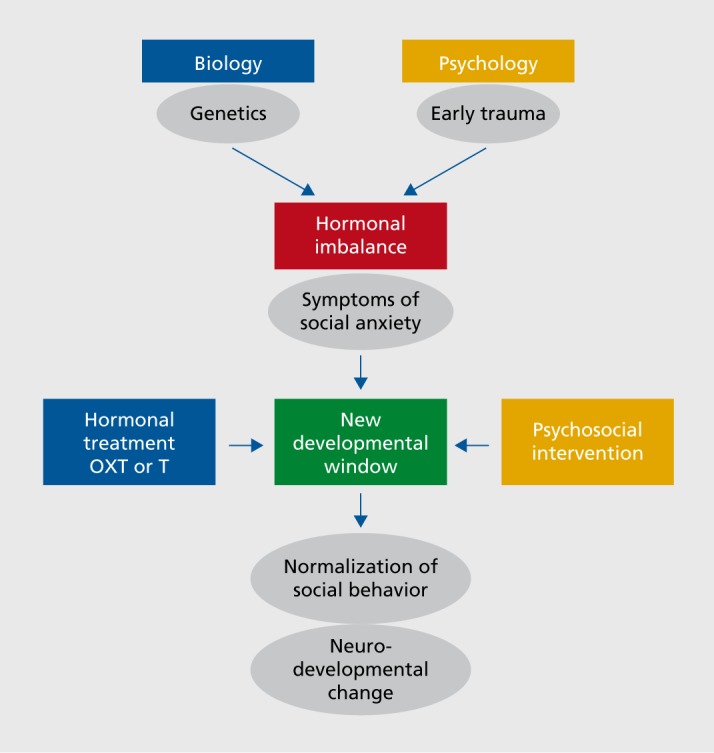
Social anxiety disorder (SAD) is a highly prevalent and disabling disorder with key behavioral traits of social fearfulness, social avoidance, and submissiveness. Here we argue that hormonal systems play a key role in mediating social anxiety, and so may be important in SAD. Hormonal alterations, often established early in development through the interaction between biological and psychological factors (eg, genetic predisposition x early trauma), predispose to socially fearful, avoidant, and submissive behavior. However, whereas gene variants and histories of trauma persist, hormonal systems can be remodeled over the course of life. Hormones play a key role during the periods of all sensitive developmental windows (ie, prenatal, neonatal, puberty, aging), and are capable of opening up new developmental windows in adulthood. Indeed, the developmental plasticity of our social brain, and thus of social behavior in adulthood, critically depends on steroid hormones such as testosterone and peptide hormones such as oxytocin. These steroid and peptide hormones in interaction with social experiences may have potential for reprogramming the socially anxious brain. Certainly, single administrations of oxytocin and testosterone in humans reduce socially fearful, avoidant, and submissive behavior. Such work may ultimately lead to new approaches to the treatment of SAD.
社交焦虑障碍(SAD)是一种高度流行且使人致残的疾病,具有社交恐惧、社交回避和顺从等关键行为特征。在此我们认为,激素系统在介导社交焦虑中起关键作用,因此在社交焦虑障碍中可能很重要。激素改变通常在发育早期通过生物和心理因素(如遗传易感性x早期创伤)之间的相互作用而形成,易导致社交恐惧、回避和顺从行为。然而,尽管基因变异和创伤史持续存在,但激素系统在生命过程中可以重塑。激素在所有敏感发育窗口(即产前、新生儿期、青春期、衰老期)都起着关键作用,并且能够在成年期开启新的发育窗口。事实上,我们社交大脑的发育可塑性,以及成年期社交行为的可塑性,关键取决于睾酮等类固醇激素和催产素等肽类激素。这些类固醇和肽类激素与社交经历相互作用,可能具有重新编程社交焦虑大脑的潜力。当然,在人类中单次给予催产素和睾酮可减少社交恐惧、回避和顺从行为。此类研究最终可能会带来治疗社交焦虑障碍的新方法。